

UAE President to make first official Pakistan visit today with Islamabad set for arrival

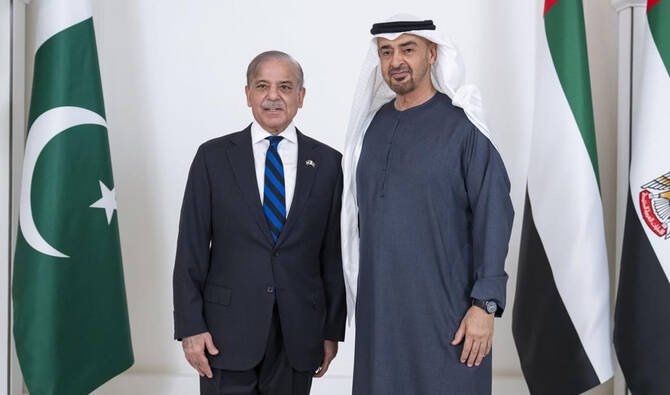
In this handout photo, released by the Pakistan Prime Minister’s Office, United Arab Emirates President Sheikh Mohamed bin Zayed Al Nahyan receives Pakistan Prime Minister Shehbaz Sharif (left) at the Qasr Al Shati in Abu Dhabi, UAE, on June 12, 2025. (PMO/File)
Short Url
Updated 26 December 2025
Follow

UAE President to make first official Pakistan visit today with Islamabad set for arrival

  • Foreign office says talks will cover investment, energy cooperation and regional stability
  • UAE is Pakistan’s third-largest trading partner and a key source of long-term investment

ISLAMABAD: Sheikh Mohamed bin Zayed Al Nahyan, President of the United Arab Emirates, is scheduled to arrive in Pakistan today, Friday, for his first official visit since assuming office, with Islamabad adorned with Pakistani and Emirati flags to mark the occasion.

The visit, taking place at the invitation of Prime Minister Shehbaz Sharif, is aimed at reviewing bilateral ties and exploring ways to deepen cooperation in trade, investment, energy and development, according to Pakistan’s foreign office.

Ahead of the visit, Islamabad has been decked out with large billboards carrying images of the visiting UAE president alongside President Asif Ali Zardari and Prime Minister Sharif.

Rehearsals were also held a day earlier along roads leading to Constitution Avenue, the seat of the government, where groups dressed in traditional attire lined both sides of the route to welcome the visiting delegation.

“During the visit, His Highness will hold a meeting with the Prime Minister of Pakistan, where the two leaders will review the entire spectrum of bilateral relations and exchange views on regional and international issues of mutual interest,” the foreign office said in a statement announcing the UAE president’s planned arrival earlier this week.

“The visit will provide an important opportunity to further strengthen the longstanding brotherly relations between Pakistan and the United Arab Emirates,” it added.

The Islamabad administration has declared a public holiday in the capital, while the traffic police have rolled out an extensive plan to manage vehicular movement during the visit.

According to the state-run Associated Press of Pakistan, heavy traffic entering the city has been barred from 6 a.m. to 12:30 a.m., with several main arteries closed and alternative routes designated.

Pakistan considers the UAE one of its closest regional and economic partners. The Gulf state is Islamabad’s third-largest trading partner after China and the United States and remains a major source of foreign investment.

Over the past two decades, Emirati investment in Pakistan has exceeded $10 billion, according to the UAE’s foreign ministry.

Policymakers in Pakistan also consider the UAE an optimal export destination due to its geographical proximity, which minimizes transportation and freight costs while facilitating commercial transactions.


Pakistan’s Mahnoor Omer named among TIME’s ‘Women of the Year’ for 2026

Updated 01 March 2026
Follow

Pakistan’s Mahnoor Omer named among TIME’s ‘Women of the Year’ for 2026

  • Omer moved a Pakistani court against the so-called ‘period tax’ in Sept. 2025 which has since sparked a national debate
  • Taxes on sanitary pads in Pakistan can add up to 40 percent to retail price, UNICEF says only around 12 percent women use such products

ISLAMABAD: Pakistani women’s rights activist Mahnoor Omer, who fought against taxes on menstrual products, has been named among the TIME magazine’s ‘Women of the Year’ for 2026.

Omer’s efforts have been recognized alongside 16 activists, artists, athletes and businesswomen in the TIME’s Women of the Year 2026 list, including Olympic gold medalist Sydney McLaughlin-Levrone and Oscar-nominated filmmaker Chloe Zhao.

Dissatisfied with the efforts to educate Pakistani girls about sexual violence, Omer founded the Noor Foundation at the age of 14 and held her own workshops with village girls about everything from climate change to menstruation, according to the TIME magazine.

Two years later, a conversation with a domestic worker about the price of pads made her realize that not everyone could afford these essentials. She moved a court against the so-called “period tax” in Sept. 2025 and the case has sparked a national debate on the subject, considered a taboo by many in Pakistan, since its first hearing late last year.

“A decade and one law degree after her interest in activism was sparked, Omer, now 25, is putting her passion and expertise to work in the name of gender equity,” TIME wrote about Omer on its website.

Taxes imposed on sanitary products in Pakistan can add up to 40 percent to the retail price. UNICEF estimates just 12 percent of women in the country use commercially produced pads or tampons. The alternative, using cloth, risks health impacts including rashes and infections, and can make it impossible for girls to attend school while menstruating.

Omer’s suit, which awaits the government response, has sparked a national discussion. She says she spoke about menstruation to her father and male cousins, who thanked her for standing up for their daughters.
The 25-year-old, who is currently enrolled in a master’s degree in gender, peace, and security at the London School of Economics, sees this case as just the first of many.

“I’m not free until every woman is free,” she was quoted as saying by TIME. “I want to leave no stones unturned in terms of what I can do with the next few decades, as a lawyer for the women in my country and gender minorities in general.”