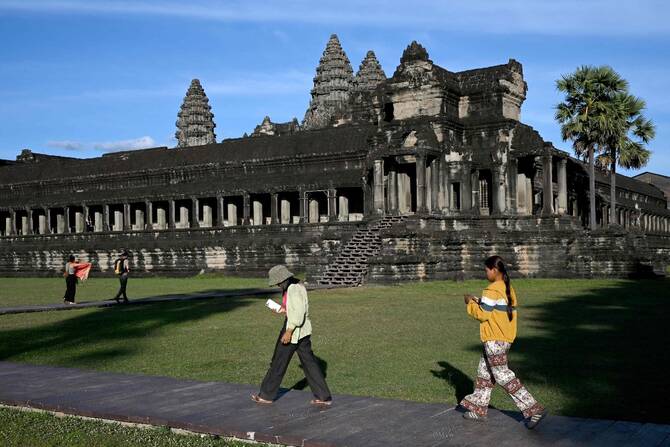

SIEM REAP: Chasing visitors around Cambodia’s Angkor temple ruins to offer his services, tour guide Bun Ratana says he has had little work since deadly clashes with Thailand broke out, despite it being high season.
The UNESCO heritage site lies in Siem Reap city, just a two-hour drive from the Thai border, which for more than two weeks has been roiled by military combat that has killed dozens.
Travel cancelations due to the conflict have left the centuries-old stone structures — Cambodia’s top tourist attraction — unusually quiet and businesses desperate.
With more than 10 canceled tours in December alone, Bun Ratana said his income has plunged by around 80 percent, to just $150, compared to the same month last year.
He blamed the renewed fighting, rooted in a border dispute dating to the colonial era.
But he is hopeful tourists will return to the Angkor archaeological park — home to scores of temple ruins from the Khmer Empire, including the Bayon Temple and top attraction, Angkor Wat.
“Some tourists are scared, but here in Siem Reap it is safe,” Bun Ratana told AFP.
After the dispute flared with fresh fighting in May, the neighbors shuttered overland crossings.
Tour operators, vendors and drivers in Siem Reap and Bangkok say the closures and renewed clashes in July and this month have sharply hit business.
Founder of tour agency Journey Cambodia, Ream Boret, told AFP bookings were down.
Outside Angkor Wat, tuk-tuk driver Nov Mao said his income had halved since the clashes began.
- ‘They may be scared’ -
Tourism makes up around a tenth of Cambodia’s GDP, with a record-breaking 6.7 million arrivals last year.
But ticket sales to Angkor were down at least 17 percent year-on-year from June to November, according to Angkor Enterprise — spiralling after July’s five-day clashes killed dozens.
Unlike past Decembers, quietness has fallen over the park, as local and foreign tourists have “disappeared,” said T-shirt vendor Run Kea.
“I think they may be scared... I am scared too,” the 40-year-old said, adding she was only making a fraction of her usual earnings.
Around 420 kilometers (260 miles) away in the Thai capital, minivans that once plied the six-hour route shuttling tourists to Angkor Wat sit idle since border crossings were closed to tourists earlier this year.
Tour agencies told AFP that bus trips to the border had ceased, and uncertainty had hit tourism in Thailand too.
Thai owner of Lampoo Ocean Travel Prasit Chankliang said when customers ask if they could travel to Cambodia, “we can only tell them that they can’t go — and there’s nothing we can tell them about when they might be able to travel again.”
- ‘Very safe’ -
Arnaud Darc, hospitality industry expert and CEO of Cambodia-based Thalias Group, said the local tourism industry relied heavily on the Angkor temples and a few entry points to the country, especially overland routes via neighboring nations.
“Disruption is concentrated in overland regional travel, not in global demand for Cambodia,” he said, citing fewer Thai visitors but more Chinese arrivals.
Several foreign tourists at Cambodia’s most famous temple complex told AFP they had not been put off traveling by the conflict.
An American tourist called Dorothy said she wasn’t worried about visiting Angkor as she was clued in to travel logistics and border rules, saying she felt “very safe.”
“We are very happy that we came here and we feel safe at the moment,” said German visitor Kay Florek, who arrived in Siem Reap with her family despite hearing news of combat.
But experts say fear persists, which has been worsened by widespread media reports and a blockbuster movie about Internet scam networks run by criminal groups across the region.
At cyberscam compounds, mostly in Cambodia and Myanmar, thousands of willing and trafficked scammers con victims out of billions of dollars a year with romance and investment schemes, monitors say.
“Sadly, the reality on the ground is that Cambodia’s top tourism hotspots are safe — but the headlines have done damage already,” said Hannah Pearson, director of Southeast Asia tourism consultancy Pear Anderson.
Like Cambodia, she said Thailand had also recorded fewer visitors this year, “triggered initially by worries over scam centers” and worsened by the border clashes.
Director of Siem Reap’s provincial tourism department Thim Sereyvudh admitted that Cambodia’s reputation as a host of transnational scammers had hurt the industry.
But he was confident tourists would return to Angkor Wat after the fighting ceased.
“The sooner the war ends,” he said, “the sooner they will come back.”