

Israel extends foreign media ban law until end of 2027

The move has drawn sharp criticism from human rights and media groups, who warn it entrenches restrictions on Arab and foreign outlets amid a broader erosion of press freedoms. (AFP/File)
Short Url
Updated 24 December 2025
Follow

Israel extends foreign media ban law until end of 2027

  • Order replaces temporary emergency legislation that allowed authorization of so-called ‘Al Jazeera bill’
  • Extension of temporary order empowers Communications Ministry to restrict foreign channels deemed to cause ‘real harm to state security’

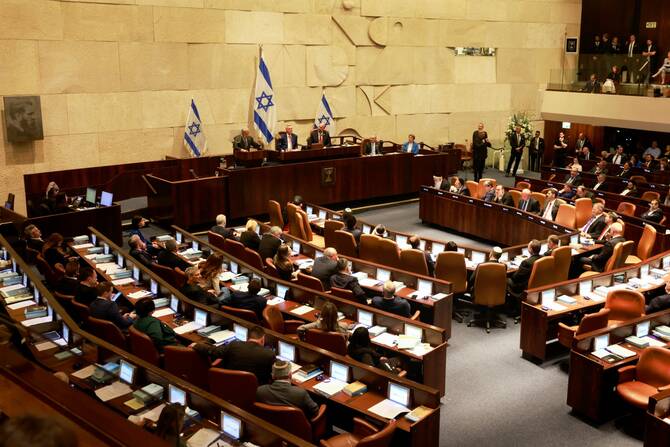
LONDON: Israel’s Knesset approved late Monday an extension of the temporary order empowering the Communications Ministry to shut down foreign media outlets, pushing the measure through until Dec. 31, 2027.

The bill, proposed by Likud lawmaker Ariel Kallner, passed its second and third readings by a 22-10 vote, replacing wartime emergency legislation known as the “Al Jazeera Law.”

Under the extended order, the communications minister — with prime ministerial approval and security cabinet or government ratification — can restrict foreign channels deemed to cause “real harm to state security,” even outside states of emergency.

Measures include suspending broadcasts, closing offices, seizing equipment, blocking websites, and directing the defense minister to block satellite signals, including in the West Bank, without disrupting other channels.

Administrative orders last 90 days, with possible extensions. Unlike the temporary measure, the new law does not require court approval to shut down a media outlet.

The move has drawn sharp criticism from human rights and media groups, who warn it entrenches restrictions on Arab and foreign outlets amid a broader erosion of press freedoms.

“Israel is openly waging a battle against media outlets, both local and foreign, that criticize the government’s narrative; that is typical behavior of authoritarian regimes,” International Federation of Journalists General Secretary Anthony Bellanger said in November after the bill’s first reading.

“We are deeply concerned about the Israeli parliament passing this controversial bill, as it would be a serious blow to free speech and media freedom, and a direct attack on the public’s right to know.”

In a parallel development, the Israeli Cabinet unanimously approved on Monday the shutdown of Army Radio (Galei Tzahal) after 75 years, with operations ceasing on March 1, 2026.

In a statement, Attorney General Gali Baharav-Miara warned the decision “undermines public broadcasting in Israel and restricts freedom of expression,” lacking a legal basis.


RT Arabic to launch new TV program marking 100 years of Russia-Saudi relations

Updated 10 January 2026
Follow

RT Arabic to launch new TV program marking 100 years of Russia-Saudi relations

  • The program will broadcast twice a month starting next month

RIYADH: Russian news network, RT Arabic, is set to launch a new analytical program, “Studio Riyadh,” from the capital next month as part of celebrations marking 100 years of diplomatic relations between Moscow and Saudi Arabia.

The program will be hosted by veteran Saudi journalist Mohammed Al-Rashed and broadcast twice a month, starting February 2026. It will provide in-depth analysis of regional and international developments, featuring prominent political and media figures.

Maya Manna, head of RT Arabic, said that the launch aligned with commemorations of the historic ties between the two countries and reflected a growing commitment to media cooperation.

“Studio Riyadh” will join RT Arabic’s lineup of international programs broadcast from major capitals including Beirut, Cairo, Washington and Paris.

Each 26-minute episode will air on Tuesdays at 7 p.m. and feature a focused dialogue on a pressing current affairs topic.

Al-Rashed, a seasoned presenter and correspondent with more than 20 years of experience, is expected to bring deep regional insight and journalistic rigor to the program.

RT Arabic, which was the first Russian news channel to broadcast 24/7 in Arabic, has grown into one of the region’s leading platforms for political analysis. It currently reaches an estimated audience of 400 million viewers and operates a broad network of regional bureaus.