

Pakistan army chief tells Kabul to choose Islamabad or TTP militants amid strained ties

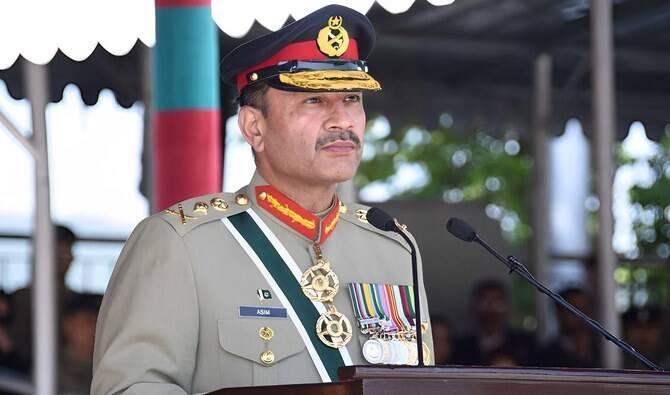
Pakistan Army Chief General Asim Munir addresses the passing out parade at the Pakistan Military Academy in Kakul, Pakistan, on April 29, 2023. (Photo courtesy: ISPR/File)
Short Url
Updated 21 December 2025
Follow

Pakistan army chief tells Kabul to choose Islamabad or TTP militants amid strained ties

  • Pakistan blames Afghanistan for facilitating cross-border attacks in its territory, allegations that Kabul denies 
  • Ties remain strained since October, when deadly border clashes left dozens dead on both sides of the border

ISLAMABAD: Pakistan’s Chief of Defense Forces Field Marshal Syed Asim Munir has told Afghanistan to choose between Islamabad and the outlawed Tehreek-e-Taliban Pakistan (TTP) militants, state media reported on Sunday as ties between both neighbors remain strained. 

Pakistan’s army and civilian government have both blamed the Afghan Taliban recently for facilitating cross-border attacks in Pakistan, a charge Kabul denies. Afghanistan says it does not allow its territory to be used for attacks against Pakistan and cannot be held responsible for Islamabad’s security challenges. 

Both countries were involved in deadly border clashes in October that saw dozens of soldiers killed and wounded on both sides. Officials from Afghanistan and Pakistan have held peace talks in Qatar, Türkiye and Saudi Arabia over the past few months but failed to reach an agreement. 

“Chief of Army Staff and Chief of Defense Forces Field Marshal Syed Asim Munir has said Afghanistan will have to choose between Fitna Al-Khawarij and Pakistan,” state broadcaster Radio Pakistan reported. 

Munir was addressing the National Ulema and Mashaikh Conference held in Islamabad earlier this month, the state media said.

“Fitna Al-Khawarij” is a term the Pakistan military frequently uses for the TTP. 

Munir highlighted that 70 percent of the TTP’s formations that enter Pakistan from Afghanistan comprise Afghan nationals. 

“He said innocent citizens, including children, are being targeted through terrorism with the backing of the Afghan Taliban,” Radio Pakistan reported. 

While Pakistan and Afghanistan have agreed to a temporary ceasefire, tensions persist between the two nations as militant attacks persist in Pakistan. 

Pakistan summoned Afghanistan’s deputy head of mission on Friday and demanded “decisive action” against TTP militants after four Pakistani soldiers were killed in an attack on a military camp in northwest Pakistan. 

The foreign office said the Afghan government had been informed that Pakistan “reserves the right to defend its sovereignty and protect its citizens” and would take all necessary measures to respond to attacks originating from Afghan territory.

Afghanistan has warned Pakistan in the past against attacking its territory, saying it reserves the right to respond to such provocations. 


At ECO meeting, Pakistan proposes ‘Regional Innovation Hub’ to curb natural disasters

Updated 21 January 2026
Follow

At ECO meeting, Pakistan proposes ‘Regional Innovation Hub’ to curb natural disasters

  • Pakistan hosts high-level 10th ECO Ministerial Meeting on Disaster Risk Reduction in Islamabad
  • Innovation hub to focus on early warning technologies, risk informed infrastructure planning

ISLAMABAD: Pakistan has proposed to set up a “Regional Innovation Hub on Disaster Risk Reduction” that focuses on early warning technologies and risk informed infrastructure planning, the Press Information Department (PID) said on Wednesday, as Islamabad hosts a high-level meeting of the Economic Cooperation Organization (ECO).

The ECO’s 10th Ministerial Meeting on Disaster Risk Reduction (DRR) is being held from Jan. 21-22 at the headquarters of the National Disaster Management Authority (NDMA) in Pakistan’s capital. 

The high-level regional forum brings together ministers, and senior officials from ECO member states, representatives of the ECO Secretariat and regional and international partner organizations. The event is aimed to strengthen collective efforts toward enhancing disaster resilience across the ECO region, the PID said. 

“Key agenda items include regional cooperation on early warning systems, disaster risk information management, landslide hazard zoning, inclusive disaster preparedness initiatives, and Pakistan’s proposal to establish a Regional Innovation Hub on Disaster Risk Reduction, focusing on early warning technologies, satellite data utilization, and risk-informed infrastructure planning,” the statement said. 

The meeting was attended by delegations from ECO member states including Pakistan, Türkiye, Azerbaijan, Iran, Kyrgyzstan, Tajikistan, Turkmenistan and Uzbekistan. Representatives of regional and international organizations and development partners were also in attendance.

Discussions focused on enhancing regional coordination, harmonizing disaster risk reduction frameworks, and strengthening collective preparedness against transboundary and climate-induced hazards impacting the ECO region, the PID said. 

ECO members states such as Pakistan, Türkiye, Afghanistan and others have faced natural calamities such as floods and earthquakes in recent years that have killed tens of thousands of people. 

Heavy rains triggered catastrophic floods in Pakistan in 2022 and 2025 that killed thousands of people and caused damages to critical infrastructure, inflicting losses worth billions of dollars. 

Islamabad has since then called on regional countries to join hands to cooperate to avert future climate disasters and promote early warning systems to avoid calamities in future.