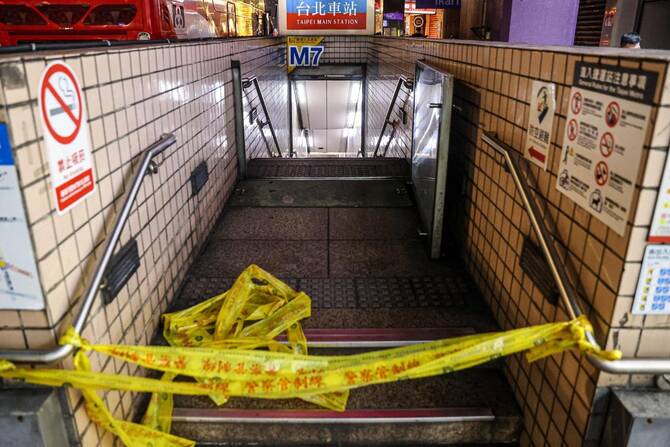
TAIPEI: Taiwan police on Sunday ruled out “terrorism” in a metro stabbing in the capital Taipei, where an attacker killed three and wounded 11.
A 27-year-old man, identified by police by his family name Chang, set off smoke bombs at Taipei Main Station metro on Friday afternoon before launching into a three hour stabbing spree.
The attacker then moved to a shopping district near Zhongshan station, authorities said.
“Based on what we have established so far in the investigation, the suspect Chang did not make or display any statements or views related to politics, religion, or any specific ideology, and we have preliminarily ruled out terrorism,” a senior Taipei City Police Department official told AFP, under the condition of anonymity.
“Terrorist attacks have a specific definition and the suspect does not meet that definition,” he added.
Taipei Mayor Chiang Wan-an said the suspect was found dead the same day, after jumping off a nearby building.
The senior police official said investigators also found searches for “random killings” on Chang’s iPad, including material related to a Taipei metro stabbing in 2014 when a man killed four people.
Chang had served in the military but was discharged over driving under the influence of alcohol, according to police, who said he was wanted after he failed to report for reserve military training.
Taiwan requires former soldiers to undergo seven to 14 days of reserve training within eight years of discharge. Failure to report is treated as evasion of military service.
In the immediate aftermath of the Friday stabbing, officials called the attack “deliberate” but said the motive was not clear.
Police said they believe Chang had acted alone and planned to “randomly kill people.” He rented an apartment in the district in January and scouted the area in advance.
The city doubled its police deployment for the Taipei Marathon on Sunday and is expected to conduct a “high-intensity” drill at metro stations ahead of New Year’s Eve, the mayor said.
Taiwan’s President Lai Ching-te said on Saturday that authorities should be “more cautious and proactive” and improve emergency protocols.
Lai said the police must be “trained and equipped for counter-terrorism operations” to protect citizens.
Metro Taipei announced that it had shut down a Christmas market near Zhongshan station on Saturday, which will remain closed for three days in honor of the victims.

Taiwan police rule out ‘terrorism’ in metro stabbing
https://arab.news/zv3uc
Taiwan police rule out ‘terrorism’ in metro stabbing
- Taiwan police on Sunday ruled out “terrorism” in a metro stabbing in the capital Taipei, where an attacker killed three and wounded 11
Coast Guard is pursuing another tanker helping Venezuela skirt sanctions, US official says
- US oil companies dominated Venezuela’s petroleum industry until the country’s leaders moved to nationalize the sector, first in the 1970s and again in the 21st century under Maduro and his predecessor, Hugo Chávez
WEST PALM BEACH, Florida: The US Coast Guard on Sunday was pursuing another sanctioned oil tanker in the Caribbean Sea as the Trump administration appeared to be intensifying its targeting of such vessels connected to the Venezuelan government.
The pursuit of the tanker, which was confirmed by a US official briefed on the operation, comes after the US administration announced Saturday it had seized a tanker for the second time in less than two weeks.
The official, who was not authorized to comment publicly about the ongoing operation and spoke on the condition of anonymity, said Sunday’s pursuit involved “a sanctioned dark fleet vessel that is part of Venezuela’s illegal sanctions evasion.”
The official said the vessel was flying a false flag and under a judicial seizure order.
The Pentagon and Department of Homeland Security, which oversees the US Coast Guard, deferred questions about the operation to the White House, which did not offer comment on the operation.
Saturday’s predawn seizure of a Panama-flagged vessel called Centuries targeted what the White House described as a “falsely flagged vessel operating as part of the Venezuelan shadow fleet to traffic stolen oil.”
The Coast Guard, with assistance from the Navy, seized a sanctioned tanker called Skipper on Dec. 10, another part of the shadow fleet of tankers that the US says operates on the fringes of the law to move sanctioned cargo. It was not even flying a nation’s flag when it was seized by the Coast Guard.
President Donald Trump, after that first seizure, said that the US would carry out a “blockade” of Venezuela. It all comes as Trump has ratcheted up his rhetoric toward Venezuelan President Nicolás Maduro.
This past week Trump demanded that Venezuela return assets that it seized from US oil companies years ago, justifying anew his announcement of a “blockade” against oil tankers traveling to or from the South American country that face American sanctions.
Trump cited the lost US investments in Venezuela when asked about his newest tactic in a pressure campaign against Maduro, suggesting the Republican administration’s moves are at least somewhat motivated by disputes over oil investments, along with accusations of drug trafficking. Some sanctioned tankers already are diverting away from Venezuela.
US oil companies dominated Venezuela’s petroleum industry until the country’s leaders moved to nationalize the sector, first in the 1970s and again in the 21st century under Maduro and his predecessor, Hugo Chávez. Compensation offered by Venezuela was deemed insufficient, and in 2014, an international arbitration panel ordered the country’s socialist government to pay $1.6 billion to ExxonMobil.
Maduro said in a message Sunday on Telegram that Venezuela has spent months “denouncing, challenging and defeating a campaign of aggression that goes from psychological terrorism to corsairs attacking oil tankers.”
He added: “We are ready to accelerate the pace of our deep revolution!”
Sen. Rand Paul, R-Kentucky, who has been critical of Trump’s Venezuela policy, called the tanker seizures a “provocation and a prelude to war.”
“Look, at any point in time, there are 20, 30 governments around the world that we don’t like that are either socialist or communist or have human rights violations,” Paul said on ABC’s’ “This Week.” ”But it isn’t the job of the American soldier to be the policeman of the world.”
The targeting of tankers comes as Trump has ordered the Defense Department to carry out a series of attacks on vessels in the Caribbean and eastern Pacific Ocean that his administration alleges are smuggling fentanyl and other illegal drugs into the United States and beyond.
At least 104 people have been killed in 28 known strikes since early September. The strikes have faced scrutiny from US lawmakers and human rights activists, who say the administration has offered scant evidence that its targets are indeed drug smugglers and that the fatal strikes amount to extrajudicial killings.
Trump has repeatedly said Maduro’s days in power are numbered. White House chief of staff Susie Wiles said in an interview with Vanity Fair published last week that Trump “wants to keep on blowing boats up until Maduro cries uncle.”
Sen. Tim Kaine, D-Virginia, told NBC’s “Meet the Press” on Sunday that Trump’s use of military to mount pressure on Maduro runs contrary to Trump’s pledge to keep the United States out of unnecessary wars.
Democrats have been pressing Trump to seek congressional authorization for the military action in the Caribbean.
“We should be using sanctions and other tools at our disposal to punish this dictator who is violating the human rights of his civilians and has run the Venezuelan economy into the ground,” Kaine said. “But I’ll tell you, we should not be waging war against Venezuela. We definitely should not be waging war without a vote of Congress.


