

Three Afghan migrants die crossing into Iran as UN warns of new displacement toward Pakistan

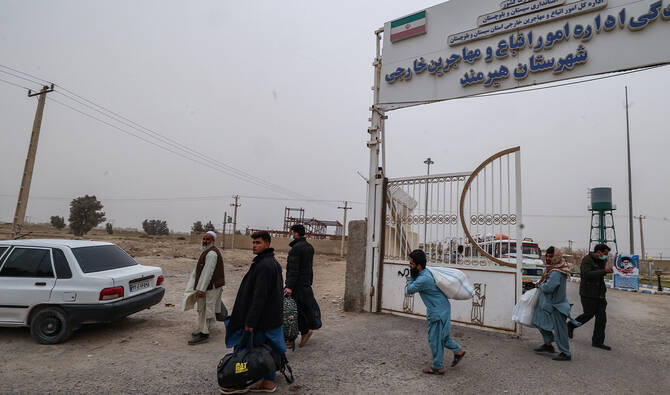
Afghan migrants who reportedly failed to legalise their status in Iran, carry their personal belogings as they wait to be deported at the Milak border crossing camp near the town of Zabol, in the southeastern province of Sistan-Baluchistan bordering Afghanistan on December 17, 2025. (AFP)
Short Url
Updated 20 December 2025
Follow

Three Afghan migrants die crossing into Iran as UN warns of new displacement toward Pakistan

  • UNHCR says 1.8 million Afghans were forced to return from Iran this year, straining Afghanistan’s resources
  • Rights groups warn forced refugee returns risk harm as Afghanistan faces food shortages and climate shocks

KABUL: Three Afghans died from exposure in freezing temperatures in the western province of Herat while trying to illegally enter Iran, a local army official said on Saturday.

“Three people who wanted to illegally cross the Iran-Afghanistan border have died because of the cold weather,” the Afghan army official told AFP on condition of anonymity.

He added that a shepherd was also found dead in the mountainous area of Kohsan from the cold.

The migrants were part of a group that attempted to cross into Iran on Wednesday and was stopped by Afghan border forces.

“Searches took place on Wednesday night, but the bodies were only found on Thursday,” the army official said.

More than 1.8 million Afghans were forced to return to Afghanistan by the Iranian authorities between January and the end of November 2025, according to the latest figures from the United Nations refugee agency (UNHCR), which said that the majority were “forced and coerced returns.”

“These mass returns in adverse circumstances have strained Afghanistan’s already overstretched resources and services” which leads to “risks of onward and new displacement, including return movements back into Pakistan and Iran and onward,” UNHCR posted on its site dedicated to Afghanistan’s situation.

This week, Amnesty International called on countries to stop forcibly returning people to Afghanistan, citing a “real risk of serious harm for returnees.”

Hit by two major earthquakes in recent months and highly vulnerable to climate change, Afghanistan faces multiple challenges.

It is subject to international sanctions particularly due to the exclusion of women from many jobs and public places, described by the UN as “gender apartheid.”

More than 17 million people in the country are facing acute food insecurity, the UN World Food Program said Tuesday.


Pakistan joins 22 Muslim states, OIC to condemn Israeli FM’s visit to Somaliland

Updated 08 January 2026
Follow

Pakistan joins 22 Muslim states, OIC to condemn Israeli FM’s visit to Somaliland

  • Israeli Foreign Minister Gideon Saar visited breakaway African region of Somaliland on January 6
  • Muslim states urge Israel to withdraw Somaliland recognition, respect Somalia’s sovereignty

ISLAMABAD: A joint statement by Pakistan, 22 other Muslim states and the Organization of Islamic Cooperation (OIC) on Thursday condemned Israeli Foreign Minister Gideon Saar’s recent visit to Somaliland as a violation of the African nation’s territorial integrity and sovereignty.

Saar’s visit to Somaliland capital Hargeisa on Jan. 6 followed Israel’s move last month to recognize Somaliland, a breakaway region from Somalia, as an independent country. The move drew a sharp reaction from Muslim states, including Pakistan, who said it was in contravention of the UN Charter and international norms. 

Several international news outlets months earlier reported that Israel had contacted Somaliland over the potential resettlement of Palestinians forcibly removed from Gaza. Muslim countries fear Israel’s recognition of the breakaway region could be part of its plan to forcibly relocate Palestinians from Gaza to the region. 

“The said visit constitutes a clear violation of the sovereignty and territorial integrity of the Federal Republic of Somalia, and undermines established international norms and the United Nations Charter,” the joint statement shared by Pakistan’s foreign office, read. 

The joint statement was issued on behalf of 23 Muslim states, including Saudi Arabia, Bangladesh, Pakistan, Egypt, Iraq, Iran, Palestine, Jordan, Kuwait, Türkiye, Oman and others. 

It reaffirmed support for Somalia’s territorial integrity and sovereignty, pointing out that respect for international law and non-interference in the internal affairs of sovereign states was necessary for regional stability. 

“Encouraging secessionist agendas are unacceptable and risk exacerbating tensions in an already fragile region,” the statement said. 

The joint statement urged Israel to revoke its recognition of the breakaway region. 

“Israel should fully respect Somalia’s sovereignty, national unity and territorial integrity and honor its obligations in compliance with international law, and demand immediate revocation of the recognition issued by Israel,” the statement read.

Somaliland broke away from Somalia unilaterally in 1991 as a civil war raged in the country. Somaliland has its own constitution, parliament and currency, a move that has infuriated Somalia over the years as it insists the region is part of its territory.