

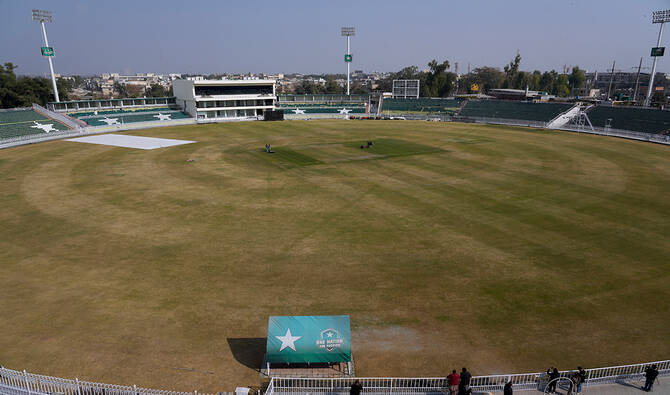

ISLAMABAD: Nestled against the green foothills of the Margalla Hills, Pakistan’s capital is set to get its first purpose-built cricket stadium, a long-awaited project that officials say will add a major landmark to Islamabad’s sporting infrastructure and bring top-level cricket closer to its residents.
Cricket is Pakistan’s most popular sport, followed passionately across the country, and Islamabad is no exception. Fans routinely pack cafes, homes and public spaces to watch domestic and international matches, while children play taped-ball cricket in residential streets and office workers debate team selections and tactics, reflecting the game’s deep cultural hold.
Despite being the political capital, Islamabad has never had an international-standard cricket stadium of its own. High-profile matches have instead been hosted in nearby Rawalpindi or in cities such as Lahore and Karachi.
That is set to change next year.
The Capital Development Authority (CDA) plans to begin construction of the city’s first cricket stadium near Islamabad’s D-12 sector, a scenic area close to the Margalla Hills. The project is expected to allow the capital to host international matches for the first time.
“It’s basically a very beautiful site and it’s at the foothills of the Margalla Hills, with the view of the Margalla, which is the crown of Islamabad, at the backside of this cricket stadium,” CDA Chairman Muhammad Ali Randhawa told Arab News.
“The groundbreaking will be in January or February next year and we are going to try to complete it in one financial year.”
Randhawa said the CDA was working with the Pakistan Cricket Board (PCB), the country’s governing body for cricket, on the planning of the stadium.
“Its capacity is almost the same as of Qaddafi Stadium, Lahore. So, we are following the same pattern but we are trying our level best that this stadium should be of international standards where international teams can come and play.”
Qaddafi Stadium, Pakistan’s largest cricket venue, seats around 34,000 spectators and was recently renovated ahead of the International Cricket Council’s Champions Trophy 2025, featuring upgraded seating, modern scoreboards and advanced floodlighting.
While Islamabad has lacked a dedicated international venue, its twin city Rawalpindi has long hosted matches at the Rawalpindi Cricket Stadium. However, games there often cause major traffic disruptions in the densely populated garrison city.
Officials say the new Islamabad stadium’s location has been chosen to avoid those problems.
“This site is located on Iran Avenue and it will be connected with the motorway and the Islamabad airport, so we assume that the problem of traffic congestion during matches will be resolved because of the location of this cricket stadium,” Randhawa said.
“The cricketers themselves will be going to stay in the hotel which we are going to build along with this cricket stadium.”
INTERNATIONAL EXPOSURE
Security has been a major logistical challenge for international cricket in Pakistan since a 2009 militant attack on the Sri Lankan team in Lahore, which forced foreign teams to travel in heavy security convoys and led to years-long road closures around match venues. International cricket only returned gradually in the late 2010s.
The planned on-site hotel aims to reduce the need for team movements through city roads, easing security pressures and minimizing disruption for residents.
Local players say the new stadium could also strengthen cricket development in the capital.
Sudais Ulfat, a Pakistani first-class cricketer, said Islamabad-based players have long had to travel to other cities for training camps and development programs.
“It’s quite a good initiative,” he said. “When we have camps, we have to go to Rawalpindi Cricket Stadium or Qaddafi Stadium Lahore. It’s good that it [stadium] will be in our city, we will have regional and development camps here.”
Ulfat said exposure to international teams could play a key role in developing young players.
“When international players come, we share the dugout with them, we have practice matches with them, and we have a lot to learn from this,” he added.
For aspiring cricketers, distance has often been a barrier.
“Rawalpindi Cricket Stadium was too far for me,” said Muhammad Ayan, who hopes to play professionally. “This stadium is near and the crowd can easily watch [matches] there.”
Cricket analysts say the project has been decades in the making.
“Originally, the stadium was part of Islamabad’s master plan, prepared in the 1960s. It took many decades, so now, finally, city managers are all set to construct this facility for the residents of Islamabad and cricket fans are very happy,” analyst Kashif Abbasi told Arab News.
“People of Rawalpindi and Islamabad face a lot of problems during match days because of traffic blockade and road closures, and hopefully this new site will not create such problems.”


