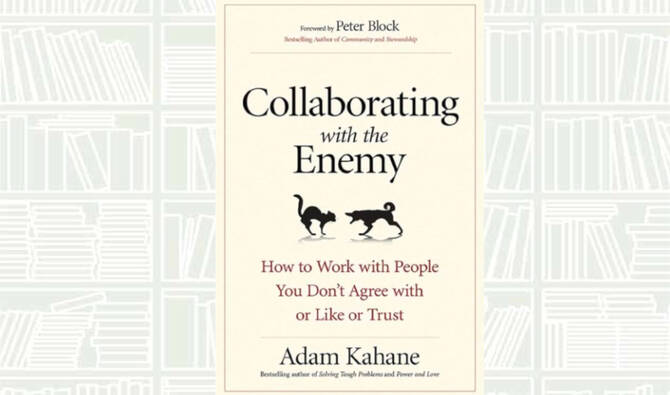
What We Are Reading Today: ‘Collaborating with the Enemy’

Photo/Supplied
Short Url
Updated 19 December 2025
Follow

What We Are Reading Today: ‘Collaborating with the Enemy’

  • This skill is certainly necessary to acquire and maintain in our increasingly globalized world

The title of the 2017 book “Collaborating with the Enemy: How to Work with People You Don’t Agree with or Like or Trust,” by Adam Kahane, is sure to catch your curiosity.

Printed by the independent, mission-driven publishing company Berrett-Koehler, the book delivers on delving into the topic.

Kahane, a director of Reos Partners — which describes itself as “an international social enterprise that helps people move forward together on their most important and intractable issues” — argues that traditional collaboration, which relies on harmony, consensus and a clear, shared plan, is often impossible to achieve in complex, polarized situations.

Instead, he proposes something called “stretch collaboration,” a framework for working with people you may not agree with, like, or even trust. 

This skill is certainly necessary to acquire and maintain in our increasingly globalized world.

Some of the practical techniques and strategies mentioned can arguably be applied beyond the workplace: in fractured families or friendships, for example.

“The problem with enemyfying is not that we never have enemies: we often face people and situations that present us with difficulties and dangers,” Kahane writes.

“Moreover, any effort we make to effect change in the world will create discomfort, resistance, and opposition. The real problem with enemyfying is that it distracts and unbalances us. We cannot avoid others whom we find challenging, so we need to focus simply on deciding, given these challenges, what we ourselves will do next.”

The book boasts a foreword by Peter Block, bestselling author of “Community and Stewardship,” who writes: “The book is really an annotation on the title. The title asks me to collaborate with people I don’t agree with. Not so difficult. But then the stakes are raised, and I am asked to collaborate with people I don’t like. This too is manageable, even common in most workplaces.

“The final ask, though, is tougher: collaborate with people I don’t trust; even people I consider enemies. To make these acts doable is the promise of the book.”

And, in a way, it does. But Kahane seems to also use this book to pat himself on the back. In parts it reads like an expanded LinkedIn testimonial to his own resume.


Book Review: ‘A Long Walk from Gaza’ by Asmaa Alatawna

Updated 14 January 2026
Follow

Book Review: ‘A Long Walk from Gaza’ by Asmaa Alatawna

JEDDAH: Asmaa Alatawna’s “A Long Walk from Gaza,” translated from Arabic by Caline Nasrallah and Michelle Hartman, depicts a Gaza — with its people, streets, routines, and rhythms of life — that no longer exists.

In that sense, the novel is not purely the story of a young woman’s search for freedom. It is also a form of preservation, a historical record of a society that has been largely obliterated by Israeli occupation forces.

The novel was published in 2024 by Palestinian American publisher Interlink Books and tells a story that parallels the author’s own background of growing up in Gaza and moving to Toulouse. 

The unnamed narrator’s tale takes on a complex and nonlinear structure and unfolds in reverse, moving backward through memories. It opens at a moment when she is inching toward a tentative sense of liberation and relief after arriving in Europe as a refugee. 

It then gradually moves to her teenage years and early childhood marked by Israeli military occupation, the suffocating control of her father’s authority, and the rush of first love, rebellion and loss. 

Nasrallah and Hartman’s translation is precise and sensitive, carrying the immediacy of the narrator’s inner world and textures of Palestinian life.

The narrative structure mimics the way memory can flow for someone living with trauma: Liberation is not clean or complete and exists in conversation with what came before. 

What makes “A Long Walk from Gaza” so arresting is its commitment to a young woman’s voice and experiences, without apology.

The novel makes room for difficult conversations about patriarchy and misogyny in Palestinian society, without reducing them to defining traits. Instead, they are situated within the broader realities of colonization and military occupation, showing how cycles of violence can settle into families. This makes the protagonist’s efforts to break away and build a different life for herself both arduous and personal. 

At one point, she notes, “What happened to me shouldn’t affect people’s perception of the Palestinian cause or obscure the suffering of the entire Palestinian people.” 

Her disclaimer exposes the cruel calculus of optics, under which personal pain is sometimes weighed against political utility. It makes one wonder how many stories remain untold for this reason. 

Alatawna does not romanticize suffering and also refuses to flatten Palestinian life into a single story. Moments of humor, friendship, and joy appear alongside violence and fear.

“A Long Walk from Gaza” was first published in Arabic in 2019, making it not only a powerful work of literature, but also an archive of memory. To read it now is to be reminded that storytelling can sometimes embody the refusal to be forgotten.