

China, US seek Thailand-Cambodia ceasefire ahead of ASEAN meeting 

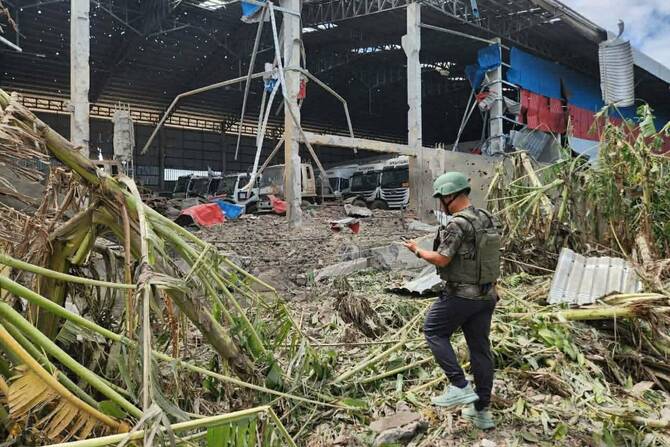
A distraction building is seen after a Thai bombing in Poipet town, Banteay Meanchey Province, Cambodia. (AKP via AP)
Short Url
Updated 19 December 2025
Follow

China, US seek Thailand-Cambodia ceasefire ahead of ASEAN meeting 

  • Around 60 people have died and more than half a million have been displaced since hostilities resumed last week between the Southeast Asian neighbors

BANGKOK/PHNOM PENH: China and the US are renewing their separate ​efforts to reach a ceasefire between Thailand and Cambodia, days ahead of a special meeting of Southeast Asian ministers on the border conflict, the worst fighting between the two in recent history.
Around 60 people have died and more than half a million have been displaced since hostilities resumed last week between the Southeast Asian neighbors, shattering a ceasefire that President Donald Trump had brokered in late July.
US Secretary of State Marco Rubio called Thai Foreign Minister Sihasak Phuangketkeow on Friday, reiterating Washington’s concerns and urging Thailand to de-escalate the situation and ‌return to the ‌ceasefire deal, the State Department said.
Chinese Foreign Minister Wang Yi ‌spoke ⁠with ​his ‌Thai and Cambodian counterparts on Thursday and said both had “expressed their desire to ease tensions and achieve a ceasefire,” China’s Foreign Ministry said.

ASEAN CHAIR CAUTIOUSLY OPTIMISTIC ABOUT MEETING
“The intensity of this round of clashes has far exceeded previous incidents, and if it continues, it will benefit neither side and will undermine (Association of Southeast Asian Nations) unity,” the ministry said in a statement, adding a special envoy had visited both countries in an effort to restore peace.
The Thai Foreign Ministry said Sihasak ⁠had reaffirmed Bangkok’s position to Rubio and “shared information on the way forward,” including joining Monday’s ASEAN meeting. The ministry also confirmed ‌the call with Wang.
Cambodia has not commented on the ‍overtures from Washington and Beijing.
Cambodian Foreign Minister Prak ‍Sokhonn is also set to join the meeting in Kuala Lumpur on Monday, which ‍would be the first face-to-face meeting between the governments since the fighting resumed on December 8.
Malaysian Prime Minister Anwar Ibrahim, the ASEAN chair who helped broker the July ceasefire, said this week he was cautiously optimistic about the meeting because the prime ministers of Thailand and Cambodia were both keen to ​reach an amicable solution.
Thailand and Cambodia accuse each other of moves that led to the breakdown of the July truce, which was expanded into a wider agreement ⁠to help settle the conflict in October. The neighbors have long disputed sections of their 817-km (508-mile) land border. The fighting now stretches from forested inland areas near Laos to coastal provinces.
Fighting continued on Friday across the frontier, with Cambodia firing heavy weapons into some area and Thailand retaliating, a Thai Defense Ministry spokesperson said.
Tensions had simmered since Thailand last month suspended de-escalation measures — including withdrawing troops and heavy weapons and freeing Cambodian prisoners of war — in response to the maiming of a Thai soldier by a land mine. Thailand says the mine was among several laid recently by Cambodia, which rejects the allegation.
Bangkok insists that any end to the current fighting must start with a cessation of hostilities by the other side and a clear ceasefire proposal, while Phnom ‌Penh maintains that it is defending itself against military actions by its neighbor.


Thousands in Kosovo march against war crimes trials on 18th anniversary of independence declaration

Updated 42 min 14 sec ago
Follow

Thousands in Kosovo march against war crimes trials on 18th anniversary of independence declaration

  • Protesters, many wrapped in red and black Albanian flags, braved cold and snowy weather in the capital, Pristina, to voice their opposition to the proceedings in The Hague
  • PM Albin Kurti added that ‘the KLA-led war was pure, liberation (struggle) and an anti-colonial war ... a just struggle of an occupied and oppressed people under apartheid’

PRISTINA, Kosovo: An air of defiance marked Kosovo’s independence celebrations on Tuesday as thousands of people joined a march in support of former fighters who are facing trial at a Netherlands-based court for alleged war crimes during a 1998-1999 separatist war from Serbia.
Protesters, many wrapped in red and black Albanian flags, braved cold and snowy weather in the capital, Pristina, to voice their opposition to the proceedings in The Hague against former president and rebel leader Hashim Thaci and three others accused of atrocities during and after the conflict that killed some 13,000 people.
Earlier on Tuesday, Kosovo’s security forces paraded in Pristina as part of the independence ceremonies, and Parliament held a special session.
The war started in 1998 when the rebel Kosovo Liberation Army launched its struggle for independence and Serbia responded with a brutal crackdown. The war ended after NATO bombed Serbia for 78 days in 1999, eventually forcing it to pull out its troops from the territory.
Serbia still does not recognize the 2008 declaration of independence of Kosovo and this has been a source of persistent tension in the volatile Balkan region. As both Kosovo and Serbia seek European Union membership, they have been told they must normalize ties before joining.
Prosecutors at the Kosovo Specialist Chambers in The Hague — which formally is part of Kosovo’s judicial system although seated abroad — have asked for a maximum 45-year prison sentence for Thaci and the other defendants. Thaci also faces a separate trial on charges of intimidating witnesses that will begin later this month.
Officials and protesters in Kosovo have criticized the proceedings as political and designed to strike a false balance with Serbia whose political and military leaders previously had been tried and convicted of war crimes in Kosovo by a separate UN court.
Protesters at Tuesday’s march held banners reading “History cannot be rewritten” and “Freedom for the liberators.” They arranged metal fences around a landmark independence monument and placed a sign reading ”Kosovo in Prison” on top of it.
President Vjosa Osmani said in a statement that “truth cannot be changed by attempts to rewrite history or to tarnish and devalue the struggle of Kosovo’s people for freedom.”
Prime Minister Albin Kurti added that “the KLA-led war was pure, liberation (struggle) and an anti-colonial war ... a just struggle of an occupied and oppressed people under apartheid.”
In Belgrade, a Serbian government liaison office for Kosovo described the independence declaration 18 years ago as a “flagrant violation of international law.” The statement alleged “systematic terror” and persecution against minority Serbs in Kosovo.
The United States and most EU countries are among more than 100 nations that have recognized Kosovo’s independence while Russia and China have backed Serbia’s claim on the territory.
Thaci resigned from office in 2020 to defend himself against the 10 charges of crimes against humanity and war crimes.
The court and an associated prosecutor’s office were created after a 2011 report by the Council of Europe, a human rights body, following allegations that KLA fighters trafficked human organs taken from prisoners and killed Serbs and fellow ethnic Albanians. The organ harvesting allegations haven’t been included in indictments issued by the court.