

Preliminary results show Prime Minister Kurti’s party won Kosovo snap vote convincingly

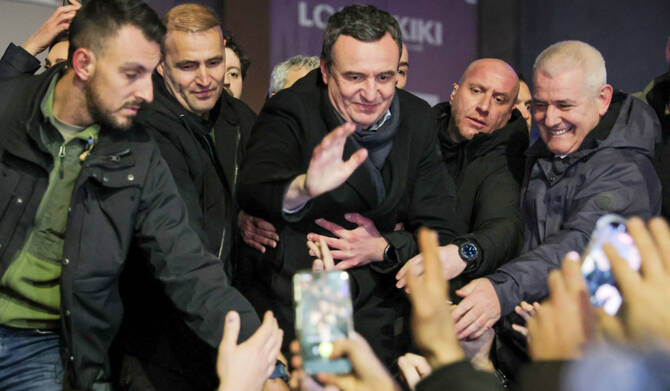
Kosovo's Prime Minister Albin Kurti waves to supporters, as his party won more than half of the votes in a snap parliamentary election, in Pristina, Kosovo, December 28, 2025. (REUTERS)
Short Url
Updated 29 December 2025
Follow

Preliminary results show Prime Minister Kurti’s party won Kosovo snap vote convincingly

  • The previous postelection stalemate marked the first time Kosovo could not form a government since it declared independence from Serbia in 2008 following a 1998-99 war that ended in a NATO intervention

PRISTINA, Kosovo: Kosovo ‘s Prime Minister Albin Kurti appeared set for another term in office after his party on Sunday convincingly won an early parliamentary election in the Balkan country, preliminary results showed.
The Vetevendosje, or Self-Determination, party won nearly 50 percent of the ballots, far ahead of the opposition Democratic Party of Kosovo with 21 percent, and the Democratic League of Kosovo with nearly 14 percent, the state election, authorities said after nearly all the ballots were counted.
“Congratulations on the biggest victory in the history of the country,” a cheerful Kurti said after results were announced. “Now we have a lot of work ahead of us.”
The snap ballot on Sunday was scheduled after the Self-Determination party failed to form a government despite also winning the most votes in a Feb. 9 election, which led to a monthslong political deadlock.
It was not immediately clear whether the Self-Determination party has won 61 seats in the 120-member parliament to be able to rule alone. Kurti said a new parliament and a government will be formed as soon as possible.
“We don’t have time to lose and must move forward together as quickly as possible,” he said.
Hundreds of ruling party supporters gathered outside the party offices in Pristina in celebration, chanting Kurti’s name.
The previous postelection stalemate marked the first time Kosovo could not form a government since it declared independence from Serbia in 2008 following a 1998-99 war that ended in a NATO intervention.
Kosovo has not approved a budget for next year, sparking concern over the already poor economy in the country of 2 million people. Lawmakers also are set to elect a new president in March as current President Vjosa Osmani’s mandate expires in early April.
After voting Sunday, Kurti urged Kosovo’s 1.9 million voters to turn out in large numbers to grant “more legitimacy for our institutions.”
Turnout was at around 44 percent, according to the state election authorities.
According to Kosovo’s election laws, 20 parliamentary seats are automatically assigned to ethnic Serb representatives and other minority parties.
Opposition parties have accused Kurti of authoritarianism and of alienating Kosovo’s US and European Union allies since he came to power in 2021. Kurti also briefly served as prime minister in 2020, during the COVID-19 pandemic.
Lumir Abdixhiku from the Democratic League of Kosovo earlier on Sunday urged voters to “move away from the gloom, the deadlock and the division that has accompanied us for these years.”
A former political prisoner during Serbia’s rule in Kosovo, the 50-year-old Kurti has taken a tough stand in talks mediated by the European Union on normalizing relations with Belgrade. In response, the EU and the United States imposed punitive measures.
Kurti has promised to buy military equipment to boost security.
Ilmi Deliu, a 71-year-old pensioner from the capital, Pristina, said he hoped the election will bring a change or “we will end up in an abyss.”
“Young people no longer want to live here,” he said.
Tensions with restive ethnic Serbs in the north exploded in clashes in 2023 when scores of NATO-led peacekeepers were injured. In a positive step, ethnic Serb mayors this month took power peacefully there after a municipal vote.
Kurti has also agreed to accept third-country migrants deported from the United States as part of tough anti-immigration measures by the administration of President Donald Trump. One migrant has arrived so far, authorities have told The Associated Press.
Kosovo has one of the poorest economies in Europe. It is one of the six Western Balkan countries striving to eventually join the EU, but both Kosovo and Serbia have been told they must first normalize relations.


Isolated Kremlin critics lament lost future at Nemtsov memorial

Updated 4 sec ago
Follow

Isolated Kremlin critics lament lost future at Nemtsov memorial

  • Hundreds used to flock to the makeshift memorial on the anniversary of his death
  • Since Russia ordered troops into Ukraine it has intensified a crackdown on dissent, with almost no opposition to the Kremlin visible on the street

MOSCOW: On a bridge next to the Kremlin on a drizzly Friday morning, a lone Russian police officer stood looking at the half-dozen bunches of flowers laying in memory of slain opposition figure Boris Nemtsov.
The symbolism was almost too much.
Four years into Moscow’s full-scale offensive on Ukraine, which has seen President Vladimir Putin eradicate all forms of dissent and usher in strict military censorship laws that have silenced his critics, few Russians dared, or wanted, to pay tribute.
Nemtsov, a longtime Putin opponent, was shot and killed on February 27 2015, meters from the Kremlin’s red walls. He was 55.
Hundreds used to flock to the makeshift memorial on the anniversary of his death, which came on Friday.
This year, there was barely a trickle. Those who turned up were visibly nervous.
“So few people, they’ve all forgotten,” lamented one elderly man, who refused to give his name.
“Everybody is afraid,” a woman standing nearby added.
Since Russia ordered troops into Ukraine it has intensified a crackdown on dissent, with almost no opposition to the Kremlin visible on the street.
AFP reporters on Friday morning saw only around a dozen mourners alongside Western ambassadors laying red carnations.
“Keep moving, don’t gather in a crowd, don’t block the way for other citizens,” a police officer said through a megaphone.
Three days after Russia launched its offensive on Ukraine in 2022, protesters had staged an impromptu rally against the war at the memorial on the anniversary of Nemtsov’s death.
Nemtsov’s supporters have always accused Chechen leader and key Putin ally Ramzan Kadyrov of ordering his killing.
Kadyrov has rejected the claims.
Five Chechens were convicted of a contract killing but investigators never said who it was ordered by.

- ‘Everything is persecuted’ -

For his followers, Nemtsov is a totemic figure in Russian political life — seen as a once-future leader who might have taken the country on a different path.
“I come here every year,” said 79-year-old scientist Sergei at the bridge on Friday.
“Russia should have had — though unfortunately it didn’t work out — a leader exactly like Nemtsov,” he told AFP, declining to give his surname.
“Right now everything here is suppressed, everything is persecuted, people are sitting in prisons.”
A physicist by education, Nemtsov rose to fame in the 1990s as a young, liberal provincial governor, and was widely tipped to take over from Boris Yeltsin.
He gave his hesitant backing to Putin when the ex-KGB spy was tapped to enter the Kremlin instead, but became an early — and fierce — opponent of what he cast as the Russian leader’s creeping authoritarianism.
He had largely lost popularity and was only a marginal figure in Russian politics when he was killed in 2015. Still, his murder shocked the country and the world.
“The hopes of the whole country were pinned on him — of all the people who wanted it to be free here,” said Olga Vinogradova, a 66-year-old volunteer who tends to the pop-up memorial to Nemtsov on the bridge.
“When this man was killed, naturally, all of us were, we were all just executed at that moment. Because our hopes were destroyed,” she said.
“With this memorial, we remind people that there was a different path for Russia. And that there was a real person who could have led us down this path.”

- ‘Forced out’ -

Nemtsov had strongly opposed Putin’s 2014 annexation of Crimea from Ukraine and Moscow’s military backing for pro-Russian separatists in eastern Ukraine.
He was also a close and early ally of Alexei Navalny, who died in 2024 in an Arctic prison in what his supports say was a poisoning.
Open opposition to the Kremlin is unheard of inside Russia since the first days of the Ukraine offensive — when riot police cracked down hard on the thousands that took to the streets to protest.
All major critics of the Kremlin are in exile, prison or dead.
Those that remain have been silenced.
“Many have been forced out of the country, some have been killed,” said Gleb, a 23-year-old photographer.
A movement or person like Nemtsov was “impossible” to imagine right now, he said.
Still, he held on to a slither of hope.
“But everything can change at any moment.”