

UNGA adopts Pakistan-sponsored resolution focusing world attention on Palestine, Kashmir

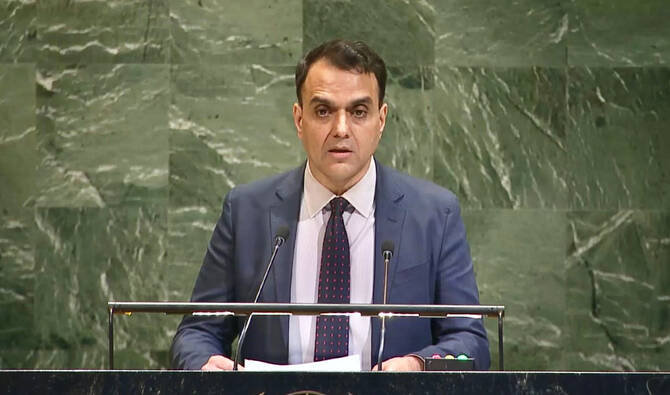
mbassador Usman Jadoon, Pakistan’s deputy permanent representative to the UN, addresses the General Assembly on the “International Day against Colonialism in All its Forms and Manifestations,” in New York, US, on December 18, 2025. (X/@PakistanUN_NY)
Short Url
Updated 19 December 2025
Follow

UNGA adopts Pakistan-sponsored resolution focusing world attention on Palestine, Kashmir

  • The resolution calls on countries to immediately cease foreign military intervention in and occupation of foreign countries and territories
  • Islamabad says the consensual adoption of the resolution manifests broad support for inalienable right of peoples facing foreign occupation

ISLAMABAD: The United Nations General Assembly (UNGA) has adopted a Pakistan-sponsored resolution on the peoples’ right to self-determination, Pakistan’s UN mission said on Friday, saying it reinforces the world attention to the Palestine and Kashmir issues.

The text, which was adopted by consensus, was recommended last month by the 193-member General Assembly’s Third Committee, which deals with social, humanitarian and cultural issues, according to Pakistani state media.

Co-sponsored by 65 countries, it called on countries to immediately cease foreign military intervention in and occupation of foreign countries and territories as well as acts of “repression, discrimination, and maltreatment.”

The resolution also declared the General Assembly’s firm opposition to acts of foreign military intervention, aggression and occupation, which have resulted in suppression of peoples’ right to self-determination in parts of the world.

“The consensual adoption of the resolution manifests broad international support for the inalienable right of the peoples facing colonialism, alien domination and foreign occupation,” Pakistan’s UN mission said on X. 

“For the people of Indian Illegally Occupied Jammu and Kashmir (IIOJK) and Palestine, the resolution reinforces international attention to their just and legitimate cause and their aspirations for freedom and dignity in accordance with UN Security Council resolutions.”

Pakistan, which does not recognize Israel, supports an independent Palestinian state based on “internationally agreed parameters” and pre-1967 borders, calling for an end to Israeli occupation of the Gaza Strip and the West Bank, including East Jerusalem.

Kashmir, on the other hand, has been divided between Pakistan and India since their independence from British rule in 1947. Both countries claim the Himalayan territory in its entirety but rule it in part and have fought multiple wars over it.

Islamabad has repeatedly urged New Delhi to hold a plebiscite in the disputed territory in line with the United Nations Security Council resolutions.

Ambassador Usman Jadoon, Pakistan’s deputy permanent representative to the UN, this week said the realization of self-determination is not merely a historical aspiration, but an enduring obligation.

“Recent developments in the Middle East demonstrate that lasting peace cannot be achieved through the continued denial and suppression of the legitimate right to self-determination of the Palestinian people,” he said on Thursday.

“Similarly, the UN Security Council has, through several resolutions, recognized the legitimate right of self-determination of the people of Jammu and Kashmir. A just resolution of the Jammu and Kashmir dispute remains central to the establishment of durable peace in South Asia.”


Pakistan assures US of facilitating foreign investment, increasing business engagement

Updated 7 sec ago
Follow

Pakistan assures US of facilitating foreign investment, increasing business engagement

  • Finance Minister Muhammad Aurangzeb meets US deputy assistant secretary of South and Central Asian Affairs
  • Both sides discuss Pakistan’s progress in implementing reforms, avenues for increasing economic cooperation

ISLAMABAD: Pakistan’s Finance Minister Muhammad Aurangzeb on Wednesday reaffirmed Islamabad’s commitment to facilitating foreign investment and enhancing engagement with the American business community, the Finance Division said in a statement. 

The statement was issued after Finance Minister Muhammad Aurangzeb met Mark Pommersheim, the US deputy assistant secretary of the Bureau of South and Central Asian Affairs. Pommersheim called on the Pakistani finance minister along with US Chargé d’Affaires Natalie Baker at the Finance Division. 

Both sides discussed Pakistan’s economic outlook, reform agenda and avenues for enhancing bilateral economic cooperation, the statement said. 

“The finance minister reiterated Pakistan’s commitment to facilitating foreign investment and maintaining regular engagement with the US business community, including the US Chamber of Commerce and the American Business Council,” the Finance Division said. 

Aurangzeb informed the US officials about the progress regarding Pakistan’s macroeconomic stabilization reforms. He shared that Pakistan’s fiscal deficit has declined in recent months while the country’s current account has improved due to strong remittance inflows and growth in IT exports.

The finance minister noted that reforms in Pakistan’s state-owned enterprises and “right-sizing” of the public sector are being accelerated to improve efficiency and reduce fiscal risks.

The Finance Division said Pommersheim acknowledged Pakistan’s efforts toward fiscal stabilization, welcoming improvement in key macroeconomic indicators. 

“He emphasized that the United States values a stable and prosperous Pakistan and noted that strengthening the investment climate remains a shared priority,” the statement said. 

“He observed that US businesses are closely watching reform progress and that improved policy consistency would further support commercial engagement.”

Pakistan has sought to re-energize economic diplomacy with Washington as it attempts to enhance its exports, attract foreign investment and stabilize its economy under an International Monetary Fund-backed reform program.

Relations between Pakistan and the US have improved significantly under President Trump’s administration. In July 2025, the two countries agreed to a bilateral trade deal that included reciprocal tariff reductions. 

Since 2025, the two sides have increased diplomatic contacts, including meetings between Prime Minister Shehbaz Sharif, Pakistan’s military leadership and US officials, alongside discussions on trade, minerals, security cooperation and regional stability.