

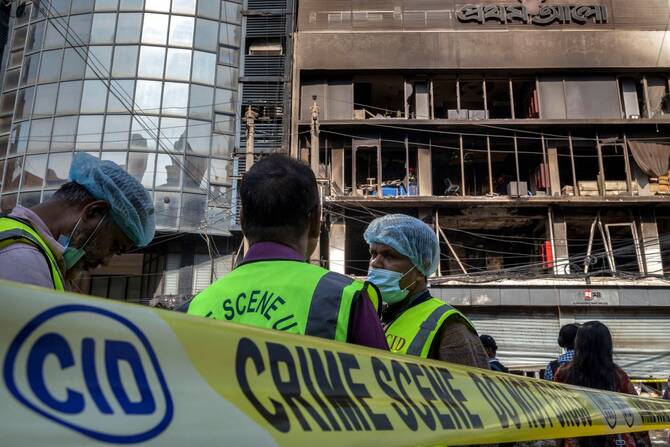
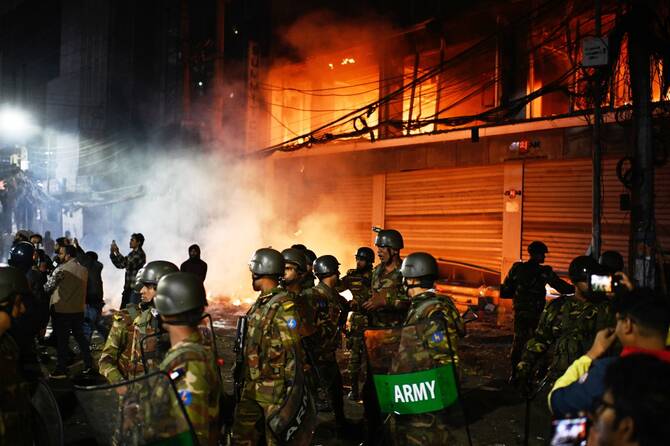

DHAKA: Violent protests have gripped Bangladesh’s capital since Friday morning, with crowds setting fire to several landmark buildings and blocking the city, after a prominent youth leader died from gunshot wounds sustained in an attack last week.
Sharif Osman Hadi, 32, played a significant role in the 2024 student-led uprising that led to the ouster of former Prime Minister Sheikh Hasina. After Hasina fled to India and the regime was overthrown, he became the convenor of the Inqilab Mancha — a platform highly critical of the former premier and India’s political influence in Bangladesh.
Shot in the head by masked assailants in Dhaka, Hadi was rushed to Dhaka Medical College Hospital for treatment, where doctors reported brain-stem damage. He was flown to Singapore for neurosurgical intensive care but died from his injuries on Thursday, six days after the attack.
After the announcement of Hadi’s death, his supporters, along with angry crowds, took to the streets of the capital on Thursday, blocking the Shahbagh intersection — one of the city’s most prominent traffic hubs and a historical protest site.
Another group set fire to the offices of The Daily Star and Prothom Alo — two major national newspapers, which certain anti-India factions have criticized for allegedly being “pro-Indian.”
Groups also damaged the Bangabandhu Museum, a historic building that once served as the residence of Sheikh Mujibur Rahman — Hasina’s father and one of the most prominent Bengali nationalist leaders.
The angry protesters also damaged the Chayanat Bhaban, a music school famous for promoting the work of Rabindranath Tagore, the renowned Bengali poet and the first non-European to win the Nobel Prize in Literature.
Bangladesh’s interim government has condemned all the attacks and called on citizens to “resist all forms of mob violence committed by a few fringe elements.”
Prof. Muhammad Yunus, the Nobel Peace Prize laureate who has been leading Bangladesh’s interim government, said Hadi’s death was an “irreplaceable loss to the nation’s political and democratic sphere,” and that the government was committed to a transparent investigation.
He warned that violence would undermine Bangladesh’s national elections scheduled for Feb. 12.
As protests and roadblocks continued across Dhaka following Friday prayers, Prof. A.S.M. Amanullah, a sociologist and vice chancellor of the National University in Dhaka, told Arab News that they were a “natural reaction” to Hadi’s death.
“He was anti-Indian, anti-imperialist ... He is a really very popular leader among the students and among the protesting citizens of Bangladesh,” Amanullah said.
He said events in the city appeared to be “targeted attacks” by a group or a faction that “might try to derail” the achievements of the 2024 student movement. “It’s a section of a vested quarter,” he said.
“Though we need investigation, apparently, as a ready reference, if we see the attackers, their body gestures and their facial expressions and their physical expressions, everything tell us that this is a vested quarter.”
Amanullah added that he did not expect the violence to affect the upcoming polls “because the mega political players already entered the election train.”
“The country can’t think of anything other than holding the general election.”


