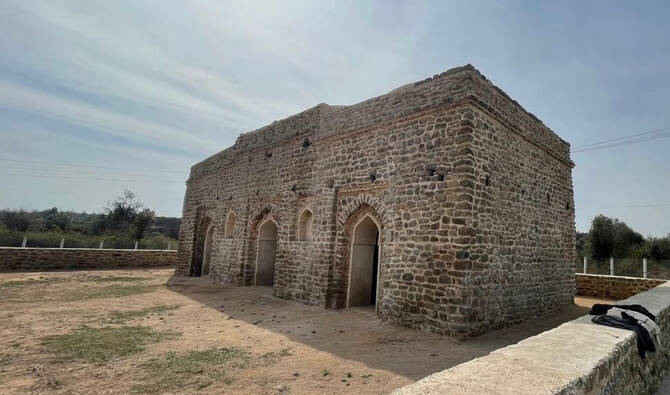
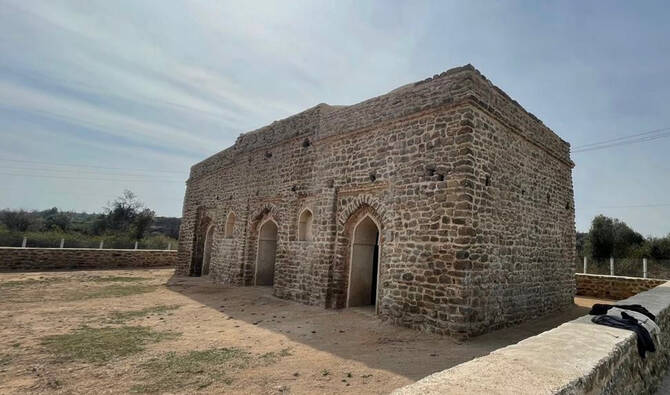
ISLAMABAD: Tucked into a hillside overlooking the Soan River on the outskirts of Pakistan’s capital, a little-known mosque believed to have been commissioned by a woman more than 500 years ago has been brought back to life, offering a rare glimpse into the region’s layered and often overlooked past.
The Mai Qamro Mosque, recently restored by Islamabad’s Department of Archaeology, is considered by officials to be among the oldest known mosques within the federal capital. Its revival has also shed light on the history of the Potohar plateau, a region shaped by medieval rivalries, shifting empires and far older human settlement.
Built in the early 16th century during the rise of the Mughal Empire, the mosque stands across the river from Pharwala Fort, once a stronghold of the Gakhar tribe, a powerful regional force that controlled key routes linking South Asia with Central Asia.
“It took us about a year to remove the wild growth from the walls and structures and then we carried out some archaeological excavations,” Dr. Abdul Ghafoor Lone, director of the Department of Archaeology, told Arab News.
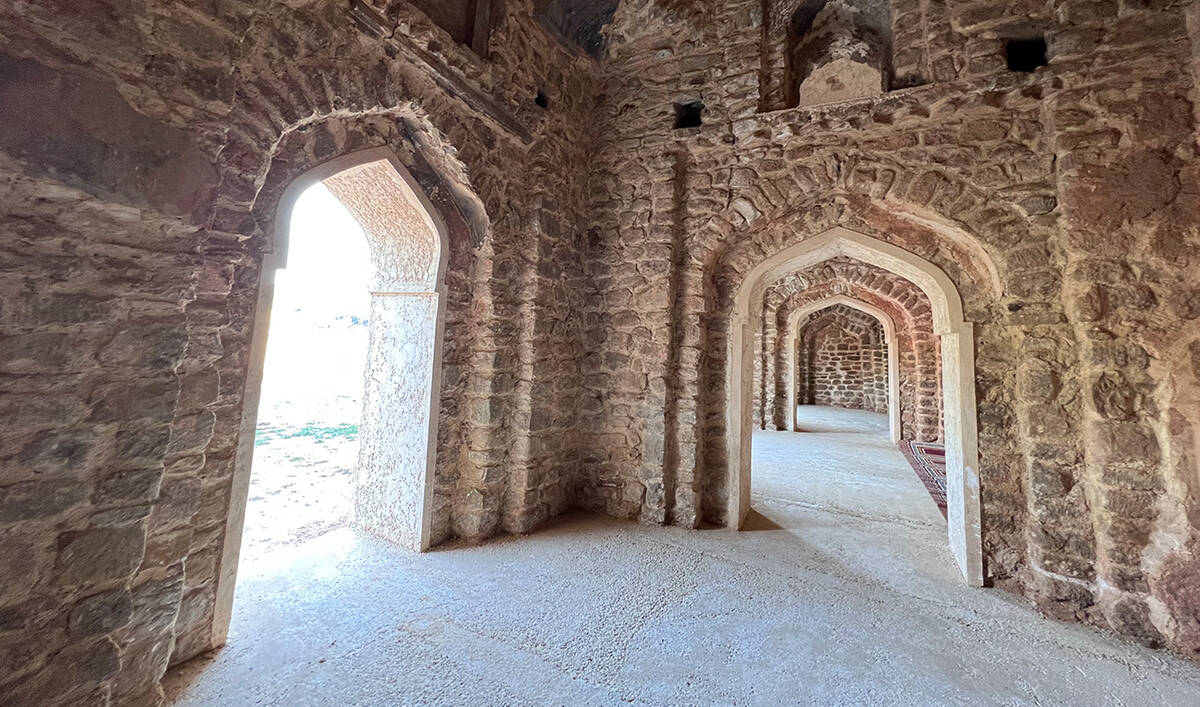
The photograph taken on March 17, 2026, shows an inside view of the Mai Qamro mosque on the outskirts of Islamabad, Pakistan. (AN)
Work on the restoration began in 2022 and was completed in June 2025 using traditional construction techniques. Conservators relied on lime mortar mixed with brick powder and jute fragments, materials consistent with 16th-century building practices, to preserve the structure’s original character.
The mosque reflects early Mughal architectural features, including a rectangular layout and three low domes. One of the domes, which had nearly collapsed, could not be fully reconstructed due to unstable ground near the river. Instead, an iron frame was installed in the original shape and finished with lime plaster to maintain its historic appearance.
“We used the mortar of the same style which was used in the 16th century with lime and stone,” Lone said. “That dome is now restored, and the mosque is in the best condition and we are hopeful that it will be secure for the next 100-200 years.”
Built with local limestone and sandstone and decorated with terracotta tiles, the structure reflects a blend of regional Gakhar craftsmanship and Mughal design influences.
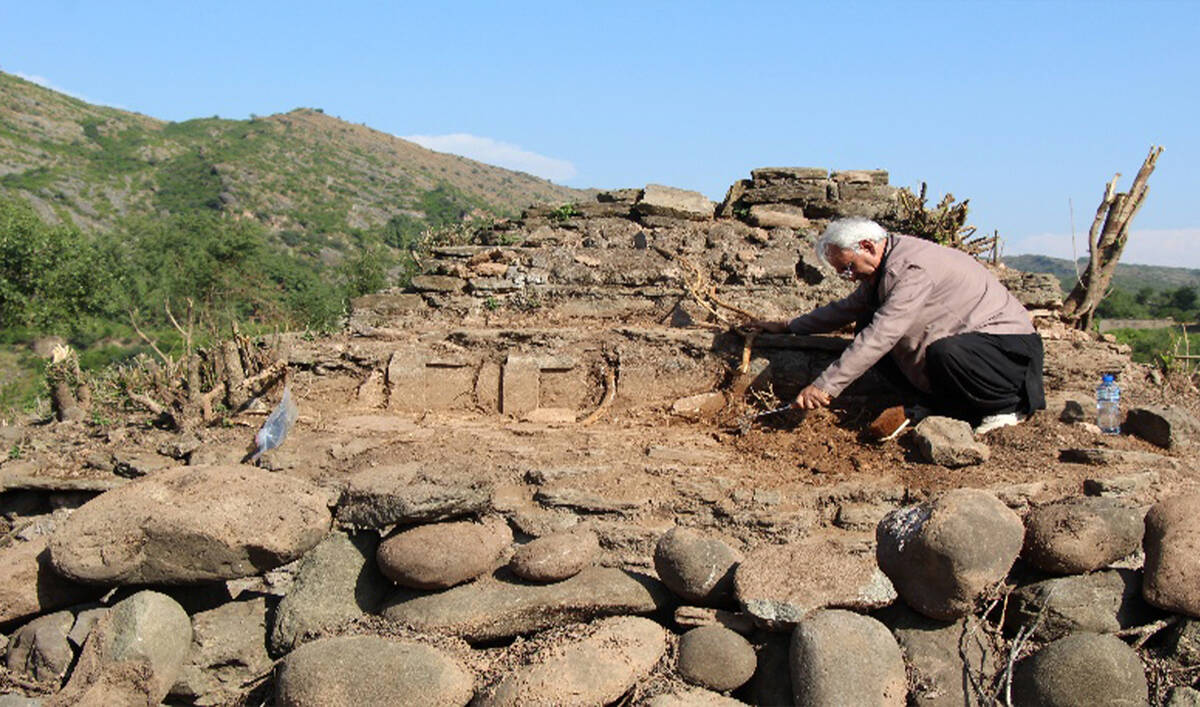
The photograph provided by the Archeological Department on March 18, 2026, shows Dr. Abdul Ghafoor Lone doing restoration work at the site of Mai Qamro mosque on the outskirts of Islamabad, Pakistan. (AN)
FORGOTTEN PATRON
The mosque is named after Mai Qamro, a little-documented historical figure believed to have been the wife of Gakhar ruler Hathi Khan and a patron of public works, including mosques, wells and caravan serais.
While historical records about her remain sparse, scholars say her association with the site highlights the role of women in commissioning religious and civic structures in South Asia, a contribution often underrepresented in mainstream histories.
Travel historian Salman Rashid believes the mosque itself may predate its widely accepted timeline.
“If you look at the interior, especially the squinches in the corner, they seem to be about from the middle of the 15th century, which was a little before Hathi Khan’s time,” he told Arab News in an online interview.
“What Mai Qamro would have done is that she might have repaired the structure or her husband might have done it and attributed it to his wife’s name.”
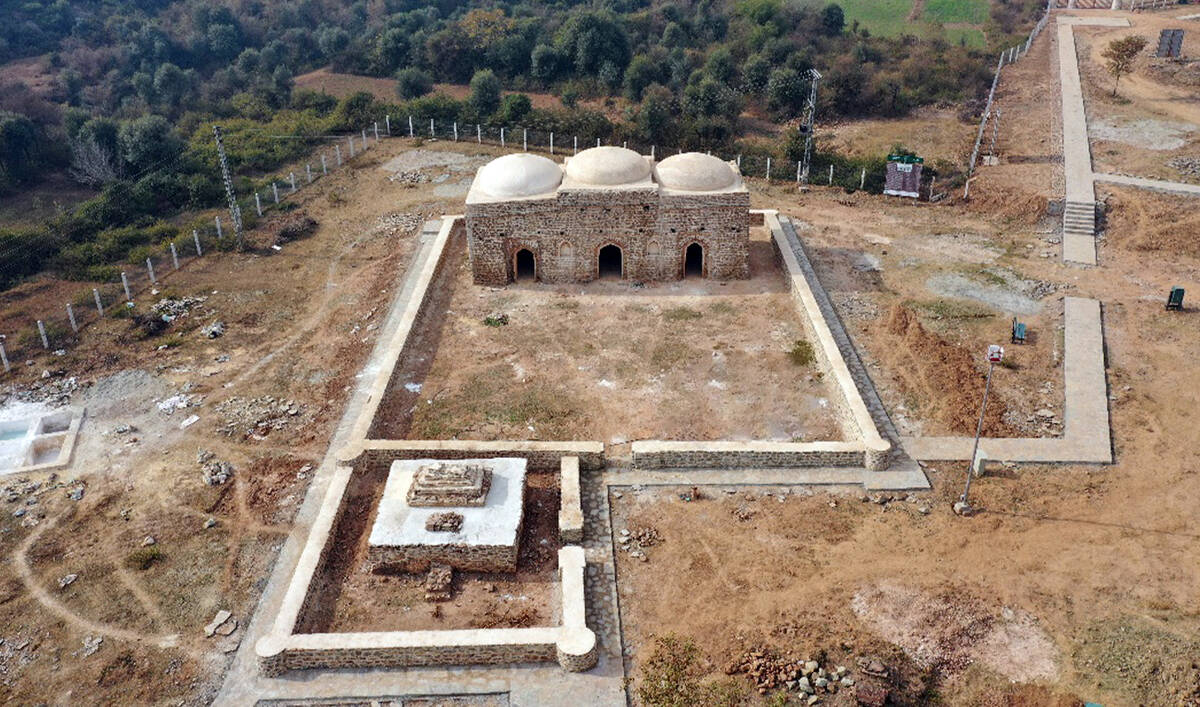
The photograph provided by the Archeological Department on March 18, 2026, shows an ariel view of the Mai Qamro mosque on the outskirts of Islamabad, Pakistan. (AN)
Rashid placed her within a broader historical tradition of influential women whose contributions have largely faded from public memory.
“These women were very active in our part of the world in the middle ages,” he said.
“We hear of Manmati, who was Akbar’s wife from the Rajput clan of Rajasthan, who built Mariam Zamani mosque in Lahore,” Rashid added. “Razia Sultana earlier was doing such things 300-400 years before Mai Qamro.”
The Gakhars themselves, who dominated the Potohar region for centuries, were known as a powerful warrior tribe navigating alliances and conflicts with successive empires, including the Mughals.
Their origins remain debated.
“The Gakhars claim to have come from Kehan or Kayyan in Iran, but that’s a false claim... in the 11th century, in his second or third attack in 1003, the Gakhars routed the Turkish army under Mahmud Ghaznavi,” Rashid said.
Far from being part of invading forces, he said, the tribe had resisted them, a narrative later reshaped in oral histories.
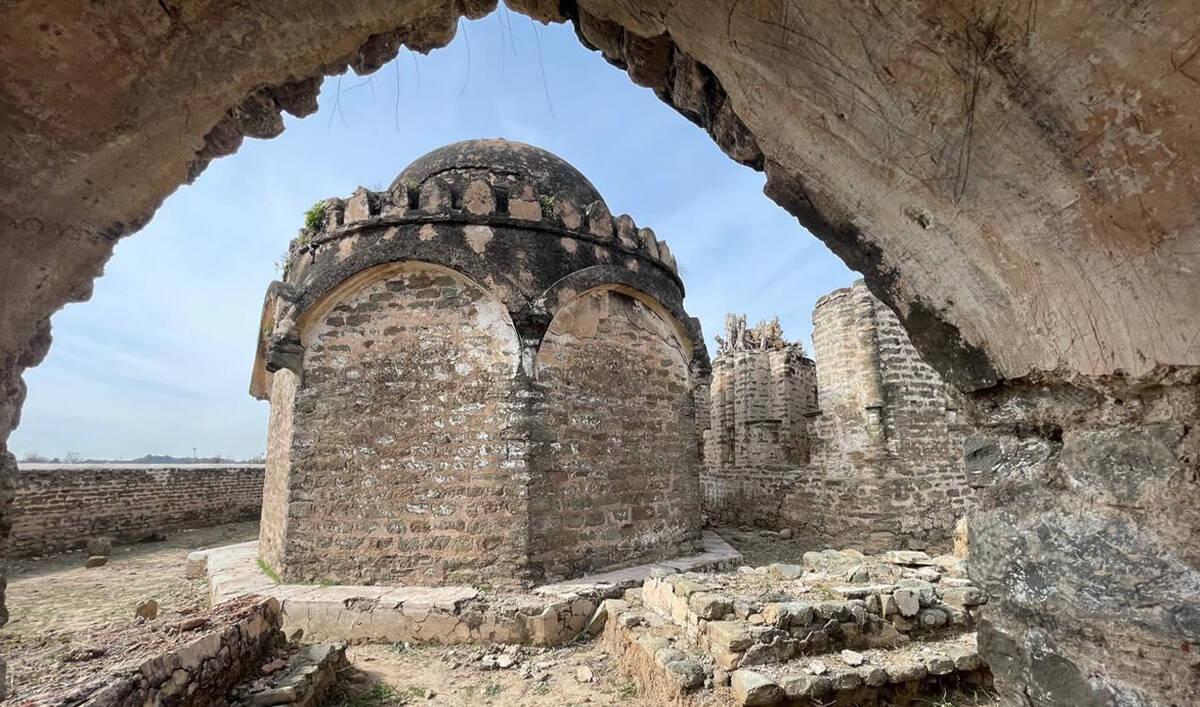
The photograph provided by the Archeological Department on March 18, 2026, shows exterior of the Tomb of Sultan Muqarab Khan near Mai Qamro mosque on the outskirts of Islamabad, Pakistan. (AN)
LAYERED HISTORY BENEATH
Excavations at the site have revealed deeper historical layers beneath the mosque, including older burial sites lying beneath 19th-century graves.
“The people who constructed the tomb, they were not aware of these graves,” Lone said.
Archaeologists found partial human remains, including fingers, hands and skull fragments, in shallow pits, suggesting hurried burials that may be linked to past conflicts in the region, including battles involving Gakhar factions and early Mughal expansion.
Across the river, visible from the mosque’s arched entrance, stands Pharwala Fort, once the center of Gakhar power. Officials say plans are in place for its restoration, subject to funding.
For historians, the mosque is part of a much longer continuum of human presence in the region.
The Soan River basin is one of South Asia’s most significant archaeological zones, where stone tools dating back nearly two million years have been discovered, pointing to some of the earliest human activity in the region.
“Islamabad might be a new city, but it still sits on a very ancient high road,” Rashid said.
For residents of nearby Bagh Jogian, however, the restoration carries a more immediate significance.
“This restoration is something very crucial for us,” said Bilal Asad, a local resident. “If these places get restored, it will be of great benefit to all of us.”