

Pakistan, IFC review steps to unlock private investment, jobs

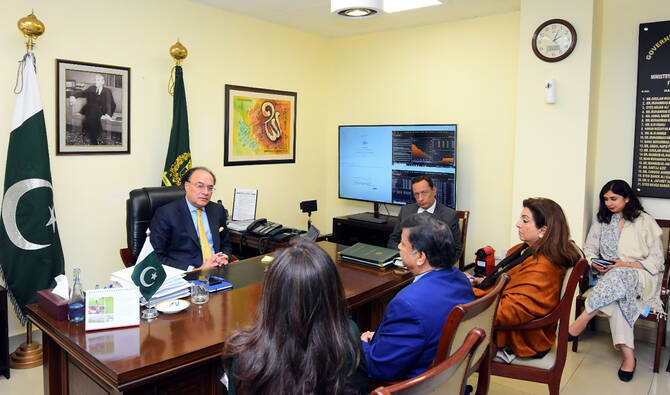
Finance Minister of Pakistan, Muhammad Aurangzeb (left) in conversation with a delegation of International Finance Corporation at the Finance Division in Islamabad, Pakistan, on December 18, 2025. (Government of Pakistan)
Short Url
Updated 18 December 2025
Follow

Pakistan, IFC review steps to unlock private investment, jobs

  • Talks focus on public-private partnerships, mobilizing private capital
  • Government flags IT, agriculture, mining, health care as priority sectors

KARACHI: Pakistan’s finance minister on Thursday reviewed ways to deepen cooperation with the International Finance Corporation (IFC) to mobilize private investment, expand public-private partnerships and support job creation, the finance ministry said in a statement.

Finance Minister Muhammad Aurangzeb met an IFC delegation led by Khawaja Aftab Ahmed, the lender’s director for the Middle East, Pakistan and Afghanistan, as Islamabad seeks to translate recent macroeconomic stabilization into sustained private-sector growth.

Pakistan has made progress under an International Monetary Fund–backed reform program, easing immediate default risks and restoring a measure of macroeconomic stability. But officials say the next phase hinges on reviving investment, expanding exports and creating jobs, particularly as fiscal space remains tight and development spending constrained.

“Both sides agreed on the need to align investment and advisory support with Pakistan’s medium-term development priorities, with a clear focus on job creation, sustainability, and export-oriented growth,” the finance ministry said.

According to the statement, the IFC briefed the minister on its expanding engagement in Pakistan across investment and advisory operations, including local-currency financing, private-sector investments and sustainability-oriented initiatives. Particular emphasis was placed on the IFC’s role in strengthening public-private partnership frameworks, including projects aimed at improving urban services, infrastructure performance and resource efficiency.

Aurangzeb outlined the government’s strategy of creating enabling ecosystems rather than direct state intervention, identifying priority areas such as the digital and information technology economy, agriculture and agri-value chains, minerals and mining, health care and skills-based human capital exports.

Both sides also discussed closer coordination within the World Bank Group to deploy advisory, financing and risk-mitigation instruments more effectively, while stressing the importance of timely execution of approved transactions to maintain investor confidence.

Pakistan’s engagement with the International Finance Corporation is part of a broader long-term partnership aimed at catalyzing private sector-led growth. Since its early involvement in the country, IFC has deployed a range of equity and loan investments across sectors including renewable energy, infrastructure, manufacturing and agribusiness, with cumulative investments reaching an estimated $13 billion over several decades. 

In recent years, IFC has boosted financing for strategic initiatives such as Pakistan’s first sustainable aviation fuel facility in Punjab, where it is providing up to $35 million in equity and debt capital to generate jobs, support exports and reduce carbon emissions.


Pakistan stocks recover as oil supply fears ease after Islamabad seeks Red Sea route— analyst

Updated 5 sec ago
Follow

Pakistan stocks recover as oil supply fears ease after Islamabad seeks Red Sea route— analyst

  • Pakistan has sought Saudi help to secure oil supplies via Red Sea port after Iran’s closure of Strait if Hormuz
  • Analyst says higher crude oil prices, expectations of IMF releasing next loan tranche also triggered bullish activity

ISLAMABAD: Pakistani stocks marked a sharp recovery when trading closed on Thursday, as institutional activity increased following Islamabad’s move to seek crude oil supplies through the Red Sea port eased oil supply fears, a financial analyst said. 

Pakistani stocks have recorded a sharp decline this week, with the benchmark KSE-100 index recording its largest-ever single-day decline on Monday when it plunged 16,089 points. Escalating conflict in the Middle East triggered panic selling at the Pakistani bourse, forcing a temporary trading halt on Monday. 

The KSE-100 index, however, gained 3.49 percent or 5,433.46 points to close at 161,210.67 when trading ended on Thursday, up from the previous close of 155,777.21 points, according to Pakistan Stock Exchange’s (PSX) data.

Pakistan’s Petroleum Minister Ali Pervaiz Malik met Saudi Ambassador Nawaf bin Said Al-Malki on Wednesday to discuss Iran’s closure of the key Strait of Hormuz, which has threatened Pakistan’s energy supply. Roughly 20 percent of the global oil and gas supply passes through the route. Saudi Arabia indicated it could facilitate shipments through the Red Sea port of Yanbu, offering an alternative route if Gulf shipping lanes remain disrupted, the petroleum ministry said on Wednesday. 

“Stocks staged a sharp recovery at PSX amid institutional activity on easing fuel supply fears after KSA [Kingdom of Saudi Arabia] commits oil supplies through the Red Sea port,” Ahsan Mehanti, chief executive officer at Arif Habib Commodities, told Arab News.

He said higher global crude oil prices and expectations of the International Monetary Fund releasing its next tranche of the $7 billion loan for Pakistan also helped bullish activity at the PSX.

An IMF mission was in Pakistan to hold talks on the third review of a $7 billion Extended Fund Facility multi-year program, and for the second review of the $1.4 billion Resilience and Sustainability Facility this week.

However, the delegation left for Türkiye amid tensions in the Gulf. Pakistani officials have said talks are likely to continue virtually in the coming days. 

Pakistani brokerage Topline Securities said in its daily market review report that strong institutional buying “turned the tide” on Thursday after the market’s recent overreaction to regional issues.

The report added that Hub Power Company (HUBC), Oil & Gas Development Company (OGDC), Fauji Fertilizer Company (FFC), Engro Corporation (ENGROH), and Meezan Bank Limited (MEBL) collectively contributed 2,197 points to the KSE benchmark’s gain.

Topline Securities said 723 million shares were traded on Thursday, with K-Electric Limited (KEL) stealing the spotlight as more than 1.17 billion shares changed hands.

Pakistani investors are closely monitoring developments in the Gulf, particularly around energy routes and further retaliatory actions, as the conflict’s trajectory remains uncertain.