What to know about the search for the Brown University shooting suspect

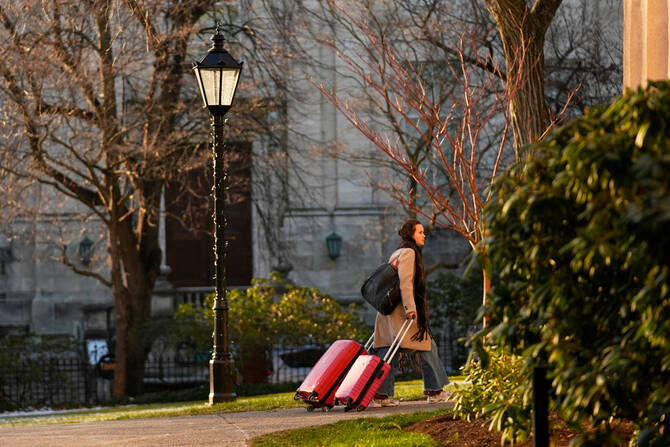
A Brown University student leaves campus, Tuesday, Dec. 16, 2025, after all classes, exams and papers were canceled for the rest of the Fall 2025 semester following the school shooting, in Providence, R.I. (AP)
Short Url
Updated 17 December 2025
Follow

What to know about the search for the Brown University shooting suspect

  • The video from more than hour before the attack shows the suspect running at times in quiet residential streets near campus

PROVIDENCE, R.I.: With the Brown University shooter still on the loose Tuesday, authorities released new video of a suspect and police fanned out to Providence schools to reassure parents, kids and teachers as investigators pushed for new evidence that might help them crack the case.
Here’s a look at what to know about the attack and the search:
Search on after new video and description of suspect
Authorities released a video timeline and a slightly clearer image of the man suspected in Saturday’s attack in an engineering building classroom, where two students were killed and nine were wounded. The video from more than hour before the attack shows the suspect running at times in quiet residential streets near campus.
In videos previously made public, the suspect’s face was masked or turned away and authorities were only able to give a vague description of him as having a stocky build and about 5 feet, 8 inches (173 centimeters) tall.
The gunman fired more than 40 rounds from a 9 mm handgun, a law enforcement official told The Associated Press on the condition of anonymity because they weren’t authorized to discuss the investigation publicly.
Police have asked the public for tips, and said they had received about 200 by Tuesday. Col. Oscar Perez, the Providence police chief, asked the public Tuesday to look at their camera systems in the area where the person was walking to review any footage that goes back a week.
Authorities on Sunday released a different person of interest after determining he wasn’t behind the attack, which happened in a first-floor classroom where students were cramming for an exam. Providence police spokeswoman Kristy dosReis said the man’s detention didn’t affect the ongoing investigation.
Police fan out to local schools
Tensions remain high in Providence. Ten state troopers were assigned to support the local police sent to beef up security at schools, district Superintendent Javier Montañez said. The district said it canceled after-school activities, sporting events and field trips this week “out of an abundance of caution.”
The attack and the shooter’s escape also have raised questions about campus security, including a lack of security cameras, and led to calls for better locks on campus doors. But some said what they called the real issue needs to be addressed.
“The issue isn’t the doors, it’s the guns,” said Zoe Kass, a senior who fled the engineering building Saturday.
Authorities have said that one reason they lacked video of the shooter was because Brown’s older engineering building doesn’t have many cameras.
University defends response
Brown President Christina Paxson defended the university’s response, saying it was deeply committed to the safety, security and well-being of its students. She also said the campus is equipped with 1,200 cameras.
“I have been deeply saddened by people questioning that,” she said Tuesday. “As time goes on, there is a natural instinct to assign responsibility for tragic events like this. Anxiety here is very natural, but the shooter is responsible.”
Paxson said the university has two security systems. One system is activated at a time of emergency and sent out text messages, phone calls and emails that, in this shooting, reached 20,000 individuals. The other system features three sirens across campus, but Paxson said that would not be activated in an active shooter situation.
“Those get activated when there is a broad scale emergency, and we want people to rush into buildings,” she said. “In the case of an active shooter, activating that system could have caused people to rush into Barus and Holley.”
When pressed by a reporter who noted the university website says the sirens can be used when there is an active shooter, Paxson reaffirmed she didn’t think it would be used in that situation.
“It depends on the circumstances and where the active shooter would be but you don’t want to ever get people rushing into buildings that might be the site of an active shooter,” she said.
Details about the victims emerge
Two of the wounded students had been released from the hospital as of Tuesday, Brown spokeswoman Amanda McGregor said. Of the seven others, one remained in critical condition, five were in critical but stable condition and one was in stable condition, Providence Mayor Brett Smiley said.
One of the wounded, 18-year-old freshman Spencer Yang of New York City, told the New York Times and the Brown Daily Herald there was a scramble after the gunman entered the room. Yang said he wound up on the ground and was shot in the leg.
The students who died were MukhammadAziz Umurzokov, an 18-year-old freshman from Brandermill, Virginia, and Ella Cook, a 19-year-old sophomore from a suburb of Birmingham, Alabama.
Jacob Spears, 18, a freshman from Evans, Georgia, was shot in the stomach, “but through sheer adrenaline and courage, he managed to run outside, where he was aided by others,” according to a GoFundMe site organized for him.
Durham Academy, a private K-12 school in Durham, North Carolina, confirmed that a recent graduate, Kendall Turner, was wounded.


Rubio defends US ouster of Venezuela’s Maduro to Caribbean leaders unsettled by Trump policies

Updated 26 February 2026
Follow

Rubio defends US ouster of Venezuela’s Maduro to Caribbean leaders unsettled by Trump policies

BASSETERRE, St. Kitts and Nevis: US Secretary of State Marco Rubio on Wednesday defended the Trump administration’s military operation to capture Venezuela’s Nicolás Maduro, telling Caribbean leaders, many of whom objected to that move, that the country and the region were better off as a result.
Speaking to leaders from the 15-member Caribbean Community bloc at a summit in the country of St. Kitts and Nevis, Rubio brushed aside concerns about the legality of Maduro’s capture last month that have been raised among Venezuela’s island-state neighbors and others.
“Irrespective of how some of you may have individually felt about our operations and our policy toward Venezuela, I will tell you this, and I will tell you this without any apology or without any apprehension: Venezuela is better off today than it was eight weeks ago,” Rubio told the leaders in a closed-door meeting, according to a transcript of his remarks later distributed by the US State Department.
Rubio said that since Maduro’s ouster and the effective takeover of Venezuela’s oil sector by the United States, the interim authorities in the South American country have made “substantial” progress in improving conditions by doing “things that eight or nine weeks ago would have been unimaginable.”
The Caribbean leaders have gathered to debate pressing issues in a region that President Donald Trump has targeted for a 21st-century incarnation of the Monroe Doctrine meant to ensure Washington’s dominance in the Western Hemisphere. The Republican administration has declared a focus closer to home even as Washington increasingly has been preoccupied by the possibility of a US military attack on Iran.
Rubio downplays antagonism in US regional push
In his remarks to the group, America’s top diplomat tried to play down any antagonistic intent in what Trump has referred to as the “Donroe Doctrine.” Rubio said the administration wants to strengthen ties with the region in the wake of the Venezuela operation and ensure that issues such as crime and economic opportunities are jointly addressed.
“I am very happy to be in an administration that’s giving priority to the Western Hemisphere after largely being ignored for a very long time,” Rubio said. “We share common opportunities, and we share some common challenges. And that’s what we hope to confront.”
He said transnational criminal organizations pose the biggest threat to the Caribbean while recognizing that many are buying weapons from the United States, a problem he said authorities are tackling.
Rubio also said the US and the Caribbean can work together on economic advancement and energy issues, especially because many leaders at the four-day summit have energy resources they seek to explore. “We want to be your partner in that regard,” he said.
Rubio said the US recognizes the need for fair, democratic elections in Venezuela, which lies just miles away from Trinidad and Tobago at the closest point.
“We do believe that a prosperous, free Venezuela who’s governed by a legitimate government who has the interests of their people in mind could also be an extraordinary partner and asset to many of the countries represented here today in terms of energy needs and the like, and also one less source of instability in the region,” he said.
Rubio added: “We view our security, our prosperity, our stability to be intricately tied to yours.”
Trump plays up Maduro’s ouster
Trump, in his State of the Union address Tuesday night, called the operation that spirited Maduro out of Venezuela to face drug trafficking charges in New York “an absolutely colossal victory for the security of the United States.”
The US had built up the largest military presence in the Caribbean Sea in generations before the Jan. 3 raid. That has now been exceeded by the surge of American warships and aircraft to the Middle East as the administration pressures Iran to make a deal over its nuclear program.
In the Caribbean, Trump has stepped up aggressive tactics to combat alleged drug smuggling with a series of strikes on boats that have killed over 150 people and he has tightened pressure on Cuba. Regional leaders have complained about administration demands for nations to accept third-country deportees from the US and to chill relations with China.
One regional leader who has backed the US escalation is Trinidad and Tobago Prime Min­is­ter Kam­la Persad-Bisses­sar, whom Rubio thanked for her “public support for US military operations in the South Caribbean Sea,” the State Department said.
Persad-Bissessar told reporters that her conversation with Rubio focused on “Haiti; we talked about Cuba of course; we talked about engagements with Venezuela and the way forward.”
She was asked if she considered the latest US military strikes in Caribbean waters as extrajudicial killings: “I don’t think they are, and if they are, we will find out, but our legal advice is they are not.”
Rubio had other one-on-one meetings with heads of government, including from St. Kitts and Nevis, Haiti, Jamaica and Guyana.
Caribbean leaders point to shifting global order
Trump said during the State of the Union that his administration is “restoring American security and dominance in the Western Hemisphere, acting to secure our national interests and defend our country from violence, drugs, terrorism and foreign interference.”
Terrance Drew, prime minister of St. Kitts and Nevis and chair of the Caribbean Community bloc, said the region “stands at a decisive hour” and that “the global order is shifting.”
Drew and other leaders said Cuba’s humanitarian situation must be addressed.
“It must be clear that a prolonged crisis in Cuba will not remain confined to Cuba,” Jamaican Prime Minister Andrew Holness warned. “It will affect migration, security and economic stability across the Caribbean basin.”
The US Treasury Department on Wednesday slightly eased restrictions on the sale of Venezuelan oil to Cuba, which instituted austere fuel-saving measures in the weeks after the US raid in Venezuela.
That move came hours before Cuba’s government announced that its soldiers killed four people aboard a speedboat registered in Florida that had opened fire on officers in Cuban waters.