

Pakistan and Italy mark 70 years of archaeological cooperation in Swat

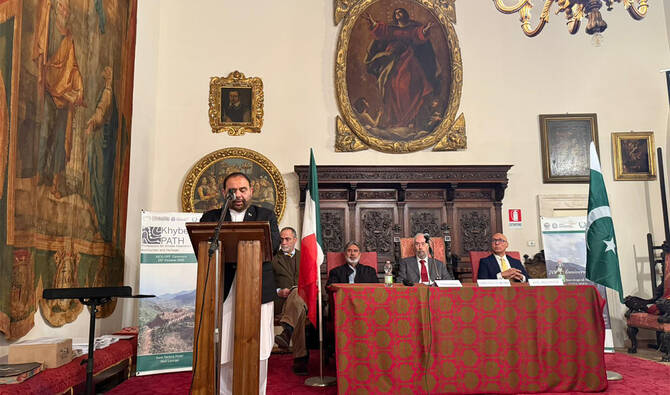
Federal Minister for National Heritage & Culture, Aurangzeb Khan Khichi, speaking at an event marking 70 years anniversary of Italian Archaeology Center at Swat, in Italy on December 14, 2025. (MoFA)
Short Url
Updated 14 December 2025
Follow

Pakistan and Italy mark 70 years of archaeological cooperation in Swat

  • Founded in 1955, Italy’s Swat mission has led excavations and conservation work at major Gandhara sites
  • Italian archaeologists have also contributed to training Pakistani researchers and museum development

ISLAMABAD: Pakistan and Italy marked 70 years of archaeological cooperation, said an official statement on Sunday, with officials highlighting decades of joint work in preserving ancient sites in the country’s northwest, where Italian researchers have played a central role in documenting and conserving remnants of the Gandhara civilization.

The Italian Archaeological Mission in Swat was established in 1955 by Italian scholar Giuseppe Tucci, a leading expert on Asian art and religions, with the aim of studying, excavating and preserving Buddhist and pre-Islamic sites in what is now Pakistan’s Khyber Pakhtunkhwa province.

Over the decades, the mission has become one of the longest-running foreign archaeological projects in the country, working closely with Pakistani authorities and academic institutions.

“Pakistan is committed to advancing archaeological research, conservation and education, and looks forward to deepening cooperation with Italy in both scope and dimension,” Pakistan’s Minister for National Heritage and Culture Aurangzeb Khan Khichi said while addressing a ceremony in Rome marking the mission’s anniversary.

The event was organized by Italy’s International Association for Mediterranean and Oriental Studies (ISMEO), with support from the Italian Agency for Development Cooperation and the University of Venice, and was attended by Pakistani and Italian academics, diplomats and cultural officials.

The Italian mission was originally conceived to systematically document Buddhist sites in the Swat Valley, once a major center of the ancient Gandhara civilization, which flourished from around the first century BCE and became a crossroads of South Asian, Central Asian and Hellenistic influences.

Since its inception, the mission has led or supported excavations and conservation work at several key sites, including Barikot, believed to be ancient Bazira mentioned by classical sources, as well as Butkara and Saidu Sharif, helping establish chronologies, preserve stupas and monasteries and train generations of Pakistani archaeologists.

Italian researchers have also worked with local authorities on site protection, museum development and post-conflict rehabilitation, particularly after natural disasters and periods of unrest that threatened archaeological heritage in the region.

The anniversary program featured sessions on the history of the mission, its collaboration with the provincial government of Khyber Pakhtunkhwa, and future research areas such as archaeobotany, epigraphy and geoarchaeology.

The event was moderated by Professor Luca Maria Olivieri of the University of Venice, who has been associated with archaeological fieldwork in Pakistan for nearly four decades and was awarded Pakistan’s Sitara-e-Imtiaz for his contributions to heritage preservation.

Officials said the mission’s longevity reflected a rare continuity in international cultural cooperation and underscored Pakistan’s efforts to protect its archaeological legacy through partnerships with foreign institutions.


Pakistan launches final polio drive of 2025 as official calls disease persistence an embarrassment

Updated 4 sec ago
Follow

Pakistan launches final polio drive of 2025 as official calls disease persistence an embarrassment

  • Sindh chief minister says Muslim-majority countries have eliminated polio by ensuring universal vaccination
  • Sindh chief minister says Muslim-majority countries have eliminated polio by ensuring universal vaccination

ISLAMABAD: Pakistan launched its final nationwide polio vaccination campaign of 2025 on Monday as a senior government official described the continued presence of the disease in the country as an embarrassment and said the only way to eradicate it was to vaccinate every child under the age of five.

The campaign, which will run from Dec. 15 to Dec. 21, aims to administer oral polio drops to more than 45 million children across the country, according to the National Emergency Operations Center (NEOC).

Pakistan is one of only two countries in the world, along with Afghanistan, where polio has not yet been eradicated.

“There is only one way to eliminate this disease, and the entire world has adopted it: every child under the age of five must be given two drops of the polio vaccine,” Sindh Chief Minister Murad Ali Shah said while inaugurating the campaign in Karachi.

“There is no other way.”

Shah said it was “quite embarrassing” that polio continued to persist in Pakistan, noting that around 30 children had been infected so far this year, including nine cases in Sindh province.

He added that many Muslim-majority countries had successfully eliminated polio by ensuring universal vaccination of children.

To ensure the safety of vaccination teams, authorities have deployed around 21,000 security personnel nationwide, including about 1,000 women, to accompany frontline polio workers during the campaign, Shah said.

According to the NEOC, more than 23 million children will be vaccinated in Punjab, over 10.6 million in Sindh, about 7.2 million in Khyber Pakhtunkhwa and more than 2.6 million in Balochistan.

The campaign also targets around 460,000 children in Islamabad, 228,000 in Gilgit-Baltistan and more than 760,000 in Azad Jammu and Kashmir.

Health authorities have urged parents to cooperate with vaccination teams, open their doors to polio workers and ensure that all children under five receive two drops of the vaccine, while also completing routine immunization schedules for infants up to 15 months old.

Pakistan has struggled for decades to eradicate polio due to misinformation, vaccine hesitancy and security challenges, despite repeated nationwide immunization drives.