Trump eyes anti-drug operations in Mexico, Colombia as Venezuela looms – Politico

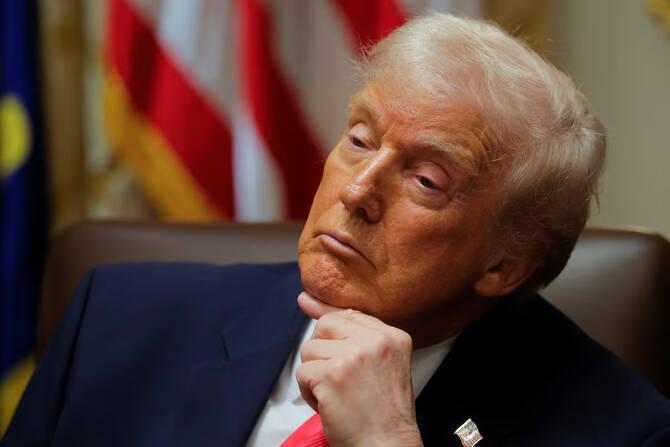
US President Donald Trump continued his threats of land strikes against suspected Venezuelan drug traffickers in an interview published on Tuesday as Trump administration officials prepared to brief top US lawmakers amid mounting tensions. (Reuters/File)
Short Url
Updated 10 December 2025
Follow

Trump eyes anti-drug operations in Mexico, Colombia as Venezuela looms – Politico

  • The Republican president also told Politico that he could extend anti-drug military operations to Mexico and Colombia
  • “They’re weak,” Trump told Politico, referring to Europe’s political leaders

WASHINGTON: US President Donald Trump continued his threats of land strikes against suspected Venezuelan drug traffickers in an interview published on Tuesday as Trump administration officials prepared to brief top US lawmakers amid mounting tensions.

The Republican president also told Politico that he could extend anti-drug military operations to Mexico and Colombia, speaking in a wide-ranging interview that also took aim at Europe, including another call for Ukrainian elections and support for Hungary’s leader.

His comments, in an interview conducted Monday, reiterated much of his world view after releasing a sweeping US strategy roadmap last week seeking to reframe the country’s global role.

That National Security Strategy described a nation focused on reasserting itself in the Western Hemisphere while warning Europe that it must change course or face “erasure.”

“They’re weak,” Trump told Politico, referring to Europe’s political leaders. “They want to be so politically correct.”

“They don’t know what to do,” he added. “Europe doesn’t know what to do.”

In the Americas, Trump repeatedly declined to rule out sending American troops into Venezuela as part of an effort to bring down President Nicolas Maduro, saying he did not want to discuss military strategy: “I don’t want to rule in or out.”

Asked if he would consider using force against targets in other countries where the drug trade is highly active, including Mexico and Colombia, he said: “I would.”

Later on Tuesday, US Defense Secretary Pete Hegseth, Chairman of the Joint Chiefs of Staff General Dan Caine and US Secretary of State Marco Rubio are expected to brief congressional leaders and the heads of Congress’ intelligence panels, sources told Reuters.

The briefing follows a months-long military campaign against alleged drug boats in the Caribbean and Pacific that has come under intense scrutiny following a September 2 decision to launch a second strike on a suspected drug boat in the Caribbean.

“Weak” Europe

A spokesperson for the European Commission, asked about Trump’s comments, defended the bloc’s leaders and said the region remained committed to their union despite challenges such as Russia’s war in Ukraine and Trump’s tariff policies.

“I will refrain from commenting, other than confirming that we are very pleased and grateful to have excellent leaders,” EU Spokesperson Paula Pinho said at a daily briefing for journalists, adding that they were “leading the EU with all the challenges that it is facing, from trade to war in our neighborhood, and who are showing that they can be united.”

In his interview, Trump again said he thought it was time for Ukraine to hold elections as the war nears its four-year mark. Ukraine is expected to share a revised peace plan with the US later on Tuesday, one day after hastily arranged talks with European leaders.

He also said he did not offer a financial lifeline to the government of ally Hungarian Prime Minister Viktor Orban, who met with Trump last month at the White House.

“No, I didn’t promise him, but he certainly asked for it,” he said.


Families mourn those killed in a Congo mine landslide as some survivors prepare to return

Updated 9 sec ago
Follow

Families mourn those killed in a Congo mine landslide as some survivors prepare to return

GOMA, Congo: After a landslide last week killed at least 200 people in eastern Congo at a rebel-controlled coltan mine, families of the deceased and survivors are mourning their lost loved ones, and some survivors prepared to head back to the reopened mines.
On Wednesday, following heavy rains in eastern Congo, a network of hand-dug tunnels at the Rubaya mining complex collapsed, killing at least 200 artisanal miners and trapping an unknown number who remain missing. The mine, located around 25 miles (40 kilometers) to the west of the regional capital of Goma, has been under the control of Rwandan-backed M23 rebels since early 2024 and employs thousands of miners who work largely by hand.
Family members grieve
In the Mugunga neighborhood in Goma, the family of Bosco Nguvumali Kalabosh, 39, mourned his death Monday.
Since last Thursday, relatives, neighbors and loved ones have been gathering at the family home, sitting around a photograph of him placed up against a wall.
“He was supposed to return to Goma on Thursday,” said his older brother, Thimothée Kalabosh Nzanga.
Kalabosh had been a miner for more than 10 years. He owned his own mines on the site and came from a family where artisanal mining — mining for minerals using basic hand tools — had been passed down from generation to generation. He leaves behind a widow and four children, the eldest of whom is 5 years old.
Survivors head back to Rubaya
For survivors trickling back into town, the pressure to return to the mines is clear — despite the constant danger.
Tumaini Munguiko, a survivor of the collapse, came to offer his condolences to Kalabosh’s family. “Seeing our peers die is very painful. But despite the pain, we are forced to return to the mines to survive,” he said.
Munguiko calmly explained that he had already experienced several similar disasters. “It has almost become normal. We accept it because it is our means of survival. I was saved this time, but I lost five friends and my older brother.”
According to him, landslides are common in Rubaya, especially during the rainy season. “When it rains, the clay soils become unstable. Some take shelter, others perish, others survive, and others watch from afar,” he said.
Miners dig long tunnels, often parallel to one another, with limited support and no safe evacuation route in case of a collapse.
A former miner at the site told The Associated Press that there have been repeated landslides because the tunnels are dug by hand, poorly constructed and not maintained.
“People dig everywhere, without control or safety measures. In a single pit, there can be as many as 500 miners, and because the tunnels run parallel, one collapse can affect many pits at once,” former miner Clovis Mafare said.
“The diggers don’t have insurance,” said Mafare. Of potential compensation for families, he said: “It’s a whole legal process, and it’s very long. They might receive some money for the funerals, but that small amount isn’t compensation.”
Kalabosh’s family has not received compensation for their loss.
However, both Munguiko and Nzanga say they will return to the mines soon despite the risks.
“I have no choice. Our whole life is there,” said Munguiko.
Rare earth minerals
The Rubaya mines have been at the center of the recent fighting in eastern Congo, changing hands between the Congolese government and rebel groups. For over a year now, the site has been controlled by the M23 rebels.
The mines produce coltan — short for columbite-tantalite — an ore from which the metals tantalum and niobium are extracted. Both are considered critical raw materials by the United States, the European Union, China and Japan. Tantalum is used in mobile phones, computers and automotive electronics, as well as in aircraft engines, missile components and GPS systems. Niobium is used in pipelines, rockets and jet engines.
The mines at Rubaya are massive and attract people from across the region. Artisanal miners and workers have been flocking there for years, drawn to the site to earn a steady income in a region plagued by poverty and chronic insecurity. A disaster like this affects people across eastern Congo and the grief has spread to regional hubs like Goma.
For the last two weeks, Rubaya has been virtually cut off from the world. The mining town has no mobile network or Internet connection. Poor infrastructure, coupled with persistent conflict, means cellular service and electricity are unreliable. To communicate with the outside world, residents must pay around 5,000 Congolese francs — just over $2 — for 30 minutes of connection via a private Starlink system.
Congo’s government, in a statement on X, expressed solidarity with the victims’ families and accused the rebels of illegally and unsafely exploiting the region’s natural resources while blaming Rwanda. An M23 spokesperson accused the government of politicizing the tragedy and listed other collapses at government-controlled mines.