Colombia’s ELN guerrillas place communities in lockdown citing Trump ‘intervention’ threats

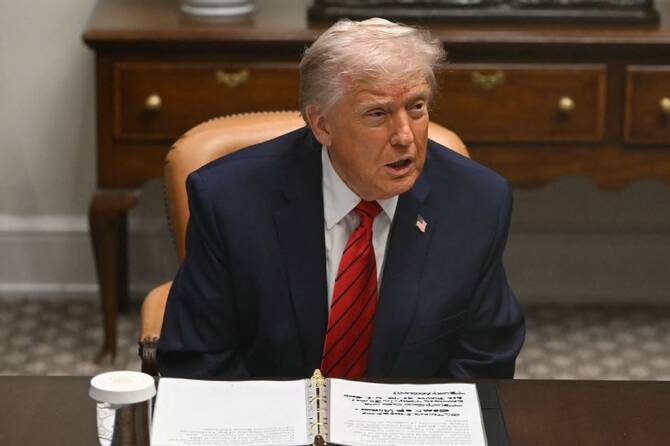
US President Donald Trump speaks during a roundtable discussion in the Roosevelt Room of the White House in Washington, DC, (AFP)
Short Url
Updated 13 December 2025
Follow

Colombia’s ELN guerrillas place communities in lockdown citing Trump ‘intervention’ threats

  • The ELN urged civilians in areas it controls to stay indoors for 72 hours starting at 6:00 am on Sunday, avoiding main roads and rivers

BOGOTA: Colombia’s National Liberation Army (ELN) guerrilla group ordered civilians in areas under its control on Friday to stay home for three days as it carries out military exercises in response to “intervention” threats from US President Donald Trump.
The ELN, the oldest surviving guerrilla group in the Americas, controls key drug-producing regions of Colombia and vowed Friday to fight for the country’s “defense” in the face of Trump’s “threats of imperialist intervention.”
Amid a major US pressure campaign against Venezuela, which many view as an attempt to push out strongman Nicolas Maduro, Trump on Wednesday warned that Colombia’s leftist President Gustavo Petro could “be next” over his country’s mass cocaine production.
“He’s going to have himself some big problems if he doesn’t wise up. Colombia is producing a lot of drugs,” Trump told reporters, when asked if he expected to speak with frequent foe Petro.
“He better wise up, or he’ll be next...I hope he’s listening.”
The ELN urged civilians in areas it controls to stay indoors for 72 hours starting at 6:00 am on Sunday, avoiding main roads and rivers.
“It is necessary for civilians not to mix with fighters to avoid accidents,” the group said in a statement.
Petro criticized the move on social media, saying one “doesn’t protest against anyone by killing peasants and taking away their freedom.”
“You, gentlemen of the ELN, are declaring an armed strike not against Trump, but in favor of the drug traffickers who control you,” he wrote on X.
Colombian Defense Minister Pedro Sanchez dismissed the ELN move as “nothing more than criminal coercion” and vowed the military “will be everywhere — in every mountain, every jungle, every river” to counter its threat.
With a force of about 5,800 combatants, the ELN is present in over a fifth of Colombia’s 1,100-plus municipalities, according to the Insight Crime research center.
The ELN has also taken part in failed peace negotiations with Colombia’s last five governments.
While claiming to be driven by leftist, nationalist ideology, the ELN is deeply rooted in the drug trade and has become one of the region’s most powerful organized crime groups.
It vies for territory and control of lucrative coca plantations and trafficking routes with dissident fighters that refused to lay down arms when the FARC guerrilla army disarmed under a 2016 peace deal.
One ELN stronghold is the Catatumbo region near the Venezuelan border — one of the areas with the most coca crops in the world.
Colombia is the world’s top cocaine producer, according to the UN.

- Souring ties -

Historically strong relations between Bogota and Washington have deeply soured since Trump’s return to office.
Petro, who came to power in 2022 as Colombia’s first-ever leftist president, has openly clashed with Trump calling him “rude and ignorant” and comparing him to Adolf Hitler.
The Colombian leader denounced the Trump administration’s treatment of migrants and what he has termed the “extrajudicial executions” of nearly 90 people in strikes on boats in the Caribbean and Pacific the US claims, without providing evidence, were ferrying drugs.
Petro has also criticized Washington’s military deployment within striking distance of Venezuela, where Maduro fears he is the target of a regime-change plot under the guise of an anti-drug operation.
Washington, in turn, has accused Petro of drug trafficking and imposed sanctions.
Trump removed Bogota from a list of allies in the fight against narco trafficking, but the country has so far escaped harsher punishment.


Rubio to visit eastern Europe, bolster ties with pro-Trump leaders

Updated 2 sec ago
Follow

Rubio to visit eastern Europe, bolster ties with pro-Trump leaders

  • Energy cooperation and NATO commitments will be discussed
  • Trump’s hard-right supporters view ‌Hungary’s Orban as a model
MUNICH: US Secretary of State Marco Rubio is set to begin a two-day trip on Sunday, to bolster ties with Slovakia and Hungary, ​whose conservative leaders, often at odds with other European Union countries, have warm ties with President Donald Trump.
Rubio will use the trip to discuss energy cooperation and bilateral issues, including NATO commitments, the State Department said in an announcement last week.
“These are countries that are very strong with us, very cooperative with the United States, work very closely with us, and it’s a good opportunity to go see them and two countries I’ve never been in,” Rubio told reporters before departing for Europe on Thursday.
Rubio, who in his dual role also serves as Trump’s national security adviser, will meet ‌in Bratislava on ‌Sunday with Slovak Prime Minister Robert Fico, who visited Trump ​in ‌Florida ⁠last month. The ​US ⁠diplomat’s trip follows his participation in the Munich Security Conference over the last few days.

WILL MEET VIKTOR ORBAN ON MONDAY
On Monday, Rubio is expected to meet with Hungarian leader Viktor Orban, who is trailing in most polls ahead of an election in April when he could be voted out of power.
“The President said he’s very supportive of him, and so are we,” Rubio said. “But obviously we were going to do that visit as a bilateral visit.”
Orban, one of Trump’s closest allies in Europe, is considered ⁠by many on the American hard-right as a model for the US ‌president’s tough policies on immigration and support for families and ‌Christian conservatism. Budapest has repeatedly hosted Conservative Political Action Conference ​events, which bring together conservative activists and leaders, ‌with another due in March.

TIES WITH MOSCOW AND CLASHES WITH THE EU
Both Fico and Orban have ‌clashed with EU institutions over probes into backsliding on democratic rules.
They have also maintained ties with Moscow, criticized and at times delayed the imposition of EU sanctions on Russia and opposed sending military aid to Ukraine.
Even as other European Union countries have secured alternative energy supplies after Moscow invaded Ukraine in 2022, including by buying ‌US natural gas, Slovakia and Hungary have also continued to buy Russian gas and oil, a practice the United States has criticized.
Rubio said ⁠this would be discussed ⁠during his brief tour, but did not give any details.
Fico, who has described the European Union as an institution that is in “deep crisis”, has showered Trump with praise saying he would bring peace back to Europe.
But Fico criticized the US capture of Venezuelan President Nicolas Maduro in early January.
Hungary and Slovakia have also so far diverged from Trump on NATO spending.
They have raised defense spending to NATO’s minimum threshold of 2 percent of GDP.
Fico has, however, refused to raise expenditure above that level for now, even though Trump has repeatedly asked all NATO members to increase their military spending to 5 percent. Hungary has also planned for 2 percent defense spending in this year’s budget.
On nuclear cooperation, Slovakia signed an agreement with the United States last month and Fico has said US-based Westinghouse was ​likely to build a new nuclear power ​plant.
He also said after meeting the chief of France’s nuclear engineering company Framatome during the week he would welcome more companies taking part in the project.