

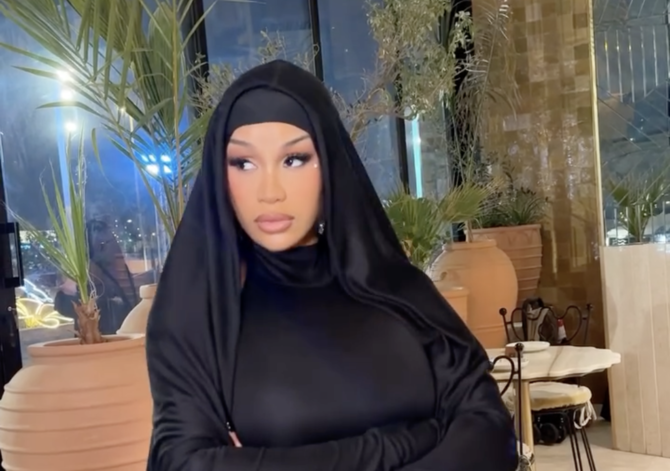
DUBAI: Cardi B was in Saudi Arabia this week, ahead of her performance in Riyadh, and shared glimpses of her time in the Kingdom.
The Grammy-winning rapper announced her arrival on Instagram, writing, “Hello Saudi Arabia … Halal B has arrived,” accompanied by a green heart and the Saudi flag emoji.
In the video she posted, Cardi B wore an all-black, floor-length dress with a high halter neckline, styled with long black gloves and a matching hood draped over her shoulders.
She was later spotted by fans shopping at Solitaire Mall in Riyadh wearing the same outfit, with clips circulating online of her greeting supporters.
She had teased her visit earlier this month on X, telling fans: “Imma shop down in Saudi Arabia aaaaaaahhhhhhhhhhhhhh … I can’t wait!”
Imma shop down in Saudi Arabia aaaaaaahhhhhhhhhhhhhh …I can’t wait !
Cardi B later shared moments from her first night on Instagram Stories, including a dessert bearing the message “Welcome Cardi B” served at a restaurant.
During a live broadcast on Friday, she spoke about her stay, saying: “This country is luxurious … I got my own gym in my own room right here. I am going to work out to be ready for tour.”
She also mentioned going shopping, adding that she picked up a few items at the mall.
Reflecting on her interactions, she said: “The little kids know me (here), everybody knows me, the grown-ups know me. These people out here are very polite … they are very kind. These are one of the nicest people.”
Cardi B will perform today at MDLBeast’s Soundstorm 2025, held from Dec. 11 to 13.
Saudi traditional meal anchors Al-Balad’s culinary scene
Slow-cooked sheep’s head is drawing new generations and visitors to Jeddah’s historic district
Updated 14 December 2025
SALEH FAREED
JEDDAH: In the streets of Al-Balad, where centuries-old buildings frame one of Saudi Arabia’s most storied districts, culinary heritage continues to draw visitors as powerfully as architecture.
Among the area’s enduring attractions is Al-Shadwy for Sheep Head Meat, a family-run restaurant that has served one of the Kingdom’s most traditional dishes since 1958, turning a once-necessity meal into a symbol of Saudi food culture and hospitality.
Tucked into Baba Makkah, Al-Balad’s historic core, Al-Shadwy began as a modest corner table before becoming a landmark destination for locals, food enthusiasts and tourists seeking an authentic taste of the past.
Eating sheep’s head has long been rooted in Arab culinary traditions, shaped by the principle of using the entire animal and avoiding waste. (AN photo)
Now run by the third generation of the Al-Shadwy family, the restaurant remains devoted to a single specialty; sheep’s head, slow-roasted over charcoal using a recipe unchanged for decades.
Eating sheep’s head has long been rooted in Arab culinary traditions, shaped by the principle of using the entire animal and avoiding waste. In Saudi Arabia, the dish evolved into communal meal associated with generosity, warmth and social gathering.
Sixty-five-year-old owner Ghalib Naji Al-Shadwy, who inherited the restaurant from his grandfather and father, remains a familiar presence at the restaurant, overseeing the service and greeting customers.
FASTFACTS
• Al-Shadwy for Sheep Head Meat is a family-run restaurant in Al-Balad that has served one of the Kingdom’s most traditional dishes since 1958.
• It began as a modest corner table before becoming a landmark destination for locals, food enthusiasts and tourists seeking an authentic taste of the past.
He told Arab News that the dish has been central to Saudi culinary culture for generations.
“The sheep’s head has been a staple in Saudi Arabia and other GCC countries culinary culture for centuries,” he said. “Traditionally, it was a meal served during cold winter mornings to provide energy and warmth. In many regions of Saudi Arabia, the sheep head (is) always on the top of the main plate for guests, and families festive holidays gather in restaurants or at home to enjoy the sheep’s head, making it a social and festive occasion.”
In Saudi Arabia, the dish evolved into communal meal associated with generosity, warmth and social gathering. (AN photo)
Speaking about its significance in hospitality culture, he added: “Serving it to guests is considered an act of generosity and care.” Rich and filling, it is most commonly eaten as breakfast or an early morning meal.
Preparing sheep’s head is a slow, careful process. According to Al-Shadwy, the heads are cooked at low temperatures to soften the tendons and connective tissue, resulting in tender meat and deep flavor.
The preparation includes curing and slow cooking, a method that has remained largely unchanged at the restaurant for more than six decades.
Being a family-owned restaurant here for so many years makes us a part of Jeddah’s history.
Ghalib Naji Al-Shadwy, Al-Shadwy for Sheep Head Meat owner
“I’ve cooked many sheep heads a while back and I still enjoy it,” he said. “Most of the customers actually prefer the head and the brain.”
Despite its small size and somewhat tucked-away location, the restaurant’s popularity is unmistakable. Long queues form outside each morning, often guiding first-time visitors to its door. A sign reading “Al-Shadwy Mandi” in Arabic marks the entrance, while the steady crowd confirms its reputation.
Over the years, the restaurant has attracted officials, celebrities and social media figures, with photographs of notable guests lining the walls. Al-Shadwy said the steady attention reflections Al-Balad’s growing appeal as a cultural and culinary destination.
He said that interest in sheep’s head is no longer limited to older generations. Younger Saudis, he said, are increasingly curious about traditional dishes, while tourists often see it as an adventurous experience.
“For many visitors, trying sheep’s head is considered ‘extreme food’ or a challenging dish,” he said. “But it gives them a sense of adventure and a unique story to tell.”
Inside the lively restaurant one morning, longtime customer Abu Samer Al-Sulami, who has been dining there for 40 years, described it as a rare example of authentic Saudi cuisine.
“I am a regular customer here and always come early in the morning because when you eat the sheep’s head it really gives you energy for work,” he said.
Demand is highest in the early hours, particularly on Fridays. Al-Shadwy said the restaurant often sells out by mid-morning, making early visits essential.
“The number of sheep heads our restaurant sells daily varies but it reaches around 200 heads,” he added.
As he works alongside his two sons, Al-Shadwy says preserving the family legacy is as important as serving the fish.
“Being a family-owned restaurant here for so many years makes us a part of Jeddah’s history,” he said.