

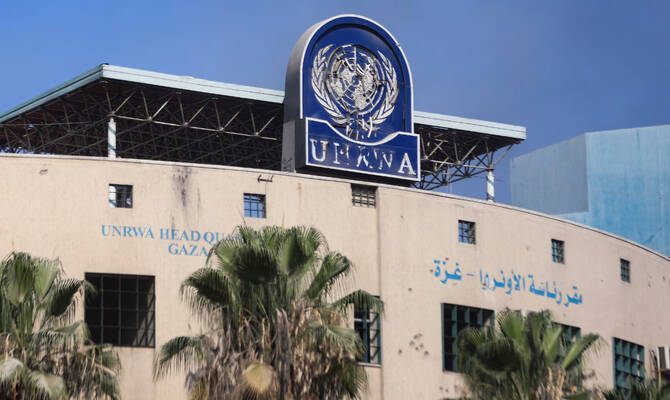

WASHINGTON: Trump administration officials have held advanced discussions on hitting UN Palestinian refugee agency UNRWA with terrorism-related sanctions, said two sources with direct knowledge of the matter, prompting serious legal and humanitarian concerns inside the State Department.
The United Nations agency operates in Gaza, the West Bank, Lebanon, Jordan and Syria, providing aid, schooling, health care, social services and shelter to millions of Palestinians.
Top UN officials and the UN Security Council have described UNRWA as the backbone of the aid response in Gaza, where the two-year war between Israel and Palestinian militant group Hamas unleashed a humanitarian catastrophe.
The Trump administration, however, has accused the agency of links with Hamas, allegations UNRWA has vigorously disputed.
Washington was long UNRWA’s biggest donor, but halted funding in January 2024 after Israel accused about a dozen UNRWA staff of taking part in the deadly Oct. 7, 2023, Hamas attack that triggered the war in Gaza. US Secretary of State Marco Rubio then accused the agency in October this year of becoming “a subsidiary of Hamas,” which the US designated as a terrorist organization in 1997. It was not immediately clear if current US discussions were focused on sanctioning the entire agency — or just specific UNRWA officials or parts of its operation, and US officials do not appear to have settled on the precise type of sanctions they would deploy against UNRWA.
Among the possibilities that State Department officials have discussed include declaring UNRWA a “foreign terrorist organization,” or FTO, the sources said, though it is not clear if that option — which would severely isolate UNRWA financially — is still a serious consideration.
Any blanket move against the entire organization could throw refugee relief efforts into disarray and cripple UNRWA, which is already facing a funding crisis.
‘UNPRECEDENTED AND UNWARRANTED’
Sanctioning UNRWA on terrorism-related grounds would be striking and unusual, as the United States is a member and the host country of the United Nations, which created the United Nations Relief and Works Agency in 1949.
William Deere, director of the UNRWA office in Washington, said the agency would be “disappointed” if US officials were in fact discussing an FTO designation. He said such a move would be “both unprecedented and unwarranted.”
“Since January 2024, four independent entities have investigated UNRWA’s neutrality including the US National Intelligence Council. While occurring at different times and from different perspectives, they have all come to the same conclusion: UNRWA is an indispensable, neutral, humanitarian actor,” Deere said.
In response to a request for comment, a State Department official called UNRWA a “corrupt organization with a proven track record of aiding and abetting terrorists.”
“Everything is on the table,” the official said. “No final decisions have yet been made.”
The White House did not respond to requests for comment. The State Department and other departments have various sanctioning options at their disposal, which generally allow for asset freezes and travel bans targeted at specific individuals and entities. An FTO designation would be among the most severe tools available to Washington and such designations are generally reserved for groups who kill civilians, like branches of Islamic State and Al-Qaeda. Dozens of key US allies provide funding to UNRWA, raising questions about whether foreign officials could face sanctions for aiding an organization if Washington sanctions UNRWA or one of its officials on terrorism-related grounds.
The United Nations has said that nine UNRWA staff may have been involved in the Oct. 7, 2023, Hamas attack and were fired. A Hamas commander in Lebanon — killed in September by Israel — was also found to have had a UNRWA job. The UN has vowed to investigate all accusations made and has repeatedly asked Israel for evidence, which it says has not been provided.
DISCUSSIONS PROVOKE HUMANITARIAN, LEGAL CONCERNS
The sources directly aware of the UNRWA discussions, who requested anonymity to disclose non-public deliberations, privately expressed various humanitarian and legal concerns, given the organization’s singular role in aiding displaced Palestinians. Politically-appointed staff at the State Department who have been installed since the beginning of Trump’s term have generally led the push to hit UNRWA with terrorism-related sanctions, the sources said.
Many career State Department officials — including some lawyers responsible for drafting designations language — have pushed back, those sources added.
In recent weeks, the potential sanctions have been discussed by officials in the State Department’s Bureau of Counterterrorism and members of its Policy Planning Staff, a powerful internal policymaking entity, one of the sources said.
Gregory LoGerfo, the nominee for the department’s top counterterrorism post, has recused himself from the UNRWA discussions while he awaits Senate confirmation, that source added.
Israeli Prime Minister Benjamin Netanyahu has for years called for UNRWA to be dismantled, accusing it of anti-Israeli incitement. Since January 30, Israel has banned UNRWA’s operation on Israeli land — including East Jerusalem, which Israel annexed in a move not recognized internationally — and contact with Israeli authorities. Israel and Hamas signed a US-brokered peace deal in October, but apparent ceasefire violations have been routine, and progress toward fulfilling the broader terms of the peace plan has been halting. More than 370 UNRWA workers have been killed in Gaza during the war, the UN agency has said.


