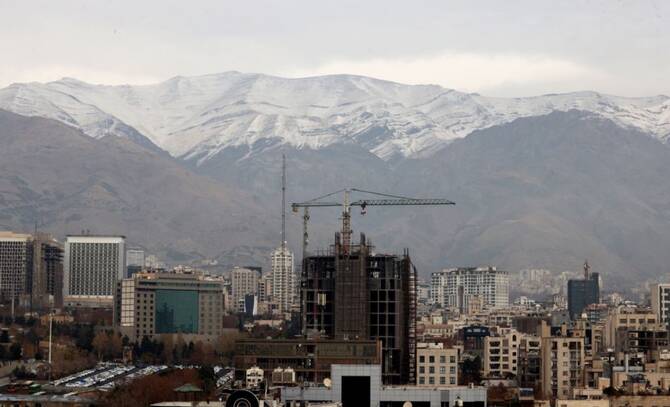
TEHRAN: Rain fell for the first time in months in Iran’s capital Wednesday, providing a brief respite for the parched Islamic Republic as it suffers through the driest autumn in over a half century.
The drought gripping Iran has seen its president warn the country it may need to move its government out of Tehran by the end of December if there’s not significant rainfall to recharge dams around the capital. Meteorologists have described this fall as the driest in over 50 years across the country — from even before its 1979 Islamic Revolution — further straining a system that expends vast amounts of water inefficiently on agriculture.
The water crisis has even become a political issue in the country, particularly as Israeli Prime Minister Benjamin Netanyahu has repeatedly offered his country’s help to Iran, a nation he launched a 12-day war against in June. Water shortages also have sparked localized protests in the past, something Iran has been trying to avoid as its economy struggles under the weight of international sanctions over its nuclear program.
“The water crisis in Iran has, in recent years, escalated from a recurring drought issue into a profound political and security problem that has the regime leadership concerned,” the New York-based Soufan Center said.
Drying reservoirs, light snowpack challenge Iran
The drought has been a long subject of conversation across Tehran and wider Iran, from government officials openly discussing it with visiting journalists to people purchasing water tanks for their homes. In the capital, government-sponsored billboards call on the public not to use garden hoses outside to avoid waste. Water service reportedly goes out for hours in some neighborhoods of Tehran, home to 10 million people.
Snowpack on the surrounding Alborz Mountains remains low as well, particularly after a summer that saw temperatures rise near 50 degrees Celsius (122 degrees Fahrenheit) in some areas of the country, forcing government buildings to shut down.
Ahad Vazifeh, an official in the government’s Iran Meteorological Organization office, called the drought “unprecedented” in an interview with the Fararu news outlet last week. Precipitation now stands at about 5 percent of what’s considered a normal autumn, he added.
“Even if rain in the winter and spring will be normal, we will have 20 percent shortage,” Vazifeh warned.
Social media videos show people standing in some reservoirs, the water lines clearly visible. Satellite pictures analyzed by The Associated Press also show reservoirs noticeably depleted. That includes the Latyan Dam — one of five key reservoirs — which is now under 10 percent full as Tehran has entered its sixth consecutive year of drought.
The state-owned Tehran Times newspaper, often following the theocracy’s line, was blunt about the scale of the challenge.
“Iran is facing an unprecedented water crisis that threatens not only its agricultural sector but also regional stability and global food markets,” the newspaper said in a story this past weekend. The faithful have also offered prayers for rain at the country’s mosques.
Long-arid Iran faces challenge of climate change
Iran, straddling the Mideast and Asia, long has been arid due to its geography. Its Alborz and Zagros mountain ranges cause a so-called “rain shadow” across much of the nation, blocking moisture coming from the Caspian Sea and the Arabian Gulf.
But the drain on the country’s water supplies has been self-inflicted. Agriculture uses an estimated 90 percent of the country’s water supplies. That hasn’t been stopped even through these recent drought years. That’s in part due to policies stemming from Iran’s 1979 Islamic Revolution and then-Supreme Leader Ayatollah Ruhollah Khomeini, who pledged water would be free for all. The intervening years of the Iran-Iraq war saw the country push for self-sufficiency above all else, irrigating arid lands to grow water-intensive crops like wheat and rice, and overdrilling wells.
Experts have described Iran as facing “water bankruptcy” over its decisions. In the past, Iranian officials have blamed their neighbors in part for their water shortage, with hard-line former President Mahmoud Ahmadinejad at one point falsely suggesting that “the enemy destroys the clouds that are headed toward our country and this is a war Iran will win.”
But that’s changed with the severity of the crisis leading to current President Masoud Pezeshkian warning the capital may need to be moved. However, such a decision would cost billions of dollars the country likely doesn’t have as it struggles through a major economic crisis.
Meanwhile, climate change likely has accelerated the droughts plaguing Iraq, which has seen the driest year on record since 1933, as well as Syria and Iran, said World Weather Attribution, a group of international scientists who study global warming’s role in extreme weather.
With the climate warmed by 1.3 degrees Celsius (2.3 degrees Fahrenheit) due to fossil fuel burning, the severity of drought seen in Iran over the last year can be expected to return every 10 years, the group said. If the temperature hadn’t risen by that much, it could be expected between every 50 to 100 years, it added.
“The current acute crisis is part of a longer term water crisis in Iran and the wider region that results from a range of issues including, frequent droughts with increasing evaporation rates, water-intensive agriculture and unsustainable groundwater extraction,” World Weather Attribution said in a recent report.
“These combined pressures contribute to chronic water stress in major urban centers including Tehran, reportedly at risk of severe water shortages and emergency rationing, while also straining agricultural productivity and heightening competition over scarce resources.”

First rain of autumn falls in Iran’s capital, but the drought-ravaged nation needs far more
https://arab.news/9unrn
First rain of autumn falls in Iran’s capital, but the drought-ravaged nation needs far more
- Water service reportedly goes out for hours in some neighborhoods of Tehran, home to 10 million people
Lifting sanctions on Syria will prevent Daesh resurgence and strengthen the nation, experts say
- Conference in Washington discusses effects US policies are having on post-Assad Syria, and the continuing economic hardships in the country that could fuel terrorism
- Participants praise US President Donald Trump for taking the right steps to help the war-torn nation move towards recovery and stabilization
Syria faces serious challenges in the aftermath of the fall of the Assad regime a year ago, including rebuilding its economy, lifting refugees and civilians out of poverty, and preventing a resurgence of Daesh terrorism.
But experts in two panel discussions during a conference at the Middle East Institute in Washington, D.C., on Wednesday, attended by Arab News, agreed that US President Donald Trump had so far taken all the right steps to help the war-torn nation move toward recovery and stabilization.
One of the discussions explored the effects American policies are having on the rebuilding of Syria, including the lifting of sanctions and efforts to attract outside investments and stabilize the economy. Moderated by the institute’s vice president for policy, Kenneth Pollack, the participants included retired ambassadors Robert Ford and Barbara Leaf, and Charles Lister, a resident fellow at the institute.
The other discussion focused on the continuing economic hardships in Syria that could fuel terrorism, including a resurgence of Daesh. Moderator Elizabeth Hagedorn, of Washington-based Middle East news website Al-Monitor, was joined by Mohammed Alaa Ghanem of the Syrian American Council, Celine Kasem of Syria Now, and Jay Salkini from the US-Syria Business Council.
“As we went into a transitional era, US diplomacy took a back step for a while as the Trump administration came into office,” Lister noted during the first panel discussion.
Everyone has been “super skeptical” of where the new government led by President Ahmad Al-Sharaa, a former commander with the Syrian opposition forces, would lead the country, he said, but Trump had stepped up through policies and support.
“Frankly, I think in January none of us expected that President Donald Trump would be shaking hands with Ahmad Al-Sharaa” a few months later, he added.
“Despite the obvious challenges, this new (Syrian) government has to be engaged.”
The US had maintained strong ties to the Syrian Democratic Forces, and with Al-Sharaa’s Hayat Tahrir Al-Sham, Lister said, in the decade leading up to the collapse of Syrian President Bashar Assad’s regime on Dec. 8, 2024.
“Of course, we’ve had 10 years of a superb partnership with the Syrian Democratic Forces, but they were a non-state actor not a sovereign government,” he continued.
“Now, we have a sovereign government that we could test, we can engage, and we can see where that goes. And in working through a sovereign government, there is no comparison that comes anywhere close to what we’ve seen on Syria.”
Lister praised Trump, saying: “I think a lot of that goes down to President Trump’s own kind of gut instinct of the way to do things.
“But there is a deeper, deeper government bench that has worked on this through Treasury and State and elsewhere. I think they all deserve credit for moving so rapidly and so boldly to give Syria a chance, as President Trump says.”
Ford said a key aspect of the process as Syria moves forward will be the removal of all sanctions imposed by the US against the Assad regime under the 2019 Caesar Act, an effort that is now underway in Congress.
He said Trump recognizes that the future of Syria and the wider Middle East lies in the hands of the Arab people, and has pursued policies based on “shared interests” including a “national security
strategy” to help the war-torn country shift away from extremism and violence toward a productive economy and safer environment for its people.
The Trump administration recognizes this reality, Ford added, and will “work on a practical level towards shared interests.”
However, he cautioned that “Syria is not out of the woods, by any stretch of the imagination” in terms of ensuring there is no resurgence of violence driven by desperate people burdened by the harsh economic realities in the country.
“If they can work with the Syrian government, and with more and more important regional actors as the United States retrenches — like Israel, Turkiye, Saudi Arabia, the United Arab Emirates, Qatar and Egypt; it’s a long list — it will become more important,” Ford said.
“There is still a way for the Americans to work with all of them, even if we don’t have big boots on the ground, or if we’re not providing billions of dollars.”
Nonetheless, “America’s voice will still be heard,” he added, thanks to the interest Trump is taking in Syria.
Adopted by Congress six years ago, toward the end of Trump’s first term as president, the Caesar Act imposed wide-ranging sanctions on Syria, including measures that targeted Assad and his family in an attempt to ensure his regime would be held accountable for war crimes committed under its reign. The act was named after a photographer who leaked images of torture taking place in Assad’s prisons.
Lister noted that the removal of the US sanctions has been progressing at “record-breaking speeds.”
In pre-taped opening remarks to the conference, which took place at the institute’s offices in Washington, Adm. Brad Cooper, commander of the US Central Command, said the Trump administration’s priority in Syria is the “aggressive and relentless pursuit” of Daesh, while working on the integration of the Syrian Democratic Forces with the new Syrian government through American military coordination.
“Just to give an example, in the month of October, US forces advised, assisted and enabled Syrian partners during more than 20 operations against (Daesh), diminishing the terrorists’ attacks and export of violence around the world,” he said. “We’re also degrading their ability to regenerate.”
Cooper added that the issue of displacement camps in northeastern Syria must also be addressed. He said he has visited Al-Hawl camp four times since his first meeting with Al-Sharaa, “which reinforced my view of the need to accelerate repatriations.”
He continued: “The impact on displaced persons devastated by years of war and repression has been immense. As I mentioned in a late-September speech at the UN, continuing to repatriate displaced persons and detainees in Syria is both a humanitarian imperative and a strategic necessity.”
The US is working with Syrian forces to “supercharge” this effort, Cooper said, noting that the populations of Al-Hawl and Al-Roj camps have fallen from 70,000 to about 26,000.
The second panel discussion painted a very bleak picture of the economic challenges the Syrian people face, with the average income only $200-$300 a month, a level that the experts warned could push desperate people to violence just to survive.
The US-Syria Business Council’s Salkini said many major companies and factories that once operated in Syria had relocated to neighboring countries such as Lebanon, Iraq and Turkiye.
“We’re looking at about 50 percent-plus unemployment,” he said. “Let me give you statistics on the wages: A factory worker today, his salary is $100-$300 a month. A farmer makes $75-$200 a month in salary. A manager (or) a private in the military makes $250 a month.
“So you can imagine how these people are living on these low wages, and still have to buy their iPhone, their internet, pay for electricity.”
Many displaced people are unable to return to their former homes, the panelists said, because they were destroyed during the war and there is no accessible construction industry to rebuild them.
The capital, Damascus, faces many challenges they added, and the situation is even worse in the country.


