

US judge orders lifting of Trump-backed limits on pro-Palestinian Tufts student

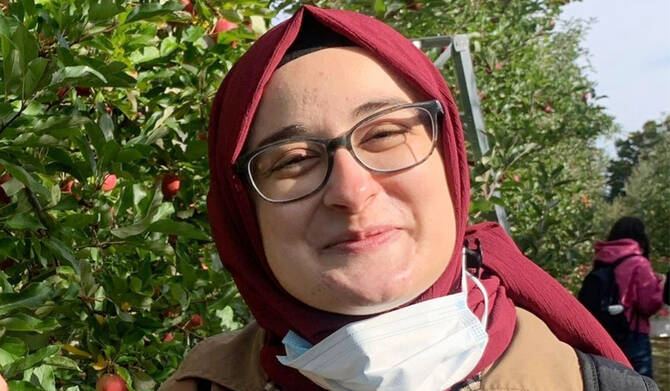
Rumeysa Ozturk in a statement said she was grateful for the ruling and that she hopes “that no one else experiences the injustices I have suffered.” (AP file photo)
Short Url
Updated 09 December 2025
Follow

US judge orders lifting of Trump-backed limits on pro-Palestinian Tufts student

  • Ozturk’s arrest on a street in the Boston suburb of Somerville, Massachusetts, was captured in a viral video that shocked many and drew criticism from civil rights groups

BOSTON: A federal judge on Monday cleared the way for a Tufts University PhD student and pro-Palestinian activist Rumeysa Ozturk to work on campus after ordering the Trump administration to restore her status in a key database used to track foreign students.
Chief US District Judge Denise Casper in Boston issued an injunction after concluding Ozturk was likely to succeed in proving US Immigration and Customs Enforcement unlawfully terminated her record in the database the same day that masked, plainclothes agents took her into custody in March.
That ICE-maintained database is called the Student and Exchange Visitor Information System and is used to track foreign students who enter on visas. The termination of a student’s record from that database prevents that person from being employed.
Ozturk in a statement said she was grateful for the ruling and that she hopes “that no one else experiences the injustices I have suffered.”
The US Department of Homeland Security, which oversees ICE, did not immediately respond to a request for comment.
Ozturk’s arrest on a street in the Boston suburb of Somerville, Massachusetts, was captured in a viral video that shocked many and drew criticism from civil rights groups.
She was detained after the US Department of State revoked her student visa as the Trump administration moved to crack down on non-citizens who engaged in pro-Palestinian activism on campuses.
The sole basis authorities provided for revoking her visa was an editorial she co-authored in Tufts’ student newspaper a year earlier criticizing her school’s response to Israel’s war in Gaza.
The former Fulbright scholar was held for 45 days in a detention facility in Louisiana until a federal judge in Vermont, where she had briefly been held, ordered her immediately released after finding she raised a substantial claim that her detention constituted unlawful retaliation in violation of her free speech rights under the US Constitution’s First Amendment.
Following her release, Ozturk, a child development researcher, resumed her studies at Massachusetts-based Tufts.
But the administration’s refusal to restore her SEVIS record has prevented her from teaching or working as a research assistant, leading her lawyers to ask Casper to order its reinstatement so her academic and career development would not be further jeopardized in the final months before she graduates.
Casper, who was appointed by Democratic President Barack Obama, said the administration had provided “shifting justifications” for terminating Ozturk’s SEVIS record, at times wrongly claiming she had failed to maintain her lawful, foreign student status.
To the extent it now acknowledges she complied with rules governing foreign students like herself, “it is all the more irrational that the government has imposed negative consequences on her that are inconsistent with that status,” Casper wrote. 


More than 200 political prisoners in Venezuela launch hunger strike

Updated 3 sec ago
Follow

More than 200 political prisoners in Venezuela launch hunger strike

GUATIRE: More than 200 Venezuelan political prisoners were on hunger strike Sunday to demand their release under a new amnesty law that excludes many of them.
The inmates at the Rodeo I prison, about 40 kilometers (25 miles) east of capital Caracas, shouted to their loved ones as part of the protest, an AFP journalist witnessed.
“Freedom!,” “release us all!” and “Rodeo I on strike” were among the cries from the prisoners that were audible from outside the facility.
The amnesty law was approved by Venezuela’s congress on Thursday as part of a wave of reforms encouraged by the United States after it ousted and captured former president Nicolas Maduro on January 3.
The hunger strike, which began Friday night, came about after inmates complained they would not benefit from the law because it excludes cases involving the military, which are the most common ones at that facility.
“Approximately 214 people in total, including Venezuelans and foreigners, are on hunger strike,” said Yalitza Garcia, mother-in-law of a prisoner named Nahuel Agustin Gallo.
Gallo, an Argentine police officer, is accused of terrorism, another category that is excluded.
“They decided Friday to go on hunger strike because of the scope of the amnesty law, which excludes many of them,” said Shakira Ibarreto, the daughter of a policeman arrested in 2024.
On Sunday, a team from the International Committee of the Red Cross (ICRC) visited the Rodeo I prison.
“This is the first time they have allowed us to approach that prison,” Filippo Gatti, the ICRC’s health coordinator for Venezuela, told family members. “It’s a first step, and I think we’re on the right track.”
Not all the inmates at the prison were joining the hunger strike, the relatives said.

- Amnesty law criticized -

The amnesty law was engineered by interim leader Delcy Rodriguez under pressure from Washington after US commandos attacked Venezuela on January 3, snatched Maduro and his wife and took them to the United States for trial on drug trafficking charges.
Opposition figures have criticized the new legislation, which appears to include carve-outs for some offenses previously used by authorities to target Maduro’s political opponents.
The law also excludes members of the security forces convicted of activities related to what the government considered terrorism.
But the amnesty extends to 11,000 political prisoners who, over nearly three decades, were paroled or placed under house arrest.
More than 1,500 political prisoners in Venezuela have already applied for amnesty under the bill, the head of the country’s legislature said Saturday.
Hundreds of others had already been released by Rodriguez’s government before the amnesty bill was approved.
On Sunday, a handful of inmates were released from Rodeo I, carrying release papers in their hands. They were greeted with applause.
“I’m out, I love you so much, my queen! I’m doing well,” Robin Colina, one of the freed prisoners, said excitedly into a mobile phone.
Armando Fusil, another released prisoner, told AFP: “Right now there are quite a few people on hunger strike because they want to get out.”
The 55-year-old police commissioner from the western state of Maracaibo said he was “arrested for no reason” in October 2024.
He said loved ones came to visit him every Friday since his arrest, taking a nearly 40-hour trip just for a little bit of face time each week.
Now, they’re coming to pick him up for good.
“We all help each other,” Fusil said about his fellow detainees. “It’s created a beautiful brotherhood.”
The NGO Foro Penal, dedicated to the defense of political prisoners, reported 23 releases on Sunday.
Maduro ruled Venezuela between March 2013 and January 2026, silencing opposition and activists under his harsh leftist rule.
Maduro and his wife are in US custody awaiting trial. Maduro, 63, has pleaded not guilty to drug trafficking charges and declared that he is a prisoner of war.