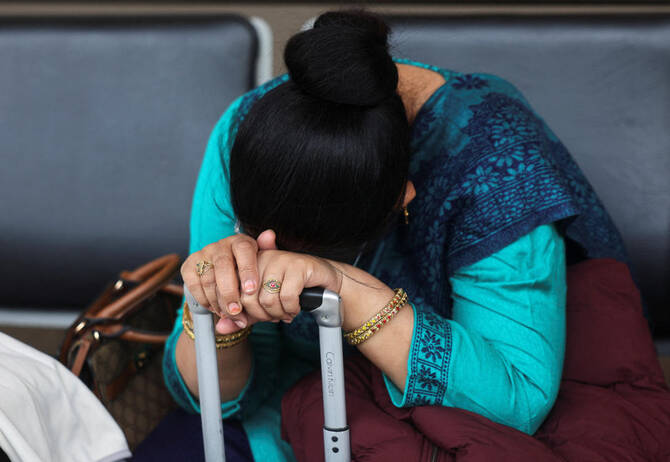
NEW DELHI/BENGALURU: India’s IndiGo is battling growing passenger fury over delays in finding and delivering thousands of stranded bags, with social media flooded with photos of luggage piling up at airports after last week’s large-scale flight disruptions. IndiGo, which has 65 percent of the domestic market, has apologized after canceling more than 2,000 flights as it failed to plan in time for stricter rules governing pilot rest, leading to crew shortages. The delays jolted tens of thousands of people, hitting travel, holiday and wedding plans in one of the worst disruptions in Indian aviation history. But last-minute cancelations and the multiple connecting flights used to reroute passengers, has also left thousands of suitcases and bags misplaced, some containing valuable items such as passports, house keys and medicines.
Passengers furious as bags lost, wedding clothes missing
Social media posts showed security-tagged bags piled up in terminal areas in New Delhi, Mumbai and Bengaluru airports with many furious passengers seeking help from IndiGo’s social media team on X. “Delhi Left Holding The Bag,” read the headline of a Times of India newspaper photo that went viral showing hundreds of bags in an area typically meant for passengers to sit.
The Indian government in a statement late on Sunday said it had ordered IndiGo to “trace and deliver all baggage separated from passengers due to disruptions within 48 hours.” By Saturday, the airline had delivered 3,000 pieces of baggage to passengers across India, the government said.
No response on help lines, passenger says
Vikash Bajpai, 47, said he had been waiting for four days for the luggage he and his 72-year-old mother checked in for their flight home to Pune from Kanpur city where they had attended a wedding.
They only reached home after spending a night in a New Delhi hotel, taking a series of connections to Mumbai, and then a taxi to Pune.
There was no sign of their bags when they landed in Mumbai. “I was given a number to call, but nobody answers the phone. The luggage has expensive wedding clothes and shoes, and my mother’s medication,” Bajpai said, estimating the contents were worth 90,000 rupees ($1,000).
“I am extremely upset.”
A senior IndiGo executive said on condition of anonymity the airline was working “round the clock” to clear the bags and ensure they reached their customers.
Deepak Chetry said he finally got his bags from IndiGo on Saturday, but only after waiting an entire night outside the Bengaluru airport. “All we got was a bottle of water and juice,” Chetry said.

Where’s my bag? India’s IndiGo battles passenger fury over luggage lost in chaos
https://arab.news/g8jdq
Where’s my bag? India’s IndiGo battles passenger fury over luggage lost in chaos
- Customers complain they are not able to find their luggage
- Government orders IndiGo to deliver luggage promptly
Tarique Rahman takes oath as Bangladesh’s PM after landslide election win
- 49 members of new cabinet, including ministers and state ministers, have also been sworn in
- Experts say restoring law and order will be the new government’s main immediate task
DHAKA: Bangladesh Nationalist Party Chairman Tarique Rahman took the oath as prime minister on Tuesday, days after his party secured more than a two-thirds majority in the first vote since a student-led uprising expelled former Premier Sheikh Hasina.
The son of former Prime Minister Khaleda Zia and former President Ziaur Rahman — the BNP’s founder — Rahman returned to Bangladesh in late December after nearly two decades of self-imposed exile.
He led his party to a landslide victory last week, winning an absolute majority with 209 seats in the 300-seat parliament, followed by the Jamaat-e-Islami party, which won 68 seats.
The swearing-in ceremony was held publicly for the first time, under the open sky at the south plaza of the national parliament building.
Rahman’s administration takes over from an interim government led by Nobel laureate Muhammad Yunus who during the 18 months after Hasina’s ouster in August 2024, prepared the country for reform and the next election.
One of the most immediate tasks expected of the new leadership of the country of 170 million is the restoration of law and order — an area in which the caretaker cabinet faced widespread criticism.
A crisis that swept through the police force, which was implicated in the deadly crackdown on the July to August 2024 protests, has left law enforcement significantly weakened and some of its tasks were taken over by the military.
“The law-and-order situation during the interim’s period became very volatile ... The government will have to immediately step in to stop mobocracy,” said Dr. Zahed Ur Rahman, a Dhaka-based political commentator.
“The government must think about withdrawing the military from the streets because they’ve been there for one and a half years, and the military chief repeatedly said that it is having some impact on their professionalism. The regular police should take charge fully.”
In the long-term, the new government will have to focus on reviving the economy.
Under the interim administration the country has recorded little foreign or domestic investment — a situation expected as an elected government will mean more stability to potential investors, Rahman said, warning that the process will also require better energy security.
“We do not have good energy security. Supplying energy at a cheap or affordable price will be tough because this sector suffered rampant corruption during Sheikh Hasina’s regime.
“When investment increases, energy consumption or demand increases. So, it will be a severe problem to manage the power supply,” he told Arab News.
As the BNP leader took the oath of office, he appointed 24 ministers and 25 state ministers, with former commerce minister Amir Khasru Mahmud Chowdhury taking the finance and planning portfolio, former attorney general Md. Asaduzzaman as law minister, and former state minister of power, Ikbal Hasan Mahmud Tuku, at the helm of the Ministry of Power, Energy and Mineral Resources.
The appointment of the foreign minister is still pending.
The new government’s foreign policy will have to address the influence of key players — the US, China, and India, a neighbor that was Bangladesh’s main partner during the 15-year rule of Hasina’s Awami League and with whom Dhaka has been at loggerheads since the former leader fled to New Delhi following her ouster.
Since 2024, India has suspended key transshipment access that allowed Bangladeshi exports to go via Indian ports and airports. It also put on hold most normal visa services for Bangladeshis, who were among its largest groups of medical tourists.
Bangladesh needs to revive the relationship as the “next priority” after restoring law and order, according to Mohiuddin Ahmad, a political historiographer.
“The revival of a good relationship with India will increase people-to-people contact, bilateral trade and commerce, and so on,” he said.
“The next priority should be the normalization of the relationship with India. We need such a relationship with India, which will promote all the elements of a good neighborhood.”


