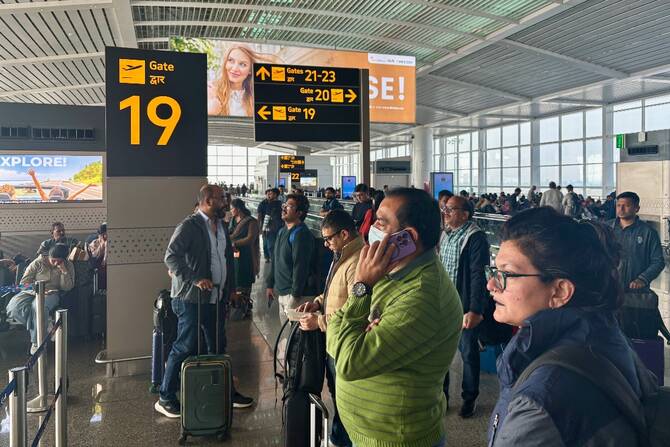
NEW DELHI: Chaos gripped major Indian airports Friday as passengers of the country’s biggest airline, IndiGo, scrambled to cope up with widespread flight disruptions and cancelations triggered by newly enforced rules limiting working hours for crew and pilots.
Scenes of frustration played out as passengers slept on airport floors, queued for hours at customer service counters and waited without clear communication from the airline.
Friday was the fourth straight day of disruptions as the low cost carrier struggles with new regulations that mandate longer rest periods and limit night flying hours to address concerns about fatigue and safety.
The first phase of the rules came into effect in July while the second phase kicked in November. IndiGo struggled to adapt its rosters in time, resulting in widespread cancelations and disruptions.
On Thursday, more than 300 IndiGo flights were grounded while several hundreds delayed. A passenger advisory from the Delhi airport Friday stated that all domestic IndiGo flights will remain canceled until midnight. Other major airlines, including Air India, have not faced similar issues so far.
IndiGo operates around 2,300 flights daily and controls nearly 65 percent of India’s domestic aviation market.
Senior citizen Sajal Bose was scheduled to travel with his wife Senjuti Bose early Friday from Kolkata to New Delhi to attend a friend’s silver jubilee celebration. His flight was canceled an hour before the scheduled take off.
Bose told The Associated Press he was now taking a nine-hour train ride to the city Bagdogra, where he plans to get a flight to New Delhi on another airline. “Its very irresponsible and complete negligence. Very difficult for older people like us,” he said.
In an internal email to employees this week, seen by The Associated Press, IndiGo CEO Pieter Elbers apologized, and cited technology glitches, schedule changes, adverse weather conditions, heightened congestion and the implementation of the new rules as the reasons for flight disruptions.
The Civil Aviation Ministry said in a statement that the disruptions arose primarily through misjudgment and planning gaps as the airline implemented phase two of the new rules, and that the airline acknowledged that the effect on crew strength exceeded their expectations.
IndiGo has sought temporary exemptions in implementing the new rules and told the government that corrective measures were underway. It has indicated the operations will be fully restored by Feb. 10.
More cancelations are expected in the next couple of weeks, and the airline said it would reduce its flight operations from Dec. 8 to minimize disruptions.

Chaos erupts at Indian airports as country’s largest airline cancels flights
https://arab.news/m9csw
Chaos erupts at Indian airports as country’s largest airline cancels flights
- The Civil Aviation Ministry said in a statement that the disruptions arose primarily through misjudgment and planning gaps as the airline implemented phase two of the new rules
Italy to open Europe’s first marine sanctuary for dolphins
- The site will be ready by the end of this month and the first dolphins are expected to arrive “no later than May or June 2026”
ROME: The Mediterranean’s first sanctuary for dolphins that have lived in captivity will open off Italy next year, as demand for re-homing rises with the closure of marine parks across Europe.
“We must develop a new model for managing dolphins in a natural but supervised environment,” Carmelo Fanizza, head of the San Paolo Dolphin Refuge, told AFP.
Located off the coast of Taranto in the southern Italian region of Puglia, the sanctuary still needs a final green light from the government.
But the site will be ready by the end of this month and the first dolphins are expected to arrive “no later than May or June 2026,” Fanizza said.
Animal rights concerns have driven countries such as Canada and France to ban the capture of dolphins, porpoises and whales, while growing numbers of marine parks are shutting.
That has created a burning question: what to do with the cetaceans, which can live for decades and have mostly only known life in captivity, so cannot be released into the wild?
The San Paolo Dolphin Refuge got permission from the Italian government in 2023 to use a seven-hectare (2.5-acre) area in the Gulf of Taranto, near the island of San Paolo.
The spot is “sheltered and protected from the sea, winds and prevailing ocean currents,” said Fanizza, brushing off concerns the site was near the industrial coastal city of Taranto.
The city is home to one of Europe’s largest steelworks, which has been embroiled in a pollution scandal, but is currently operating at reduced capacity.
“Improvements have been made to the facilities, so that the quality of the breathable air, the water column and the sediments in the area currently pose no risk to animal health,” Fanizza said.
- Sanctuary -
Located around four kilometers (nearly 2.5 miles) off the coast, the facility has a main 1,600-square-meter (17,200-square-foot) enclosure, a smaller one for potential transfers and a veterinary one for quarantine cases.
It has a floating laboratory, accommodation so staff can be on site overnight, and a food preparation area.
It is also equipped with a video surveillance system — both above and under water — as well as a series of sensors at sea, which transmit data to a control room in Taranto.
The sanctuary’s construction has been largely paid for by Jonian Dolphin Conservation — the research organization behind the initiative — with support from private donors and European public funds.
The site’s operating costs are estimated at between 350,000 and 500,000 euros ($408,000 and $584,000) per year.
It could legally accommodate up to 17 dolphins, but “the number will absolutely not be that,” said Fanizza, who stressed the importance of their well-being.
“Our goal at this stage is not to take in a large number of animals but to identify a group that, given its medical condition, behavior and social structure, could be ideal for initiating such a project,” he said.
Muriel Arnal, head of French animal rights group One Voice, which has long campaigned for marine sanctuaries, told AFP that Europe currently has around 60 dolphins in captivity.
“Once you have a model that works well, you can replicate it,” she said, adding that she hoped San Paolo would give a home to French dolphins too.


