Changes to US security strategy ‘largely consistent’ with Russia’s vision: Kremlin

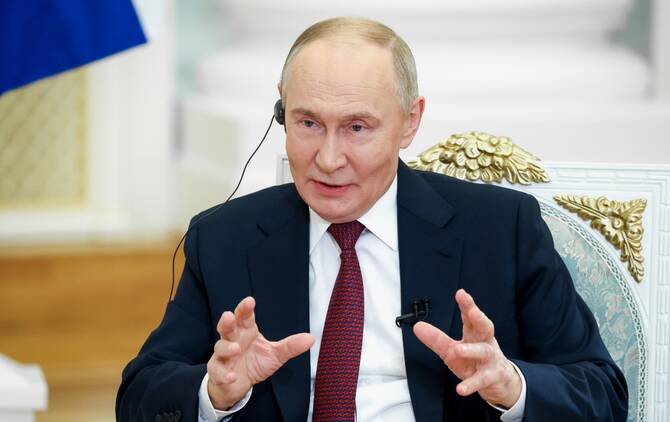
Russian President Vladimir Putin gestures during an interview with journalists at the Kremlin in Moscow, Russia. (AP)
Short Url
Updated 07 December 2025
Follow

Changes to US security strategy ‘largely consistent’ with Russia’s vision: Kremlin

  • Kremlin’s spokesman Dmitry Peskov said that the current US administration was “fundamentally different from the previous ones”

MOSCOW: Russia has welcomed changes in the US National Security Strategy, saying the adjustments that marked a radical departure from Washington’s previous policy were “largely consistent” with Moscow’s vision.
Washington’s new National Security Strategy, published early Friday, took aim at allies in Europe, calling it over-regulated, lacking in “self-confidence” and facing “civilizational erasure” due to immigration.
The document stated that the United States would also prevent other powers from dominating but added: “This does not mean wasting blood and treasure to curtail the influence of all the world’s great and middle powers.”
Commenting on the new US strategy, the Kremlin’s spokesman Dmitry Peskov said that the current US administration was “fundamentally different from the previous ones.”
“The adjustments we’re seeing, I would say, are largely consistent with our vision,” Peskov said in an interview with state TV station Rossiya aired Sunday.
“President Trump is currently strong in terms of domestic political positions. And this gives him the opportunity to adjust the concept to suit his vision,” Peskov added.
The publication of the updated security strategy came as officials from Kyiv held talks in Florida with Trump’s envoys on the US-drafted plan to end the near four-year war in Ukraine.
Three days of talks produced no apparent breakthrough.
President Volodymyr Zelensky committed to further negotiations toward “real peace,” as Russia in the early hours of Saturday launched another series of drone and missile strikes at Ukraine.
Zelensky is due to meet with European leaders — French President Emmanuel Macron, British Prime Minister Keir Starmer and German Chancellor Friedrich Merz — in London on Monday to take stock of the negotiations.


Bangladesh begins exhuming mass grave from 2024 uprising

Updated 07 December 2025
Follow

Bangladesh begins exhuming mass grave from 2024 uprising

  • The United Nations says up to 1,400 people were killed in crackdowns as Hasina attempted to cling to power — deaths that formed part of her conviction last month for crimes against humanity

DHAKA: Bangladeshi police began exhuming on Sunday a mass grave believed to contain around 114 unidentified victims of a mass uprising that toppled autocratic former prime minister Sheikh Hasina last year.
The UN-supported effort is being advised by Argentine forensic anthropologist Luis Fondebrider, who has led recovery and identification missions at mass graves worldwide for decades.
The bodies were buried at the Rayerbazar Graveyard in Dhaka by the volunteer group Anjuman Mufidul Islam, which said it handled 80 unclaimed bodies in July and another 34 in August 2024 — all people reported to have been killed during weeks of deadly protests.
The United Nations says up to 1,400 people were killed in crackdowns as Hasina attempted to cling to power — deaths that formed part of her conviction last month for crimes against humanity.
Criminal Investigation Department (CID) chief Md Sibgat Ullah said investigators believed the mass grave held roughly 114 bodies, but the exact number would only be known once exhumations were complete.
“We can only confirm once we dig the graves and exhume the bodies,” Ullah told reporters.

- ‘Searched for him’ -

Among those hoping for answers is Mohammed Nabil, who is searching for the remains of his brother Sohel Rana, 28, who vanished in July 2024.
“We searched for him everywhere,” Nabil told AFP.
He said his family first suspected Rana’s death after seeing a Facebook video, then recognized his clothing — a blue T-shirt and black trousers — in a photograph taken by burial volunteers.
Exhumed bodies will be given post-mortem examinations and DNA testing. The process is expected to take several weeks to complete.
“It’s been more than a year, so it won’t be possible to extract DNA from the soft tissues,” senior police officer Abu Taleb told AFP. “Working with bones would be more time-consuming.”
Forensic experts from four Dhaka medical colleges are part of the team, with Fondebrider brought in to offer support as part of an agreement with the UN rights body the OHCHR.
“The process is complex and unique,” Fondebrider told reporters. “We will guarantee that international standards will be followed.”
Fondebrider previously headed the Argentine Forensic Anthropology Team, founded in 1984 to investigate the tens of thousands who disappeared during Argentina’s former military dictatorship.
Authorities say the exhumed bodies will be reburied in accordance with religious rites and their families’ wishes.
Hasina, convicted in absentia last month and sentenced to death, remains in self-imposed exile in India.