
COTONOU, Benin: Benin President Patrice Talon on Sunday condemned an attempted coup that was foiled by the country’s army in his first public comments since sporadic gunfire was heard in parts of the administrative capital, Cotonou.
A group of soldiers appeared on Benin ‘s state TV earlier Sunday to announce the dissolution of the government in an apparent coup, which would have been the latest of many in West Africa. The group called itself the Military Committee for Refoundation.
Later, Interior Minister Alassane Seidou announced in a video on Facebook that the attempted coup had been “foiled,” but Talon, whose location was unclear, did not comment.
“I would also like to take this opportunity to express my condolences to the victims of this senseless adventure, as well as to those still being held by the fleeing mutineers,” the president said in a televised address to the nation that ended his silence. “I assure them that we will do everything in our power to find them safe and sound.”
The coup attempt is the latest in a string of military takeovers and attempted takeovers that have rocked West Africa. Last month, a military coup in Guinea-Bissau removed former President Umaro Embalo after a contested election in which both he and the opposition candidate declared themselves winners.

Benin President Patrice Talon addresses the nation on state broadcaster after coup attempt, in Cotonou, Benin, on December 7, 2025. (Benin TV/Reuters TV via REUTERS)
Talon did not provide figures on casualties or hostages in Sunday’s attempted coup.
“In the early morning of Sunday, Dec. 7, 2025, a small group of soldiers launched a mutiny to destabilize the state and its institutions,” Seidou said. “Faced with this situation, the Beninese Armed Forces and their leadership, true to their oath, remained committed to the republic.”
The regional bloc, the Economic Community of West African States, or ECOWAS, said it ordered the deployment of troops from Nigeria, Sierra Leone, Ivory Coast and Ghana to support Benin’s army to “preserve constitutional order and the territorial integrity of the Republic of Benin.”
ECOWAS earlier called the attempted coup “a subversion of the will of the people of Benin.”
Nigeria’s President Bola Tinubu praised the Nigerian armed forces for their involvement in restoring the government in Benin. In a statement by the Nigerian government’s spokesperson, Bayo Onanuga said Benin’s government made two separate requests for air and ground forces.
“It took some hours before the government’s loyal forces, assisted by Nigeria, took control and flushed out the coup plotters from the National TV,” Onanuga said in the statement.
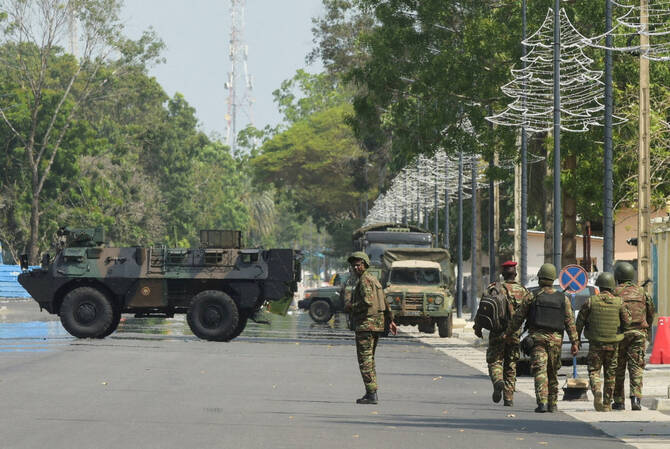
Local media reported the arrest of 13 soldiers who took part in the coup earlier on Sunday, citing sources close to the presidency. It remained unclear if Lt. Col. Pascal Tigri, the coup leader, had been apprehended. Gunfire was heard and soldiers were seen patrolling in some locations in Cotonou, but the city has been relatively calm since the coup attempt was announced.

Illustration courtesy of Gemini
The Military Committee for Refoundation earlier said that Tigri was appointed president of the military committee.
Following its independence from France in 1960, the West African nation witnessed multiple coups. Since 1991, the country has been politically stable following the two-decade rule of Marxist-Leninist Mathieu Kérékou.
The signal to the state television and public radio, which was cut off, was later restored.
Talon has been in power since 2016 and is due to step down next April after a presidential election.
Talon’s party pick, former Finance Minister Romuald Wadagni, is the favorite to win the election. Opposition candidate Renaud Agbodjo was rejected by the electoral commission on the grounds that he did not have sufficient sponsors.
In January, two associates of Talon were sentenced to 20 years in prison for an alleged 2024 coup plot.
Last month, the country’s legislature extended the presidential term of office from five to seven years, keeping the term limit at two.