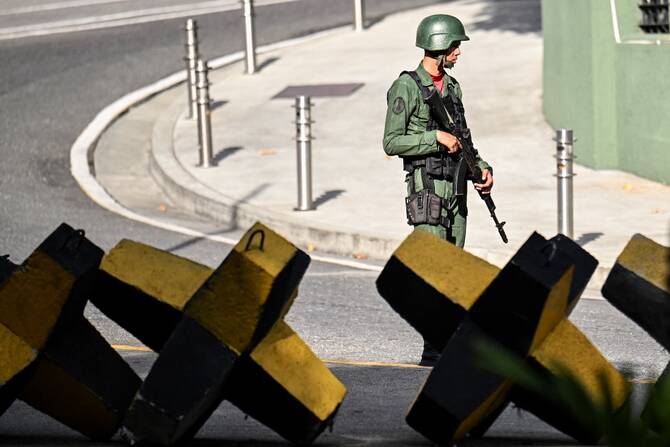
CARACAS: The Venezuelan army swore in 5,600 soldiers on Saturday, as the United States cranks up military pressure on the oil-producing country.
President Nicolas Maduro has called for stepped-up military recruitment after the United States deployed a fleet of warships and the world’s largest aircraft carrier to the Caribbean under the pretext of combating drug trafficking.
American forces have carried out deadly strikes on more than 20 vessels, killing at least 87.
Washington has accused Maduro of leading the alleged “Cartel of the Suns,” which it declared a terrorist organization last month.
Maduro asserts the American deployment aims to overthrow him and seize the country’s oil reserves.
“Under no circumstances will we allow an invasion by an imperialist force,” Col. Gabriel Rendon said Saturday during a ceremony at Fuerte Tiuna, Venezuela’s largest military complex, in Caracas.
According to official figures, Venezuela has around 200,000 troops and an additional 200,000 police officers.
A former opposition governor died in prison on Saturday where he had been detained on charges of terrorism and incitement, a rights group said.
Alfredo Diaz was at least the sixth opposition member to die in prison since November 2024.
They had been arrested following protests sparked by last July’s disputed election, when Maduro claimed a third term despite accusations of fraud.
The protests resulted in 28 deaths and around 2,400 arrests, with nearly 2,000 people released since then.
Diaz, governor of Nueva Esparta from 2017 to 2021, “had been imprisoned and held in isolation for a year; only one visit from his daughter was allowed,” said Alfredo Romero, director of the NGO Foro Penal, which defends political prisoners.
The group says there are at least 887 political prisoners in Venezuela.
Opposition leader and Nobel Peace Prize laureate Maria Corina Machado condemned the deaths of political prisoners in Venezuela during “post-electoral repression.”
“The circumstances of these deaths — which include denial of medical care, inhumane conditions, isolation, torture, cruel, inhuman and degrading treatment — reveal a sustained pattern of state repression,” Machado said in a joint statement with Edmundo Gonzalez Urrutia, the opposition candidate she believes won the election.

Venezuela swears in 5,600 troops after US military build-up
https://arab.news/vnkva
Venezuela swears in 5,600 troops after US military build-up
- American forces have carried out deadly strikes on more than 20 vessels, killing at least 87
94 million need cataract surgery, but access lacking: WHO
- Of the 94 million affected, fewer than 20 percent are blind, while the rest suffer from impaired vision
GENEVA: More than 94 million people suffer from cataracts, but half of them do not have access to the surgery needed to fix it, the World Health Organization said Wednesday.
Cataracts — the clouding of the eye’s lens that causes blurred vision and can lead to blindness — are on the rise as populations get older, with age being the main risk factor.
“Cataract surgery — a simple, 15-minute procedure — is one of the most cost-effective medical procedures, providing immediate and lasting restoration of sight,” the WHO said.
It is one of the most frequently performed surgeries undertaken in high-income countries.
However, “half of the world’s population in need of cataract surgery don’t have access to it,” said Stuart Keel, the UN health agency’s technical lead for eye care.
The situation is worst in the WHO’s Africa region, where three in four people needing cataract surgery remain untreated.
In Kenya, at the current rate, 77 percent of people needing cataract surgery are likely to die with their cataract blindness or vision impairment, said Keel.
Across all regions, women consistently experience lower access to care than men.
Of the 94 million affected, fewer than 20 percent are blind, while the rest suffer from impaired vision.
- 2030 vision -
The WHO said that over the past two decades, global cataract surgery coverage had increased by 15 percent.
In 2021, WHO member states set a target of a 30-percent increase by 2030.
However, current modelling predicts that cataract surgery coverage will rise by only about 8.4 percent this decade.
To close the gap, the WHO urged countries to integrate eye examinations into primary health care and invest in the required surgical equipment.
States should also expand the eye-care workforce, training surgeons in a standardised manner and then distributing them throughout the country, notably outside major cities.
The WHO was on Wednesday launching new guidance for countries on how to provide quality cataract surgery services.
It will also issue guidance to help support workforce development.
Keel said the main issue was capacity and financing.
“We do need money invested to get rid of this backlog, which is nearly 100 million people,” he told a press conference.
While age is the primary risk factor for cataracts, others include prolonged UV-B light exposure, tobacco use, prolonged corticosteroid use and diabetes.
Keel urged people to keep up regular eye checks as they get older, with most problems able to be either prevented or diagnosed and treated.
The cost of the new lens that goes inside the eye can be under $100.
However, out-of-pocket costs can be higher when not covered by health insurance.
“Cataract surgery is one of the most powerful tools we have to restore vision and transform lives,” said Devora Kestel, head of the WHO’s noncommunicable diseases and mental health department.
“When people regain their sight, they regain independence, dignity, and opportunity.”


