

Pakistan’s Pak-Qatar Family Takaful to raise $3.9 million in Islamic insurance IPO

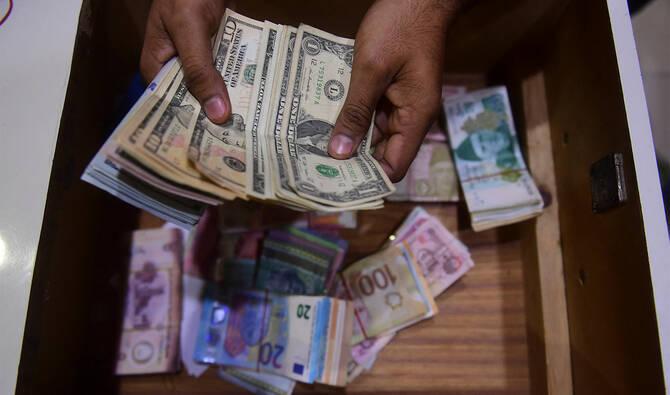
A dealer counts US dollars at a money exchange market in Karachi on January 27, 2023. (AFP/File)
Short Url
Updated 05 December 2025
Follow

Pakistan’s Pak-Qatar Family Takaful to raise $3.9 million in Islamic insurance IPO

  • Company to offer 50 million shares with a price band of $0.05–0.07 per share
  • Proceeds to support capital needs, digital expansion, new customer-focused products

ISLAMABAD: Pak-Qatar Family Takaful Limited, Pakistan’s largest dedicated Islamic insurance provider, will launch an initial public offering this month to raise about Rs1.1 billion ($3.9 million), with book-building scheduled for Dec. 11–12 and registration opening Dec. 8, the company said in a statement on Friday.

The offer will make Pak-Qatar the first dedicated family takaful operator to list on the Pakistan Stock Exchange, marking a notable development for the country’s insurance landscape, where penetration remains low by global standards. The IPO comes as the company looks to scale operations, strengthen technology channels and widen product distribution in a market where Shariah-compliant savings and protection instruments have grown steadily.

“Pak Qatar Family Takaful Limited is all set to list itself at Pakistan Stock Exchange through an IPO with registration starting 08th December. Through this IPO PQFTL is aiming to raise approx. Rs. 1.1 billion,” the statement said.

The company will offer 50 million shares, starting at a floor price of Rs14 per share ($0.05), with a ceiling of Rs21 per share ($0.07). Of the total issue, 37.5 million shares will be allocated to institutional investors, while 12.5 million shares will be offered to the general public.

Lead manager Shahid Ali Habib of Arif Habib Ltd. said investor response has been strong as the offering represents a sector first. According to the statement, proceeds will be used to meet capital requirements, develop new products and accelerate digital outreach.

Pak-Qatar Family Takaful is the country’s first and largest dedicated shariah-compliant family risk-protection provider, holding 44 percent of the total family takaful market and more than 90 percent of the fully dedicated segment, with a nationwide presence of 73 branches and 1,971 field representatives.

Despite Pakistan’s population size, insurance penetration stood at just 0.7 percent in 2024, the company noted, adding that rising awareness and economic shifts leave room for growth compared with advanced markets where penetration has crossed 10%.


Pakistan, global crypto exchange discuss modernizing digital payments, creating job prospects 

Updated 05 December 2025
Follow

Pakistan, global crypto exchange discuss modernizing digital payments, creating job prospects 

  • Pakistani officials, Binance team discuss coordination between Islamabad, local banks and global exchanges
  • Pakistan has attempted to tap into growing crypto market to curb illicit transactions, improve oversight

ISLAMABAD: Pakistan’s finance officials and the team of a global cryptocurrency exchange on Friday held discussions aimed at modernizing the country’s digital payments system and building local talent pipelines to meet rising demand for blockchain and Web3 skills, the finance ministry said.

The development took place during a high-level meeting between Finance Minister Muhammad Aurangzeb, Pakistan Virtual Assets Regulatory Authority (PVARA) Chairman Bilal bin Saqib, domestic bank presidents and a Binance team led by Global CEO Richard Teng. The meeting was held to advance work on Pakistan’s National Digital Asset Framework, a regulatory setup to govern Pakistan’s digital assets.

Pakistan has been moving to regulate its fast-growing crypto and digital assets market by bringing virtual asset service providers (VASPs) under a formal licensing regime. Officials say the push is aimed at curbing illicit transactions, improving oversight, and encouraging innovation in blockchain-based financial services.

“Participants reviewed opportunities to modernize Pakistan’s digital payments landscape, noting that blockchain-based systems could significantly reduce costs from the country’s $38 billion annual remittance flows,” the finance ministry said in a statement. 

“Discussions also emphasized building local talent pipelines to meet rising global demand for blockchain and Web3 skills, creating high-value employment prospects for Pakistani youth.”

Blockchain is a type of digital database that is shared, transparent and tamper-resistant. Instead of being stored on one computer, the data is kept on a distributed network of computers, making it very hard to alter or hack.

Web3 refers to the next generation of the Internet built using blockchain, focusing on giving users more control over their data, identity and digital assets rather than big tech companies controlling it.

Participants of the meeting also discussed sovereign debt tokenization, which is the process of converting a country’s debt such as government bonds, into digital tokens on a blockchain, the ministry said. 

Aurangzeb called for close coordination between the government, domestic banks and global exchanges to modernize Pakistan’s payment landscape.

Participants of the meeting also discussed considering a “time-bound amnesty” to encourage users to move assets onto regulated platforms, stressing the need for stronger verifications and a risk-mitigation system.

Pakistan has attempted in recent months to tap into the country’s growing crypto market, crack down on money laundering and terror financing, and promote responsible innovation — a move analysts say could bring an estimated $25 billion in virtual assets into the tax net.

In September, Islamabad invited international crypto exchanges and other VASPs to apply for licenses to operate in the country, a step aimed at formalizing and regulating its fast-growing digital market.