JERUSALEM: Israeli Prime Minister Benjamin Netanyahu denounced the ongoing corruption case against him as a “Bugs Bunny trial” and defended his controversial pardon request in a video published on social media.
The three-minute video, released late Thursday, came a week after Netanyahu formally requested a pardon from Israeli President Isaac Herzog, arguing that his prosecution was dividing the nation.
US President Donald Trump also sent a letter last month to Herzog with the same request.
In the video shared online late Thursday, Netanyahu denounced the proceedings a “political trial” designed to force him from office, reiterating his longstanding denial of any wrongdoing.
The charges include two cases in which Netanyahu allegedly negotiated favorable media coverage from Israeli news outlets, and a third involving accusations he accepted more than $260,000 in luxury gifts — including cigars, jewelry, and champagne from billionaires in exchange for political favors.
A fourth corruption charge was previously dismissed.
In the video, Netanyahu held up a Bugs Bunny puppet, mocking prosecutors for allegedly citing a cartoon doll he received as a gift for his son 29 years ago as evidence against him.
“From now on, this trial will be known as the Bugs Bunny trial,” he declared.
Netanyahu further dismissed the cigar gifts as presents “from a friend” and claimed his alleged attempts to secure favorable coverage from “a second-rate Internet site” instead resulted in “the most hateful, antagonistic, negative press coverage you can imagine in Israel.”
Netanyahu is the first sitting Israeli prime minister to stand trial for corruption.
The proceedings, which began in 2019, have recently required him to testify three times weekly — a schedule he argues prevents him from effectively governing.
“This farce is costing the country dearly,” he said. “I can’t deal with that... So I asked for a pardon.”
The cases have exposed sharp divisions in Israeli society.
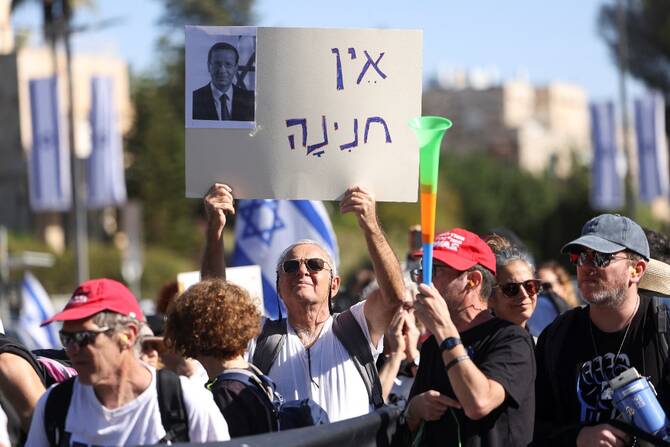
On Monday, before Netanyahu’s latest court appearance, rival groups of protesters gathered outside the Tel Aviv courthouse — some chanting in support of the prime minister, others opposing him, including demonstrators wearing bright orange prison-style jumpsuits to imply that he should be imprisoned.


Netanyahu mocks corruption trial as ‘Bugs Bunny’ farce
https://arab.news/gezr5
Netanyahu mocks corruption trial as ‘Bugs Bunny’ farce

- In a video, Netanyahu held up a Bugs Bunny puppet, mocking prosecutors for allegedly citing a cartoon doll he received as a gift for his son 29 years ago as evidence against him


Lebanon foreign minister declines Tehran visit, proposes talks in neutral country
- Lebanon’s foreign minister Youssef Raji cited ‘current conditions’ for the decision not to go to Iran
Lebanon’s foreign minister Youssef Raji said on Wednesday he had declined an invitation to visit Tehran for now, proposing instead talks with Iran in a mutually agreed neutral third country, Lebanese state news agency NNA reported.
Raji cited “current conditions” for the decision not to go to Iran, without elaborating, and stressed that the move did not mean rejection of dialogue with Iran. He did not immediately respond to a request from Reuters for additional comment.
Iran’s Foreign Minister Abbas Araqchi had extended the invitation last week, seeking talks on bilateral ties.
Raji said Lebanon stood ready to open a new phase of constructive relations with Iran, on the condition that ties be based strictly on mutual respect, full recognition of each country’s independence and sovereignty, and non-interference in internal affairs under any pretext.
In an apparent reference to calls to disarm Hezbollah, the Lebanese armed movement allied for decades to Iran, Raji added that no strong state could be built unless the government held the exclusive right to hold weapons.
Hezbollah, once a dominant political force with wide influence over the Lebanese state, was severely weakened by Israeli strikes last year that ended with a US-brokered ceasefire. It has been under mounting domestic and international pressure to surrender its weapons and place all arms under state control.
In August, Iran’s top security official Ali Larijani visited Beirut, warning Lebanon not to “confuse its enemies with its friends.” In June, Foreign Minister Araqchi said Tehran sought a
“new page” in ties.


