

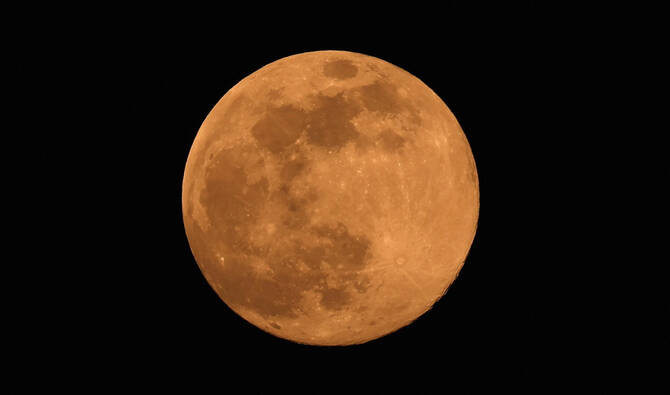
Last supermoon of the year illuminates the night sky over Pakistan

The Cold Moon, the last supermoon of 2025, lights up the night sky in Karachi, Pakistan, on December 4, 2025. (REUTERS/File)
Short Url
Updated 05 December 2025
Follow

Last supermoon of the year illuminates the night sky over Pakistan

  • ‘Cold moon’ visible from Thursday evening to early Friday 
  • Brightest supermoon of the year occurred earlier on Nov. 5

LAHORE: Astronomy enthusiasts, students and families gathered in Pakistan’s cultural capital Lahore on Thursday night to observe the final supermoon of 2025.

It’s the third supermoon of the year and the last supermoon of 2025, according to Pakistan Space and Upper Atmosphere Research Commission (SUPARCO).

A supermoon occurs when a full moon coincides with the Moon’s closest point to Earth in its orbit, causing it to appear slightly larger and brighter than usual.

There are typically three to four supermoons in a year.

“It looks just beautiful, a delight. It is bright and shiny. I like watching full moon and always watch it when bright and full. Watching full moon always gives me a soothing pleasure,” resident of Lahore Saeeda Ahmed said. 

“The supermoon is beautiful,” said another resident Ahsan Rasheed.

“There is a waterfall nearby and it’s reflection in water is enhancing the beauty. As you can feel the moon is very bright today. It is brighter than an ordinary full moon.”

The December full moon is traditionally called the Cold Moon due to its appearance in the Northern Hemisphere’s winter season.

SUPARCO on Wednesday encouraged astronomy enthusiasts, families and students to observe the event, noting that no special optical gear is required.

The brightest supermoon of the year occurred earlier on Nov. 5, when the Moon came slightly closer at 356,978 km. 

Pakistan’s space agency said 2025 has been one of the most favorable years for sky-watchers in South Asia, with multiple clear viewing windows and high illumination.


Pakistan vaccinates over 44 million children as nationwide anti-polio drive enters last day

Updated 4 sec ago
Follow

Pakistan vaccinates over 44 million children as nationwide anti-polio drive enters last day

  • Pakistan kicked off seven-day nationwide anti-polio campaign on Feb. 2 to vaccinate over 45 million children
  • Pakistan reported 31 polio cases in 2025, a significant drop from the alarming 74 cases it reported in 2024

ISLAMABAD: Pakistani health volunteers have vaccinated over 44.1 million children against poliovirus in six days so far, the National Emergency Operations Center (NEOC) said on Sunday as the nationwide campaign entered its last day. 

Pakistan kicked off the seven-day anti-polio campaign on Feb. 2 to vaccinate over 45 million children under the age of five against poliovirus. 

In Punjab, health workers have vaccinated over 22.9 million children, in Sindh 10.4 million, in Khyber Pakhtunkhwa (KP) 7.1 million, in Balochistan 2.324 million, in Islamabad over 455,000, in Gilgit-Baltistan over 261,000 and in Azad Kashmir over 673,000 in the last six days, the NEOC said. 

“In six days, vaccination of more than 44.1 million children has been completed across the country,” the NEOC said in a statement. 

It said over 400,000 trained polio workers are going door-to-door to administer polio drops to children.

“Open your doors for polio workers and ensure your children receive polio drops,” the NEOC said. “Parents and communities are urged to fully cooperate with polio workers.”

Pakistan and Afghanistan remain the only two countries worldwide where polio remains endemic. The NEOC said the anti-polio drive was being conducted simultaneously in both countries. 

Last year, Pakistan reported 31 polio cases, a significant drop from the alarming 74 cases reported in the country in 2024. The South Asian nation reported six cases in 2023 and only one in 2021, but saw a sharp resurgence in 2024.

Pakistan’s polio program began in 1994, but efforts to eradicate the virus have been repeatedly undermined by vaccine misinformation and resistance from some religious hard-liners who claim that immunization is a foreign plot to sterilize Muslim children or a cover for Western espionage.

Militant groups have also frequently targeted polio vaccination teams and the security personnel assigned to protect them, often resulting in deadly attacks, particularly in KP and Balochistan.