

UN Security Council begins Syria-Lebanon mission, says Damascus talks focus on rebuilding trust

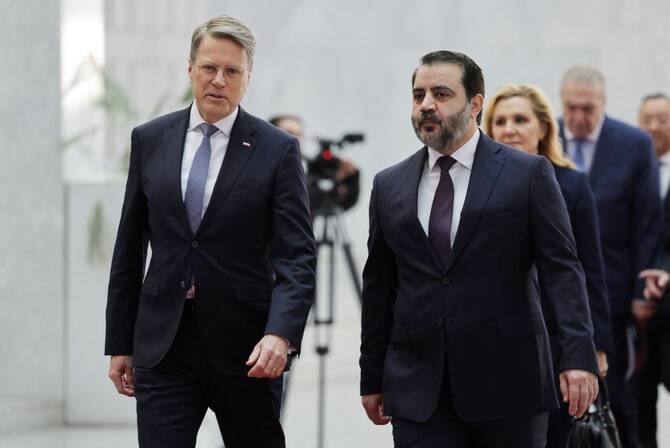
Slovenia’s Ambassador to the United Nations, Samuel Zbogar, left, with Syria’s Foreign Minister Asaad Al-Shaibani, at the People’s Palace, in Damascus, Syria, Dec. 4, 2025. (Reuters)
Short Url
Updated 04 December 2025
Follow

UN Security Council begins Syria-Lebanon mission, says Damascus talks focus on rebuilding trust

  • Council delegation meets President Ahmad Al-Sharaa, government ministers, religious and civil society leaders, communities affected by recent violence
  • Topics discussed include justice and reconciliation, the political transition and inclusivity, national dialogue, humanitarian needs, reconstruction and counterterrorism

NEW YORK CITY: Samuel Zbogar, Slovenia’s permanent representative to the UN Security Council and its president for December, said a visit by a council delegation to Syria on Thursday, part of a broader regional mission that will also include time in Lebanon, is designed to rebuild confidence between Syrians and the international community.

Speaking from Damascus on behalf of the delegation, he stressed that the future of the country must be “Syria-led and Syria-owned.”

He continued: “The word of today was the word ‘trust.’ We heard a lot about trust, and we came here to build trust: to build our trust in your efforts for a better future, and to build your trust in the intentions of the Security Council and the intentions of the United Nations.”

Zbogar said the delegation took part in a wide range of meetings throughout the day, beginning with a session with President Ahmad Al-Sharaa, his foreign minister and other government ministers.

The delegates then met the UN’s country team in Syria, which Zbogar described as “quite a large, impressive team here in Damascus,” before moving on to talks with religious leaders, civil society figures, representatives of communities affected by recent violence in coastal regions and Sweida, and governors from coastal provinces.

They also met representatives of Syria’s National Commission for Missing Persons, other investigative commissions, and the country’s electoral committee.

Zbogar described the day’s discussions as both enlightening and sobering.

“As much as painful to listen to, (they were) at the same time presenting the reality of the situation in Syria,” he said.

Specific topics raised included justice and reconciliation, inclusivity within the political process, national dialogue, humanitarian needs, reconstruction and economic development, the political transition, counterterrorism, and Syria’s obligation not to be a source of threat to regional security.

The Security Council and President Al-Sharaa agreed on “the importance of economic development and reconstruction of Syria,” Zbogar said.

The primary purpose of the delegation’s mission during its visit was to demonstrate the international community’s backing for the country, he added.

“We reiterated our clear support for the sovereignty, unity, independence and territorial integrity of Syria.”

The unified message from Council members, Zbogar continued, was straightforward: “We recognize your country’s aspirations and challenges, and the path to a better future of new Syria will be Syria-led and Syria-owned, and the international community stands ready to support you wherever you believe that we can be helpful.”

He highlighted the strong presence of the UN in Syria and the ability of the organization to assist through the various tools and expertise it possesses.

“We want to help build a bridge to this better future for all Syrians,” Zbogar said, and both the UN and the Security Council “stand ready to help you do that.”

The Council delegation will continue its regional mission with a visit to Lebanon in the coming days.


Israeli attacks on Lebanon kill four, including security officer and child

Updated 7 sec ago
Follow

Israeli attacks on Lebanon kill four, including security officer and child

  • Lebanon’s health ministry says Israeli strike on village of Yanuh in the south killed three people
  • Israeli gunfire also killed one person in the border village of Aita Al-Shaab
BEIRUT: Israeli attacks on Lebanon killed four people on Monday including a Lebanese security forces member and his child, hours after the Israeli army seized a member of Islamist group Jamaa Islamiya.
Israel frequently strikes Lebanon despite a November 2024 ceasefire aimed at ending more than a year of hostilities with militant group Hezbollah.
On Monday, Lebanon’s health ministry said an Israeli strike on the village of Yanuh in the south killed three people.
The Israeli military said the strike targeted Ahmad Ali Salameh, who it alleged was Hezbollah’s head of artillery and had been working to restore the group’s capabilities.
In addition to Salameh, the strike killed a member of Lebanon’s security forces and his three-year-old child, who were passing by, according to Lebanon’s state-run National News Agency (NNA).
The Israeli military said the incident was “under review” after it was made “aware of the claim that uninvolved civilians were killed.”
Later on Monday, the health ministry reported that Israeli gunfire killed one person in the border village of Aita Al-Shaab, with the Israeli military saying it killed a Hezbollah member.
It alleged he was “gathering intelligence on (Israeli) troops and operated to rehabilitate Hezbollah’s terrorist infrastructure in southern Lebanon.”
In addition to recurring attacks, the Israeli army still has troops deployed on five border positions in Lebanon it deems strategic.
Monday’s incidents come hours after the Jamaa Islamiya group, an ally of Palestinian militants Hamas, accused Israel of seizing one of its officials, Atwi Atwi, from his home in the Hasbaya district, south Lebanon, and taking him to an unknown location.
The group, which has claimed responsibility for multiple attacks against Israel during the war with Hezbollah, condemned “the Israeli occupation forces’ infiltration.”
The Israeli military said that it “apprehended a senior terrorist” in the group who was then “transferred for further questioning in Israeli territory.”
Atwi’s capture came hours after Lebanese Prime Minister Nawaf Salam completed a two-day visit to the south, which suffered extensive damage during the conflict with Hezbollah, with thousands displaced.
Salam in a statement condemned Atwi’s “abduction,” calling it a “blatant attack on Lebanese sovereignty, a violation of the ceasefire agreement and “a breach of international law.”
Hezbollah meanwhile called on the state to “take deterrent measures and firm and clear positions, and to act immediately at all political, diplomatic and legal levels, and to work seriously to protect citizens.”
Lebanon accuses Israel of having abducted several other citizens since the start of the hostilities.
Hezbollah lawmaker Hussein Al-Hajj Hassan said last month that Israel was holding “20 Lebanese prisoners,” alleging 10 had been abducted “inside Lebanese territory after the ceasefire.”
Lebanon says Israel must release these detainees and withdraw from the border positions it retains, in addition to halting air strikes on Lebanon.