

South Africa prepared to ‘take a break’ from G20 after US ban

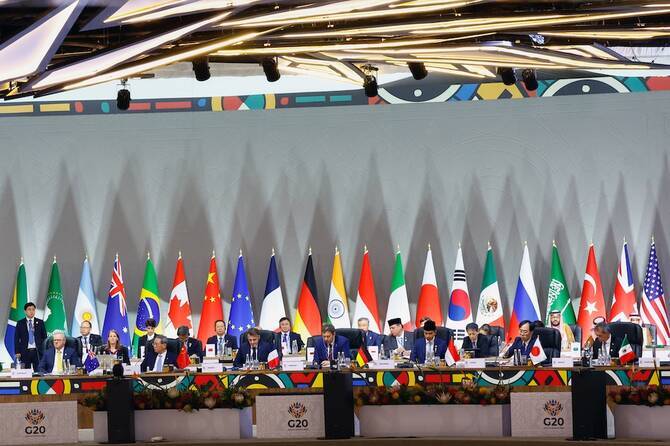
Leaders attend a plenary session on the opening day of the G20 Summit in Johannesburg, South Africa on Nov. 22, 2025. (AP/File)
Short Url
Updated 04 December 2025
Follow

South Africa prepared to ‘take a break’ from G20 after US ban

  • Magwenya said earlier that South Africa was prepared to sit out the forum’s 2026 series
  • “About this time next year, the UK will be taking over the G20 Presidency“

JOHANNESBURG: South Africa said Thursday it was prepared to wait out next year’s G20 after being barred by the United States and did not expect other countries to lobby for its inclusion.
The United States this month took over the year-long presidency of the group of leading economies after largely boycotting South Africa’s tenure, including the November summit, in an escalation of its attacks on Pretoria.
President Donald Trump said on social media late November that South Africa would not be invited to the summit in Miami, which Secretary of State Marco Rubio repeated in comments Wednesday.

“We are yet to receive it in writing and we will deal with that when it comes,” President Cyril Ramaphosa told reporters on Thursday.
South Africa was “fully fledged member of the G20” and its presidency had been internationally described as successful, he said.
Presidential spokesman Vincent Magwenya said earlier that South Africa was prepared to sit out the forum’s 2026 series and resume participation when the G20 is handed to Britain in a year’s time.
“About this time next year, the UK will be taking over the G20 Presidency,” Magwenya said on social media.
“We will be able to engage meaningfully and substantively over what really matters to the rest of the world. For now, we will take a commercial break until we resume normal programming,” he said.

- ‘Spirit of G20’ -

The Johannesburg summit, the first in Africa, was attended by a host of world leaders, including from countries not in the G20, but boycotted by Trump.
Rubio said in a newsletter that South Africa’s G20 was an exercise in “radical agendas” that ignored US objections.
The “United States will not be extending an invitation to the South African government to participate in the G20 during our presidency,” he said.
Ramaphosa said South Africa would not attempt to mobilize a boycott of the US G20 to object to its exclusion. “Every country must take its own decisions,” he said.
South Africa would however want countries to “register their displeasure with the US in defense of multilateralism and the spirit and purpose of the G20,” his spokesman said in an interview with the Sunday Times Wednesday.
The G20 group of nations includes the world’s top economies as well as the European Union and the African Union regional blocs. It accounts for 85 percent of the world’s GDP and two-thirds of its population.
The Trump administration has lashed out at South Africa over a range of policies, expelling its ambassador in March and imposing 30 percent trade tariffs, which Pretoria is still seeking to overturn.


Deadly militant offensive sweeps northern and eastern Burkina Faso

Updated 6 sec ago
Follow

Deadly militant offensive sweeps northern and eastern Burkina Faso

  • Burkina Faso, ruled by a military junta since September 2022, has faced more than 10 years of raids by groups linked to Al-Qaeda and the Daesh
ABIDJAN: Al-Qaeda-affiliated JNIM has in recent days claimed to have inflicted heavy losses in Burkina Faso as a surge in deadly militant attacks sweeps across the Sahelian state.
Burkina Faso, ruled by a military junta since September 2022, has faced more than 10 years of raids by groups linked to Al-Qaeda and the Daesh, including the Group for the Support of Islam and Muslims (JNIM).
A February UN Security Council report noted that the “pace of JNIM attacks” had slowed in September as fighters were diverted to Mali to back an attempted fuel blockade.
“The group’s efforts in Mali have been the primary focus since early September last year,” said Heni Nsaibia, analyst at conflict monitor ACLED.
But attacks never fully stopped, and JNIM has launched a string of large-scale assaults in northern and eastern Burkina Faso since mid-February, killing dozens, including civilians.
“Since February 14, JNIM has claimed responsibility for 10 attacks across different regions of Burkina Faso,” said Hasret Kargin, an Africa studies researcher at intelligence firm Mintel World.
Deadly assaults
The deadliest incidents targeted Titao’s military base on February 15 in the northwest, where the group says it killed dozens of soldiers.
A separate ambush on the same day left around 50 forestry officers dead in Tandjari in the east.
Around 10 civilians were also killed in Titao, including seven Ghanaian traders.
“This latest round demonstrated a high degree of coordination, given the number of large-scale attacks that occurred between 12 and 22 February,” Nsaibia said.
“Over 130 people” — Burkinabe soldiers, civilian auxiliaries and JNIM fighters — “were killed in this series of battles.”
Kargin noted that JNIM has issued no formal statement explaining the recent uptick after several months of reduced activity.
But militant groups often strike “right before and during” the Muslim holy month of Ramadan, he said, adding current dry-season conditions had helped them on the ground.
‘Smuggling zones’
Recent attacks have gripped the country’s north and east, areas seen as financial hubs for Al-Qaeda’s Sahel branch.
“These are zones with numerous gold sites and key routes that fuel the group’s smuggling activities,” a Burkinabe security analyst said, requesting anonymity.
The north “acts as a bridge” to JNIM’s “main central command” in Mali, Kargin said, while he east — home to a vast nature reserve straddling Niger, Benin and Burkina Faso — allows the group to push into neighboring countries.
The forests, he added, both shield fighters from airstrikes and generate income through illegal timber sales and control of artisanal gold mining.
The Tandjari attack near regional capital Fada N’Gourma highlights JNIM’s growing freedom of movement after having “gained a lot of ground in recent years,” Nsaibia said.
“The question is not the frequency of attacks — they never stopped — but how these groups are able to inflict such heavy losses” when the army claims to be better equipped and better organized, said a Burkinabe political scientist.
The army, which rarely comments on attacks, said in mid-February it now controls 74 percent of national territory, with some “600 villages retaken.”
According to the UN report, JNIM recently appointed a senior leader in eastern Burkina Faso tasked with expanding into Benin, Ivory Coast, Ghana, Niger and Togo.