



BEIRUT: The Israeli army targeted several buildings on Thursday in towns across southern Lebanon after issuing evacuation warnings, including maps, to residents.
The strikes came as the army commander briefed the president and prime minister on the latest developments regarding placing weapons under state control.
The locations targeted were Mahrouna, a small agricultural village; Al-Majadel in Tyre, south of the Litani River; Jbaa in Nabatieh, which lies north of the Litani River and 64 km from Beirut; and Baraachit, a large mountainous town located between Nabatieh and Bint Jbeil, roughly 80 km from Beirut.
Israeli army spokesman Avichay Adraee claimed that forces targeted “Hezbollah’s military infrastructure in order to counter its prohibited attempts to rebuild its activities in the region.”
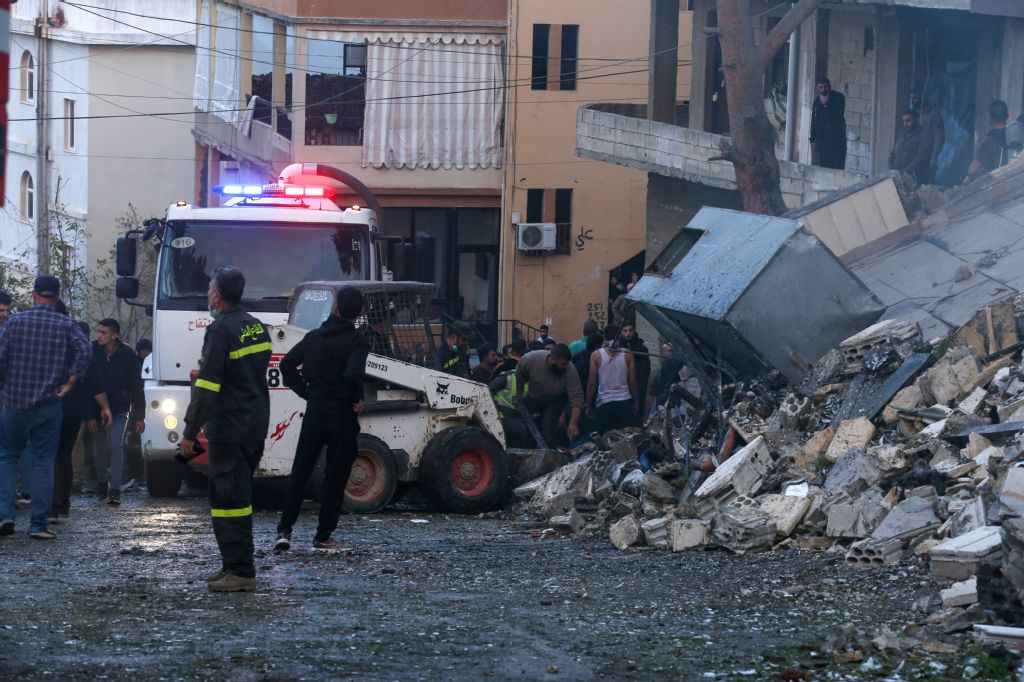
First responders clear the rubble as they search for survivors at the site of an Israeli airstrike on the southern Lebanese village of Jbaa on Thursday. (AFP)
At least one of Mahrouna’s residents received a call from someone claiming to speak on behalf of the Israeli army, instructing him to evacuate immediately. In the phone call recording, which was shared on social media, the Lebanese citizen can be heard telling the Israeli that what they intended to target was “a clinic for treating the poor.”
Citing a security source, Israel’s Channel 12 said that “the attacks targeted weapon depots belonging to Hezbollah.”
The expanded Israeli attack came 24 hours after the ceasefire mechanism committee’s meeting in Naqoura, in which civilian Israeli and Lebanese representatives engaged in direct talks for the first time in over four decades.
The attack also coincided with a meeting of the Lebanese Cabinet, headed by Prime Minister Nawaf Salam, which was attended by President Joseph Aoun.

A civil defense truck at a site struck by Israel in Jbaa in southern Lebanon on Thursday. (Reuters)
Gen. Rodolphe Haykal, commander of the Lebanese Armed Forces, presented a detailed briefing at the meeting on the army’s third report, which outlined progress in containing weapons south of the Litani River during the penultimate month of the deadline. This timeline was set by the army for completing the confiscation of Iran-backed Hezbollah’s weapons in the area, barring exceptional circumstances. The report also noted that the mission was expected to continue north of the Litani at the beginning of next year.
According to an official source, the army’s report, supported by pictures and field data, focused on “demonstrating the progress made on the ground, both south of the Litani River and in containing weapons north of it.”
This came as a response to “the Israeli allegations claiming that the army is failing to execute its mission of disarming Hezbollah, or is allowing it to rebuild its military capabilities and smuggle weapons into the region.”
The report added that “the number of soldiers south of the Litani (has) reached 10,000.” It also said that “the army is now deployed in over 200 points south of the Litani River, in addition to repositioning itself in 11 border areas,” while the Israeli army continued to occupy five strategic positions, in addition to two isolation points, with four new violations recorded in Yaroun and Rmaych.
It said: “Nine areas remain occupied among the positions where the Israeli army was present before its latest ground maneuver.” The report explained that “over 11,000 joint missions were conducted with UNIFIL, in addition to 30,000 individual military missions amid Israeli violations along the border.”
It added: “The number of tunnels that the army entered and handled reached 177, in addition to closing 11 crossings along the Litani River and seizing hundreds of rocket launchers, dozens of rockets, and other weapons and ammunition.”
It also pointed out that “despite Israel’s repeated allegations regarding Hezbollah, it didn’t find any tangible evidence proving that Hezbollah (had) resumed its military activity south of the Litani, or is systematically rebuilding its fighting capabilities.”
The army commander highlighted that UNIFIL (UN Interim Force in Lebanon) forces had begun reducing their personnel south of the Litani River in preparation for a full withdrawal scheduled by the end of 2026.
He said: “Equipment and naval vessels have been withdrawn, and 640 members of the Blue Helmets have left Lebanon. The army is working on developing the model regiment and other units that are supposed to replace UNIFIL in the 90 sites it occupies.”
Regarding the mission to restrict weapons in the Palestinian camps, the report pointed to “tightening measures on several sensitive camps such as Rashidieh in the south and Baddawi in the north, with weapons to remain confined inside them unless they are handed over.”
It was confirmed that “the army will not request an extension of the deadline set for completing its mission south of the Litani River.”
Salam has been briefed by Simon Karam, the head of the Lebanese delegation to the mechanism meetings and former ambassador of Lebanon to the US. According to his media office, Salam affirmed that “Karam’s chairing of the Lebanese delegation constitutes an important step in advancing the work of the mechanism.”
Israel and Lebanon engaged on Wednesday in their first direct negotiations since 1983, following the peace talks that took place after Israel’s invasion of Lebanon which resulted in an agreement that aimed to normalize relations but was never ratified.
Civilian representatives from both countries met at the UN peacekeeping force’s headquarters in Naqoura, near the Israeli border, in the presence of Morgan Ortagus, the US’ special envoy for Lebanon.
Michel Issa, the US ambassador to Lebanon, commended both countries on Thursday for “taking the courageous decision to open a channel of dialogue at this sensitive moment. This step signals a sincere willingness to pursue peaceful, responsible solutions grounded in good faith.”
Issa stressed that “durable progress can only be achieved when both sides feel their concerns are respected and their hopes recognized. Compromise, understanding, and principled leadership remain essential.”
He welcomed what was described as the Lebanese government’s decision to “embrace dialogue after decades of uncertainty. This represents a constructive move toward identifying pathways that may one day allow both nations to coexist peacefully, respectfully, and with dignity.”
Issa reaffirmed Washington’s commitment to supporting all peace, stability, and security initiatives. The US said it was prepared to assist efforts that alleviated the profound physical and moral suffering endured by communities, a “hardship no society should ever have to face.”
The US Embassy said that the 14th session in Naqoura — attended by Karam and Uri Resnick, Israel’s National Security Council’s senior director — demonstrated the group’s dedication to facilitating political and military dialogue for lasting security and peace among conflict-affected communities. “It is an important step toward ensuring that the work of the pentalateral is anchored in lasting civilian, as well as military, dialogue,” it added.
An official source told Arab News that “the significance of what took place is that everyone sat together and that the discussions were, for the first time, conducted directly between the Israeli and Lebanese sides.”
The move toward diplomatic negotiations is considered a response to a US request made by Ortagus during her visit to Beirut last March which noted that Lebanon, constitutionally, remained in a state of war with Israel.
Sami Gemayel, the head of the Lebanese Kataeb Party, said that “the state, after 43 years, is once again taking the same course of negotiation, and Lebanon’s demands require firmness on the part of the Lebanese state in the process of asserting sovereignty. The Shiite community must speak its word on this matter, so that Hezbollah does not speak in the name of the entire community or hold everyone hostage.”


