Pakistan opens talks for new national revenue-sharing formula amid debate over provincial autonomy

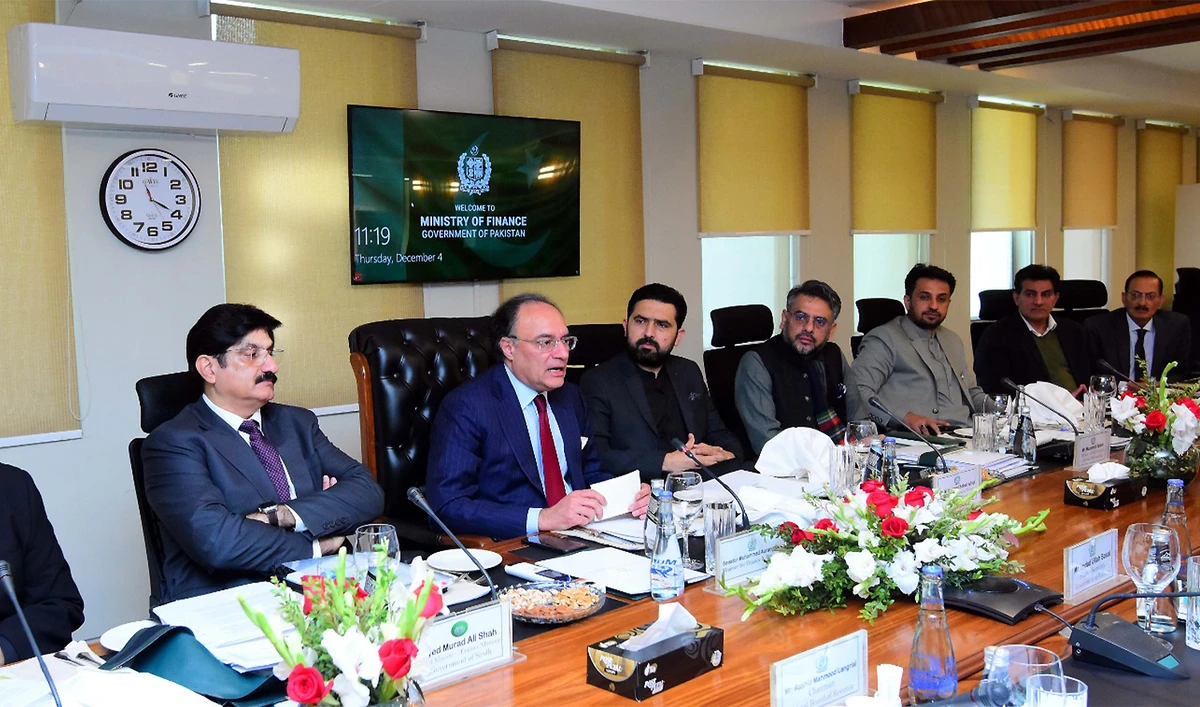
Pakistan Finance Minister Muhammad Aurangzeb (center) addresses the National Finance Commission in Islamabad, Pakistan, on December 4, 2025. (Finance Ministry)
Short Url
Updated 04 December 2025
Follow

Pakistan opens talks for new national revenue-sharing formula amid debate over provincial autonomy

  • National Finance Commission talks will decide how federal revenue is split between federation, provinces under Article 160
  • Provinces want guarantees future awards will not reduce fiscal share amid debate over increased federal control 

KARACHI: Pakistan on Thursday opened formal negotiations to devise a new national revenue-sharing formula between the federal government and the provinces, launching the 11th National Finance Commission (NFC), the constitutional body that determines how centrally collected taxes are divided across the federation.

The talks come at a politically sensitive moment, as the NFC process overlaps with debate surrounding fiscal powers and a proposed 28th constitutional amendment that critics say could dilute provincial autonomy. Under Article 160 of Pakistan’s constitution, revenue distribution must be periodically renegotiated, and provinces cannot receive less than their previous share, turning each NFC round into a test of center-province relations and economic authority.

The need for a new award has grown more urgent since the previous NFC expired on July 21, 2025, leaving Pakistan in a transitional fiscal phase while inflation, debt servicing and IMF-linked reforms strain public finances. Provinces, meanwhile, say they require guaranteed transfers to fund health care, education, policing and local development, responsibilities that have expanded significantly since devolution reforms in 2010.

Finance Minister Muhammad Aurangzeb, opening the inaugural sitting in Islamabad, thanked provincial leaders for attending despite delays caused by devastating floods earlier this year. He said the government was determined to begin negotiations without further postponement. 

“Today’s meeting is both a constitutional responsibility and an important opportunity for collective cooperation. Our first priority is to listen, with open minds and without prejudice,” Aurangzeb said according to a statement released by the finance ministry. 

He added that Prime Minister Shehbaz Sharif had personally pushed for the NFC meeting to convene quickly and emphasized transparent dialogue as the only way to address speculation surrounding the next revenue arrangement.

Aurangzeb noted that provinces recently signed a National Fiscal Pact, committing to generate surpluses to support Pakistan’s IMF program, cooperation he described as “highly commendable,” but acknowledged that the upcoming award must also deliver equitable resource distribution and financial stability across the federation.

The finance ministry said discussions will continue over the coming weeks and months, with negotiators expected to debate revenue targets, spending responsibilities, development priorities and how crises such as floods, security pressures and commodity shocks should be shared between Islamabad and the provinces.

The eventual agreement will determine how Pakistan allocates billions of rupees annually, shaping budgets, political power, and economic governance for years to come.


Peace can only prevail if Afghanistan renounces support for ‘terrorism’— Pakistan defense chief

Updated 04 March 2026
Follow

Peace can only prevail if Afghanistan renounces support for ‘terrorism’— Pakistan defense chief

  • Pakistan’s chief of defense forces visits South Waziristan district bordering Afghanistan
  • Pakistan says has killed 481 Afghan Taliban operatives since clashes began last Thursday

ISLAMABAD: Pakistan’s Chief of Defense Forces Field Marshal Syed Asim Munir said on Wednesday that peace with Afghanistan can only prevail if Kabul renounces support for “terrorism” and “terrorist” organizations, the military’s media wing said as the two countries remain locked in conflict. 

Fighting between the two neighbors, the worst in decades, broke out last Thursday night after Afghan forces attacked Pakistan’s military installations along their shared border. Afghanistan said its attacks were in response to earlier airstrikes by Pakistan against alleged militant hideouts in its country. 

Pakistan accuses Afghanistan of sheltering militant outfits such as the Tehreek-e-Taliban Pakistan (TTP) on its soil who have launched attacks against Pakistani civilians and security forces in recent years. Kabul denies the allegations. 

Munir visited Wana town in Pakistan’s South Waziristan district to review the security situation and troops’ operational preparedness at the Afghan border, the Pakistani military’s media wing said in a statement. 

“The Field Marshal reiterated that peace could only prevail between both sides if the Afghan Taliban renounced their support for terrorism and terrorist organizations,” the Inter-Services Public Relations (ISPR) said. 

The military chief said the use of Afghan soil by militant outfits to launch attacks against Pakistan was unacceptable, vowing that “all necessary measures” would be taken to neutralize cross-border threats. 

During the visit, Munir was briefed by military commanders about ongoing intelligence-based operations and measures being taken by the military to manage the border with Afghanistan.

He was also briefed about “Operation Ghazab Lil Haq” or “Wrath for the Truth,” the name Pakistan has given to its military operation against Afghan forces, the ISPR said. 

The Pakistani military chief spoke to troops deployed in the area, praising their vigilance, professional conduct and high morale, the ISPR said. 

Pakistan’s Information Minister Attaullah Tarar said on Wednesday that the military has killed 481 Taliban operatives, injured more than 690 and destroyed 226 Afghan checkposts since clashes began. 

Arab News has been unable to verify claims by both sides about the damages they claim to have inflicted on each other.

Afghanistan has signaled it is open for dialogue but Pakistan rejected the offer, saying it would continue its military operations till its objectives were achieved. 

Since the conflict began, diplomatic efforts have intensified with several countries, including global bodies such as the European Union and United Nations, urging restraint and calling for talks.

Turkish President Recep Tayyip Erdogan told Pakistani Prime Minister Shehbaz Sharif that ⁠Ankara would help ⁠reinstate a ceasefire, the Turkish Presidency said on Tuesday, as other countries that had offered to mediate have since been hit by the conflict in the Gulf.