

Pakistan to submit IMF-recommended action plan for governance reforms by Dec. 31 — finance minister

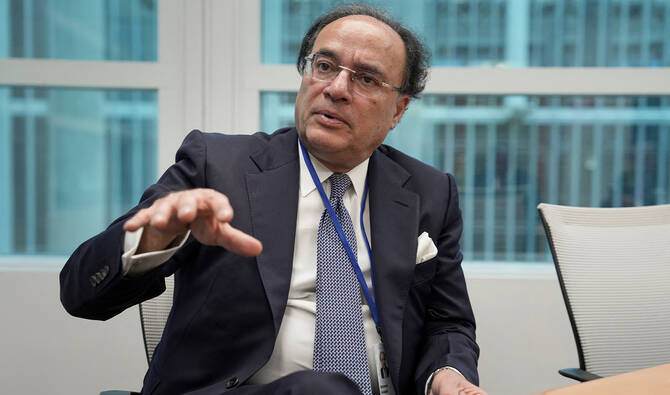
Pakistan Finance Minister Muhammad Aurangzeb speaks during a Reuters interview at the 2025 annual IMF/World Bank Spring Meetings in Washington, DC, US, on April 25, 2025. (REUTERS/File)
Short Url
Updated 04 December 2025
Follow

Pakistan to submit IMF-recommended action plan for governance reforms by Dec. 31 — finance minister

  • IMF says successful implementation of its 15-point reform package could lift Pakistan’s GDP by up to 6.5%
  • IMF governance assessment flags systemic weaknesses across all Pakistan state institutions including judiciary

ISLAMABAD: Pakistan must finalize and submit action plans on a 15-point set of governance and anti-corruption reforms recommended by the International Monetary Fund (IMF) before Dec. 31, Finance Minister Muhammad Aurangzeb told a parliamentary panel on Wednesday.

The reforms stem from the IMF’s Governance and Corruption Diagnostic Assessment, published last month as part of the lender’s broader conditions under Pakistan’s ongoing bailout programs. The report identified weaknesses across state institutions, including the civil service, judiciary, tax administration, regulators and procurement systems, and said fully implementing the recommended measures could raise Pakistan’s GDP by 5–6.5 percent.

IMF governance diagnostics are part of a newer framework applied to around 20 borrower countries, but Pakistan’s assessment drew unusually sharp political attention because it highlighted systemic failures across all branches of the state. The report’s publication was also a prior action for the IMF Executive Board’s approval of a $1.2 billion disbursement expected next month, under Pakistan’s overlapping financial and climate-linked programs.

“We are supposed to come up with an action plan, around the 15 recommendations [of IMF]. The time frame for the action plan [submission] is Dec. 31,” Aurangzeb told the National Assembly Standing Committee on Finance.

Committee Chairman Syed Naveed Qamar said the IMF’s findings were “not only an indictment of the government but also of the parliament.”

Aurangzeb rejected suggestions that the government had delayed the report’s release.

“We initiated and facilitated this report. Over the last few months, there were more than 100 meetings involving 30-plus departments,” he said, adding that Pakistan’s experience was similar to “around 20 IMF-program countries” that had undergone comparable diagnostics.

He said every department implicated in the 15 recommendations, including the judiciary, had been directed to submit its action plan before the Dec. 31 deadline.

15-POINT PLAN

The IMF recommendations span ministries and institutions including the Public Procurement Regulatory Authority (PPRA), the Special Investment Facilitation Council (SIFC), the Securities and Exchange Commission of Pakistan (SECP), the Federal Board of Revenue (FBR), the National Accountability Bureau (NAB), and the ministries of law, finance, interior, information technology and planning.

The report urged the PPRA to improve procurement transparency by eliminating preferential treatment for state-owned enterprises, and asked the SIFC, a high-level civil-military body overseeing investment deals, to publish its first annual report with full disclosure of projects and concessions.

It recommended that the SECP create a central database of federal regulations, eliminate unnecessary rules, and develop a regulatory review process. The SECP and IT ministry were asked to accelerate digitization of compliance procedures:

“Within 15 months, establish the list of regulatory processes to be digitized, and demonstrate progress in introducing digitized compliance procedures,” the IMF said.

The law ministry was advised to publish a performance-assessment methodology for courts and judges, including data on how administrative tribunals and special courts handle commercial disputes.

The finance ministry was told to publish a tax-simplification strategy by May 2026 and report annually on progress. The IMF also called for restructuring of the FBR to reduce the autonomy of field offices and reform human-resource systems.

The GCDA report was a prior action for the IMF Executive Board’s expected approval of a $1.2 billion tranche.

Pakistan resumed close engagement with the IMF last year amid severe macroeconomic strain, securing a $7 billion bailout in September 2024 after months of negotiations, followed by a $1.4 billion, 28-month Resilience and Sustainability Facility in May 2025.


Pakistan, global crypto exchange discuss modernizing digital payments, creating job prospects 

Updated 05 December 2025
Follow

Pakistan, global crypto exchange discuss modernizing digital payments, creating job prospects 

  • Pakistani officials, Binance team discuss coordination between Islamabad, local banks and global exchanges
  • Pakistan has attempted to tap into growing crypto market to curb illicit transactions, improve oversight

ISLAMABAD: Pakistan’s finance officials and the team of a global cryptocurrency exchange on Friday held discussions aimed at modernizing the country’s digital payments system and building local talent pipelines to meet rising demand for blockchain and Web3 skills, the finance ministry said.

The development took place during a high-level meeting between Finance Minister Muhammad Aurangzeb, Pakistan Virtual Assets Regulatory Authority (PVARA) Chairman Bilal bin Saqib, domestic bank presidents and a Binance team led by Global CEO Richard Teng. The meeting was held to advance work on Pakistan’s National Digital Asset Framework, a regulatory setup to govern Pakistan’s digital assets.

Pakistan has been moving to regulate its fast-growing crypto and digital assets market by bringing virtual asset service providers (VASPs) under a formal licensing regime. Officials say the push is aimed at curbing illicit transactions, improving oversight, and encouraging innovation in blockchain-based financial services.

“Participants reviewed opportunities to modernize Pakistan’s digital payments landscape, noting that blockchain-based systems could significantly reduce costs from the country’s $38 billion annual remittance flows,” the finance ministry said in a statement. 

“Discussions also emphasized building local talent pipelines to meet rising global demand for blockchain and Web3 skills, creating high-value employment prospects for Pakistani youth.”

Blockchain is a type of digital database that is shared, transparent and tamper-resistant. Instead of being stored on one computer, the data is kept on a distributed network of computers, making it very hard to alter or hack.

Web3 refers to the next generation of the Internet built using blockchain, focusing on giving users more control over their data, identity and digital assets rather than big tech companies controlling it.

Participants of the meeting also discussed sovereign debt tokenization, which is the process of converting a country’s debt such as government bonds, into digital tokens on a blockchain, the ministry said. 

Aurangzeb called for close coordination between the government, domestic banks and global exchanges to modernize Pakistan’s payment landscape.

Participants of the meeting also discussed considering a “time-bound amnesty” to encourage users to move assets onto regulated platforms, stressing the need for stronger verifications and a risk-mitigation system.

Pakistan has attempted in recent months to tap into the country’s growing crypto market, crack down on money laundering and terror financing, and promote responsible innovation — a move analysts say could bring an estimated $25 billion in virtual assets into the tax net.

In September, Islamabad invited international crypto exchanges and other VASPs to apply for licenses to operate in the country, a step aimed at formalizing and regulating its fast-growing digital market.