

Trump says Putin wants to end war, US to hold new talks with Ukraine

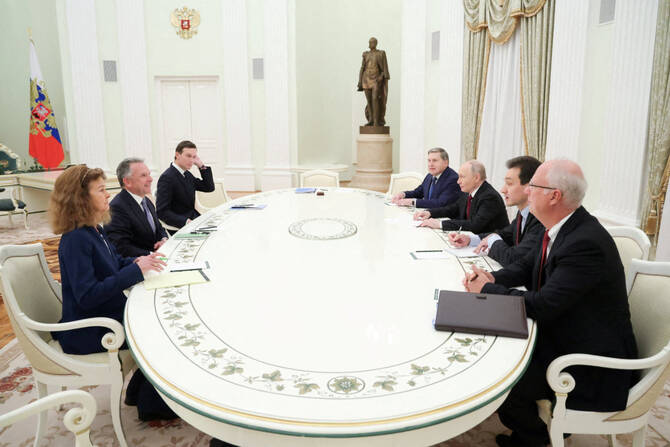
Russian President Vladimir Putin, presidential envoy Kirill Dmitriev and foreign policy aide Yuri Ushakov attend a meeting with US President Donald Trump's special envoy Steve Witkoff and son-in-law Jared Kushner at the Kremlin in Moscow on December 2, 2025. (Sputnik/Alexander Kazakov/Pool via REUTERS)
Short Url
Updated 04 December 2025
Follow

Trump says Putin wants to end war, US to hold new talks with Ukraine

  • “I can tell you that they had a reasonably good meeting with President Putin,” Trump said
  • Moscow insisted it was incorrect to say Putin rejected the plan in its entirety

WASHINGTON: President Donald Trump said Wednesday he believes Russia’s Vladimir Putin wants to end the Ukraine war despite inconclusive talks in Moscow, as US officials prepared for a follow-up meeting with Kyiv’s top negotiator.
Trump’s envoy Steve Witkoff and son-in-law Jared Kushner huddled into the early hours with Putin in the Kremlin but reached no breakthrough on halting Europe’s worst conflict since World War II.
The Kremlin said afterward it found parts of the US plan to end the war unacceptable, even though the proposal includes Ukraine ceding parts of the eastern Donbas region it still holds nearly four years after Russia’s invasion.
“I can tell you that they had a reasonably good meeting with President Putin,” Trump said when an AFP reporter asked him about the talks, adding afterwards that the talks were “very good.”
Trump said it was too soon to tell what would happen “because it does take two to tango.”
Pressed on whether Witkoff and Kushner got any sense that Putin genuinely wanted to halt Russia’s nearly four-year-old invasion, Trump replied: “He would like to end the war. That was their impression.”
Trump added that Ukraine “pretty well” backed the US proposal, although he added that Kyiv should have done so earlier when he had a notoriously heated meeting with President Volodymyr Zelensky in the Oval office in February.
Witkoff and Kushner were now due to meet top Ukrainian negotiator Rustem Umerov in Florida on Thursday, two US officials told AFP, to follow up on the Kremlin talks.


‘Successes of the Russian army’

But while the White House had voiced optimism ahead of the Kremlin talks, Moscow said that the two sides had failed to reach a compromise and that more work was needed.
The Kremlin added Wednesday that its army’s recent battlefield successes in Ukraine had bolstered its position and that Kyiv’s ties to NATO remained a key question.
Russia’s advance in eastern Ukraine gathered pace last month and Putin has said in recent days that Moscow is ready to fight on to seize the rest of the land it claims if Kyiv does not surrender it.
“The progress and nature of the negotiations were influenced by the successes of the Russian army on the battlefield in recent weeks,” Kremlin aide Yuri Ushakov, who took part in the US-Russia talks, told reporters, including AFP.
Moscow insisted it was incorrect to say Putin rejected the plan in its entirety.
It also said Russia was still committed to diplomacy, despite Putin’s stark warning earlier this week that Moscow was prepared to fight Europe if it wanted war.
“We are still ready to meet as many times as is needed to reach a peace settlement,” Kremlin spokesman Dmitry Peskov said.

‘Opportunity to end the war’

In Kyiv, Zelensky said that though a window of opportunity for peace has opened, it must be accompanied by pressure on Moscow.
“The world now clearly feels that there is an opportunity to end the war, and the current activity in negotiations must be supported by pressure on Russia,” he said in a regular evening address.
The fresh talks come as NATO pledges to buy hundreds of millions of dollars worth of US arms for Kyiv.
NATO chief Mark Rutte said it was positive that peace talks were ongoing, but that the alliance should make sure that “Ukraine is in the strongest possible position to keep the fight going.”
Russian troops have been grinding forward across the front line against outgunned and outnumbered Ukrainian forces.
Earlier this week, Moscow claimed to have captured the important stronghold of Pokrovsk, but a Ukrainian army unit fighting in the city said urban combat was still ongoing.
European countries have expressed fears Washington and Moscow will reach agreements without them and have spent the last weeks trying to amend the US plan so that it does not force Kyiv to capitulate.


Georgia’s street dogs stir affection, fear, national debate

Updated 3 sec ago
Follow

Georgia’s street dogs stir affection, fear, national debate

TBILISI: At a bus stop in central Tbilisi, two tagged dogs dozed on a bench as some commuters smiled at them and others cast angry glances.
In the streets of the Georgian capital, such scenes are part of daily life: community-fed “yard dogs,” yellow municipal tags on their ears, lounge outside bakeries, metro entrances and school gates.
The free-roaming canines stir both affection and fear. What to do with their swelling numbers — in the tens of thousands in Tbilisi alone — has become a nationwide dilemma.
Stray animals tied the top spot for public concerns in a poll by the National Democratic Institute, with 22 percent of respondents naming it the most pressing issue.
Many welcome the dogs as a symbol of Tbilisi, a showcase of Georgian hospitality and the warm street life that draws tourists to the capital.
“Street dogs in Georgia have made a more positive impact on tourism and the image of Georgia than people and culture alone,” said journalist Elena Nikoleisvili, 51, who helps street dogs.
“If anything, these adorable creatures should be the symbol of the capital — like the cats of Istanbul.”
On cafe terraces, regulars slip bones under tables as mongrels curl up between patrons’ feet, while each neighborhood and cul-de-sac has its own local canine mascot.

- ‘Drop in the ocean’ -

Others worry about safety.
“They bark and scare folks,” said plumber Oleg Berlovi, 43.
“Two weeks ago, a dog bit my kid and we needed shots. Animals are great, but they need looking after.”
According to the World Health Organization, dogs are the main vectors in human rabies cases globally.
Georgia still records a handful of human deaths from the disease each year and administers tens of thousands of post-exposure treatments, according to the Global Alliance for Rabies Control.
City officials say the answer is steady, humane population control.
“The state’s policy is to manage these animals by the most humane methods possible and to reduce to a minimum the number of stray dogs on the streets,” Nicoloz Aragveli, who heads Tbilisi city hall’s animal monitoring agency, told AFP.
A recent count put the capital’s stray dog population at about 29,000, and around 74 percent have been neutered, Aragveli said.
“We plan to do more so that we reach 100 percent,” he said.
The city runs weekly school lessons and a door-to-door registration drive to raise awareness and track owned pets.
Legislative changes have also tightened penalties for abandoning animals and for violating care and ownership rules — steps officials say will help halt the flow of pets to the streets.
But journalist Nikoleisvili said the authorities only responded after a public backlash, and “could do much more.”
The number of dogs that have been neutered in Tbilisi — around 50,000 over the last decade — is “a drop in the ocean,” she said.

- ‘Guilty party’ -

Volunteers, like theater director Zacharia Dolidze, who builds kennels, also play a big role in caring for the dogs.
“There are days I make 20 kennels. I’ve built about 2,500 in seven years,” the 40-year-old said.
He collects regular donations to help pay for materials.
Shelter operators say there are big gaps in addressing what they call one of Georgia’s biggest issues.
“You can make regulations, but if you cannot enforce them, that’s not going to help,” said Sara Anna Modzmanashvili Kemecsei, who runs a shelter that houses about 50 dogs.
In many regions, “there are absolutely no neutering campaigns.”
“I can’t really see that the government is on top of the issue, so there are lots of volunteers,” she said. “They are really good at managing these animals.”
Politics has also injected fresh uncertainty.
Last year, the government pushed a “foreign influence” law that complicates NGOs’ access to funding from foreign donors such as UK animal welfare charity Mayhew, which runs a program to vaccinate and neuter strays in Tbilisi.
Volunteers meanwhile continue to juggle feeding, sheltering and basic care.
Nino Adeishvili, 50, is a geologist and university lecturer who looks after around 10 dogs.
Her group organizes rabies shots and fundraises on Facebook for deworming, flea treatment and food.
“On the street, a dog is still unprotected,” she said.
“The guilty party is the human.”