Pakistan lifted women’s financial inclusion from 4% to 52% since 2018 — central bank

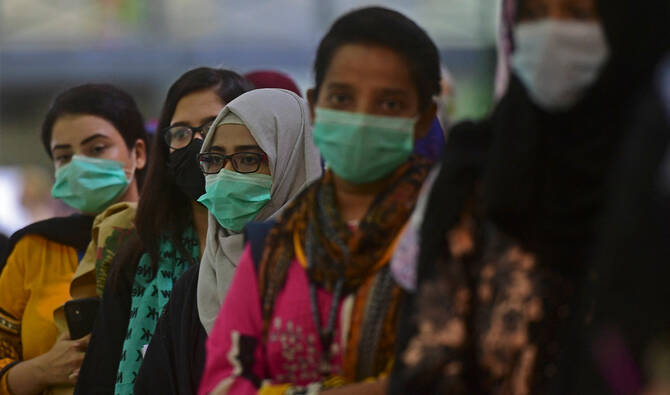
Women wait for their turn to receive a dose of the Covid-19 coronavirus Sinovac vaccine at a vaccination camp organised at expo centre in Karachi on June 3, 2021. (AFP/File)
Short Url
Updated 03 December 2025
Follow

Pakistan lifted women’s financial inclusion from 4% to 52% since 2018 — central bank

  • Pakistan added 17.6 million women-owned bank accounts since 2021, SBP governor says
  • Most women remain limited to microfinance, with only 1% accessing commercial-bank loans

KARACHI: Pakistan has increased women’s financial inclusion from 4% in 2018 to 52% in 2025, State Bank of Pakistan (SBP) Governor Jameel Ahmad said on Wednesday, calling the shift a major step toward closing the country’s long-standing gender gap in access to formal financial services.

The progress comes after years of structural constraints in Pakistan, where women have historically been excluded from banking channels due to cultural norms, low workforce participation and limited access to credit. Improving women’s access to financial services has been a central priority under the National Financial Inclusion Strategy, which aims to expand the use of bank accounts, digital payments, savings tools and small-business financing.

Global institutions including the World Economic Forum, OECD and McKinsey have repeatedly underscored that economies grow faster when women participate fully in the workforce and financial system. Pakistan has traditionally lagged behind regional peers, making the gains recorded this year significant even as major barriers persist at higher levels of business financing and leadership.

“As a result of our collective efforts, women’s financial inclusion has risen from 4% to 52%, and we have succeeded in narrowing the gender gap from 47% in 2018 to 30% in 2025,” Ahmad said in a speech marking Pakistan Women Entrepreneurship Day.

He said 17.6 million new women-owned bank accounts had been added since 2021, and that under Pakistan’s 2024–28 financial inclusion roadmap, the country now aims to push overall inclusion to 75% and reduce the gender gap further to 25%.

The governor added that financing to women entrepreneurs reached a new benchmark of Rs230 billion ($824 million), with 974,000 loans disbursed between November 2024 and October 2025. However, 93% of these loans, Rs113 billion ($405 million), fell under microfinance, showing that most women “remain clustered in micro and entry-level segments.” 

Only 1% of all commercial-bank loans went to women-led corporate and commercial enterprises, Ahmad said, adding that Pakistan’s banking workforce was also undergoing structural change, with 14,600 women joining the sector over the last three years, raising female representation from 13% to 17%. 

Pakistan became the 19th global signatory to the Women Entrepreneurs Finance Code earlier this year, with SBP and 22 banks pledging new actions and improved data reporting to expand women’s access to credit, the governor said.

He added that more than 300 awareness and mentorship programs were held across 55 districts, engaging over 45,000 women, as part of nationwide efforts to expand female entrepreneurship.

In his closing remarks, Ahmad said Pakistan must continue building an ecosystem “where women-led businesses can access finance, markets, and mentorship.”


Pakistan PM invites UAE investment across tech and resource sectors at National Day event

Updated 08 December 2025
Follow

Pakistan PM invites UAE investment across tech and resource sectors at National Day event

  • Shehbaz Sharif says the UAE remains a key economic partner and continues to lend ‘critical support’ to Pakistan
  • UAE envoy says both nations have potential for cooperation in renewable energy, AI and economic diversification

ISLAMABAD: Pakistan is ready to welcome investment from the United Arab Emirates across emerging technologies and resource sectors, Prime Minister Shehbaz Sharif said on Monday, as both countries marked the 54th National Day of the Gulf country in Islamabad.

Speaking at the ceremony attended by senior ministers, diplomats and business leaders, Sharif said the UAE remained a key economic partner for Pakistan and continued to lend “critical support” to the country’s stabilizing economy.

“Pakistan takes great pride in its strategic partnership with the UAE, which continues to deepen across every domain of life,” he said. “With Pakistan’s economy stabilizing, we stand ready to welcome Emirati investment in renewable energy, AI, fintech, agriculture and minerals.”

Sharif praised the UAE’s leadership and recalled his earliest memories of the Gulf nation as “a land that believed in possibilities long before they became realities,” saying the country’s progress under President Sheikh Mohamed bin Zayed Al Nahyan commanded “profound admiration.”

UAE Ambassador Salem Al Bawab Al Zaabi said the Emirates was committed to strengthening ties with Pakistan in areas including the economy, energy and artificial intelligence.

He said the two countries shared a “deep-rooted friendship built on mutual respect, shared values and a common vision for regional peace and development.”

“We see tremendous potential for collaboration in renewable energy, artificial intelligence, sustainability and economic diversification,” the ambassador said, adding that the UAE aimed to broaden the scope of its economic relations with Pakistan.

The UAE hosts around 1.8 million Pakistani expatriates, one of the country’s largest overseas communities, who Sharif said contributed “tirelessly” to the Gulf state’s development.

Sharif and Deputy Prime Minister Ishaq Dar also joined the UAE ambassador in a cake-cutting ceremony to mark the occasion.