

Migrants in Lebanon hope Pope’s peace message lingers amid fears of new war

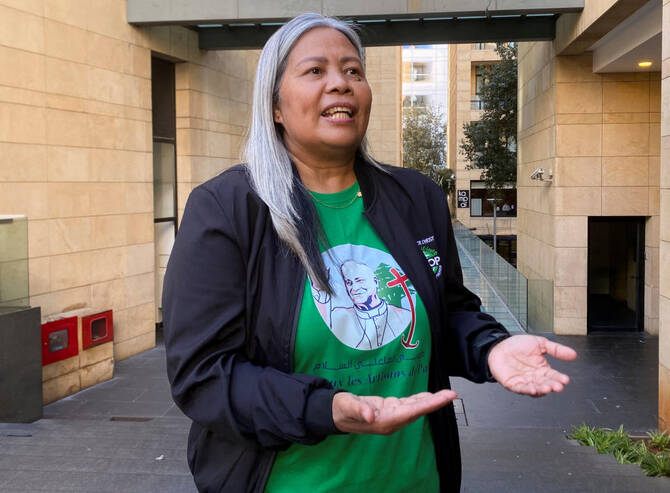
Filipino worker Loren Capobres, attends an interview with Reuters, in Beirut, Lebanon Dec. 2, 2025. (Reuters)
Short Url
Updated 03 December 2025
Follow

Migrants in Lebanon hope Pope’s peace message lingers amid fears of new war

  • “Migrants like me are not just workers. We are co-workers. We are contributors in this country, helpers, builders,” said Capobres
  • During last year’s war, Capobres’s church became a shelter for migrants and refugees

BEIRUT: Filipino worker Loren Capobres said the world stood still when she kissed Pope Leo’s hand this week in Lebanon, but hopes his message for peace will linger after his departure, leading to better working conditions and a lasting peace in the country.
Capobres, who is Catholic and has worked in Lebanon for 17 years, met Leo on Monday, alongside priests and other church volunteers on his first overseas trip as pope, in which he called on the Middle East’s leaders to reject the horror of war.
She shared testimonies of the particular challenges migrants faced during last year’s war between Israel and Lebanese armed group Hezbollah, when they were turned away from shelters hosting Lebanese fleeing intense Israeli strikes.
“Migrants like me are not just workers. We are co-workers. We are contributors in this country, helpers, builders,” said Capobres, one of more than 170,000 migrant workers in Lebanon.

A LASTING IMPACT
Leo’s departure comes as fears grow in Lebanon that a new conflict could start. Israeli strikes have killed at least 127 civilians since a 2024 truce, the United Nations human rights office said last month. A strike on Beirut’s southern suburbs last month was interpreted by many as a signal of a looming war.
Capobres hopes Leo’s push for peace across the region could take hold, and that authorities in Lebanon take heed.
“I hope that the Pope will give impact, his words will give impact for the people who are responsible for everything here in Lebanon. And, of course, I pray for peace,” she told Reuters.
During last year’s war, Capobres’s church became a shelter for migrants and refugees and she helped care for the displaced while staying there herself. “At the same time, I’m a refugee. At the same time, I’m helping,” she said.
In a Monday address after Capobres had spoken to him, Leo said that stories like hers “invite us to take a stand to ensure that no one else will have to flee from his or her country due to senseless and cruel conflicts.”

’BE STRONG’
Leo’s message of peace has a particular significance for migrants, many of whom would not be able to travel to their home countries without risking their ability to return to work.
“So we can go home, but we cannot come back. But as I said, I need to work,” said Capobres, a domestic worker.
She said fellow migrant workers, and even her employer, got in touch to congratulate her after her address to Leo.
“I’m happy that giving that testimony, I can inspire co-migrants, my fellow migrants, that their voice is heard through me,” she said.
When she finally had the opportunity to kiss the pope’s hand, Capobres said she “couldn’t see anything. I just cried. And then, you know, I feel that the world stopped.”
“But I do remember one word he said to me: be strong.”


Lebanon urges UNSC delegation to press Israel to respect ceasefire

Updated 57 min 56 sec ago
Follow

Lebanon urges UNSC delegation to press Israel to respect ceasefire

  • Israel has kept up strikes on Lebanon and has also maintained troops in five south Lebanon areas it deems strategic

BEIRUT: Lebanese President Joseph Aoun urged a United Nations Security Council delegation on Friday to pressure Israel to respect a year-old ceasefire and to support his army’s efforts to disarm Hezbollah.
Despite a November 2024 ceasefire that was supposed to end more than a year of hostilities between Israel and the Iran-backed militant group, Israel has kept up strikes on Lebanon and has also maintained troops in five south Lebanon areas it deems strategic.
Aoun “stressed the need to pressure the Israeli side to implement the ceasefire and withdraw, and expressed his hope for pressure from the delegation,” according to a statement from the presidency.
He also noted “Lebanon’s commitment to implementing international resolutions” and asked the envoys to support the Lebanese army’s efforts to disarm non-government groups.
The Lebanese government ordered its military to fully disarm Hezbollah in August, and the army expects to complete the first phase of its plan by the end of the year.
The UN delegation visited Damascus on Thursday and after its meeting with Aoun was due to inspect the border area in southern Lebanon on Saturday, accompanied by US envoy Morgan Ortagus.
The visit comes as Lebanese and Israeli civilian representatives held their first direct talks in decades.
On Thursday, Information Minister Paul Morcos quoted Aoun calling the initial negotiations “positive” and stressing “the need for the language of negotiation — not the language of war — to prevail.”
That same day, Israel struck four southern Lebanese towns, saying it was targeting Hezbollah infrastructure including weapons depots to stop the group from rearming.
UN peacekeepers called the strikes “clear violations of Security Council resolution 1701,” which ended the 2006 war between Hezbollah and Israel.
The peacekeepers also said their vehicles were fired on by six men on three mopeds near Bint Jbeil on Thursday. There were no injuries in the incident.
“Attacks on peacekeepers are unacceptable and serious violations of resolution 1701,” the international force added.
Hezbollah refuses to disarm but has not responded to Israeli attacks since the ceasefire. It has, however, promised a response to the killing of its military chief in a strike on Beirut’s southern suburbs last month.