

Climate rights group flags mental, physical strain on factory workers in Pakistan’s Karachi

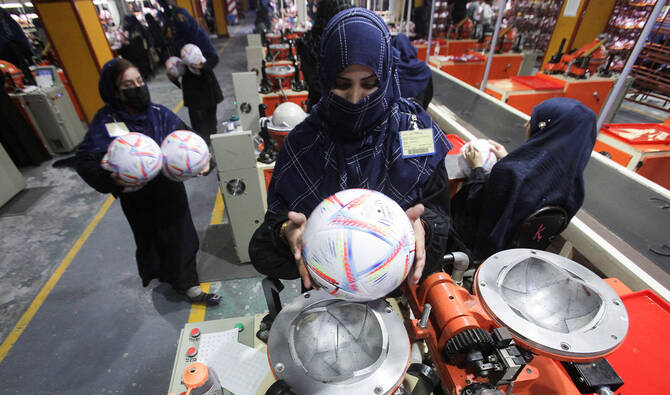
Workers conduct the final check of balls inside the soccer ball factory in Sialkot, Pakistan December 2, 2022. (Reuters/File)
Short Url
Updated 03 December 2025
Follow

Climate rights group flags mental, physical strain on factory workers in Pakistan’s Karachi

  • CRI report holds mills producing US, European brands responsible for unsafe, overheated working conditions
  • The US-based NGO warns Pakistani textile workers face long hours, extreme heat and hazardous workplaces

KARACHI: Workers for international fashion and home goods supply chains in Pakistan’s financial capital Karachi face physical and mental strain due to hot working conditions, Climate Rights International (CRI) said on Wednesday.

CRI is a US-based NGO that links climate change and human rights, documenting impacts on vulnerable communities, raising awareness and advocating for government and corporate accountability.

In its 98-page report titled “They Don’t See What Heat Does to Our Bodies: Climate Change, Labor Rights and the Cost of Fashion in Karachi,” CRI said factory and mills in Karachi making goods for US and European brands including H&M, Zara, Gap, Mango, Next, and IKEA were responsible for exploiting workers.

“The fashion industry’s role in driving both overconsumption and global emissions is well-documented,” CRI researcher and author of the report Cara Schulte said.

“And now some of the biggest household names in fashion and home goods are fueling and then ignoring new dimensions of occupational risk brought on by climate change,” she continued. “These companies are effectively turning a blind eye as workers across their supply chains continue to suffer and collapse in the heat.”

The report highlighted that temperatures in Karachi now routinely exceed 38-40°C (100-104°F), with some areas of the southern Sindh province reaching highs of over 52°C (126°F).

It said workers frequently experienced nausea, dizziness, blurred vision, muscle tremors and injuries due to the heat. Many reported that they had fainted themselves or witnessed colleagues collapsing on the job.

“You can imagine how much hotter it becomes inside, where machinery, bodies and fabric all trap heat,” the report quoted worker Mohammad Hunain as saying.

“When I get very hot, I start sweating uncontrollably. My head begins pounding. Sometimes my vision becomes blurry. I have felt dizzy many times ... when I felt like I might faint, but stopping work is not an option. If I sit down or slow down too much, the supervisors scold us, and the contractor can cut our wages.”

“There are no fans, no cooling units, no ventilation ... The workers are simply left to struggle,” he continued.

The report also highlighted numerous instances of forced and unpaid overtime, restricted recovery breaks and a lack of access to safe drinking water and sanitation.

Mir Zulfiqar Ali, a local labor rights activist and the Executive Director of the Workers Education and Research Organization in Pakistan said: “Many garment units are built like sealed boxes. The priority is to protect the product, not the people who stitch it.”

In Pakistan, many laborers, especially in manufacturing and industry sectors, work under hazardous conditions. Workers face physical and mental strain, low wages, and little protection from occupational hazards.


Pakistan to launch AI screening in January to target fake visas, agent networks

Updated 5 sec ago
Follow

Pakistan to launch AI screening in January to target fake visas, agent networks

  • New system to flag forged-document travelers before boarding and pre-verify eligibility
  • Move comes amid increasing concern over fake visas, fraudulent agents, forged papers

ISLAMABAD: Pakistan will roll out an AI-based immigration screening system in Islamabad from January to detect forged documents and prevent illegal overseas travel, the government said on Thursday. 

The move comes amid increasing concern over fake visas, fraudulent agents and forged papers, with officials warning that such activity has contributed to deportations, human smuggling and reputational damage abroad. Pakistan has also faced scrutiny over irregular migration flows and labor-market vulnerability, particularly in the Gulf region, prompting calls for more reliable pre-departure checks and digital verification.

The reforms include plans to make the protector-stamp system — the clearance required for Pakistani citizens seeking overseas employment — “foolproof”, tighten labor-visa documentation, and cancel the passports of deportees to prevent them from securing visas again. The government has sought final recommendations within seven days, signalling a rapid enforcement timeline.

“To stop illegal immigration, an AI-based app pilot project is being launched in Islamabad from January,” Interior Minister Mohsin Naqvi said following a high-level meeting chaired by him and Minister for Overseas Pakistanis Chaudhry Salik Hussain.

Naqvi said the new screening technology is intended to determine travelers’ eligibility in advance, reducing airport off-loads and closing loopholes exploited by traffickers and unregistered agents.

The interior minister added that Pakistan remains in contact with foreign governments to improve the global perception and ranking of the green passport, while a uniform international driving license will be issued through the National Police Bureau.

The meeting also approved zero-tolerance measures against fraudulent visa brokers, while the Overseas Pakistanis Ministry pledged full cooperation to streamline the emigration workflow. Minister Hussain said transparency in the protector process has become a “basic requirement,” particularly for labor-migration cases.

Pakistan’s current immigration system has long struggled with document fraud, with repeated cases of passengers grounded at airports due to forged papers or agent-facilitated travel. The launch of an AI screening layer, if implemented effectively, could shift the burden from manual counters to pre-flight verification, allowing authorities to identify risk profiles before departure rather than after arrival abroad.

The reforms also come at a moment when labor mobility is tightening globally. Gulf states have begun demanding greater documentation assurance for imported labor, while European and Asian destinations have increased scrutiny following trafficking arrests and irregular-entry routes from South Asia. For Pakistan, preventing fraudulent departures is increasingly linked to protecting genuine workers, reducing deportation cycles and stabilizing the country’s overseas employment footprint.