

Pakistan signs D-8 dispute mechanism in Egypt, calls for activating preferential trade deal

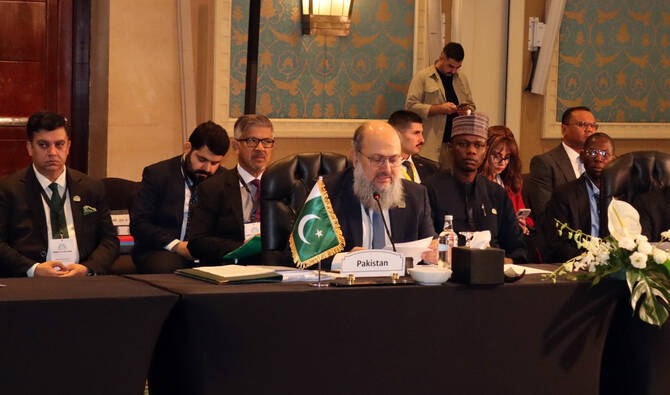
Pakistan’s Federal Minister for Commerce, Jam Kamal Khan, addresses the Fourth D-8 Trade Ministers Council in Cairo, Egypt, on December 8, 2025. (Commerce Ministry)
Short Url
Updated 03 December 2025
Follow

Pakistan signs D-8 dispute mechanism in Egypt, calls for activating preferential trade deal

  • Pakistan urges D-8 members to expand digital trade, logistics connectivity and private-sector partnerships
  • Jam Kamal Khan says the bloc must respond collectively to supply-chain disruptions, climate-related shocks

KARACHI: Pakistan has signed the Developing-8 (D-8) dispute settlement mechanism, an official statement said on Wednesday, as its commerce minister urged member states to operationalize the bloc’s preferential trade agreement (PTA) and expand cooperation in digital trade to boost regional economic integration.

The eight-nation grouping, founded in 1997 by Indonesia, Malaysia, Bangladesh, Pakistan, Iran, Türkiye, Egypt and Nigeria, aims to promote economic cooperation among large Muslim-majority developing states, though progress has often been uneven.

Commerce Minister Jam Kamal Khan made the remarks at the Fourth D-8 Trade Ministers Council in Cairo, where delegations met to review trade commitments and discuss the PTA’s implementation.

“The signing of the protocol — together with the operationalization of the PTA among D-8 member states — is expected to further enhance trade, facilitate smoother economic engagement and support the long-term vision of a more integrated D-8 economic bloc,” the commerce ministry said.

“Jam Kamal Khan stressed the urgency for regional platforms like the D-8 to respond collectively to rising protectionism, supply chain disruptions, climate-related shocks and commodity market volatility,” it added. “Strengthened cooperation, he noted, is essential to maintain resilience, sustain trade flows and foster market confidence.”

Khan also welcomed Azerbaijan’s accession as the grouping’s ninth member, calling its inclusion a boost to the bloc’s economic potential.

He emphasized the need to make the PTA fully functional, saying Pakistan was committed to harmonizing procedures, resolving operational hurdles and streamlining documentation to expand intra-D-8 trade.

The minister called for stronger institutional linkages in customs cooperation, standardization, mutual recognition and logistics connectivity to unlock regional trade.

He added that efficient transport corridors, predictable transit systems and deeper digital integration were critical for competitiveness.

Khan also urged member states to strengthen private-sector collaboration through joint ventures, technology partnerships and sector-specific cooperation.

He identified food security, textiles, agriculture, energy and technological innovation as priority areas for joint work aligned with sustainable development goals.

“Together,” he said according to the statement, “with the right policies and a strong spirit of partnership, we can transform the D-8 region into a dynamic center of trade, development, and opportunity for all our peoples.”


Pakistan says repaid over $13.06 billion domestic debt early in last 14 months

Updated 29 January 2026
Follow

Pakistan says repaid over $13.06 billion domestic debt early in last 14 months

  • Finance adviser says repayment shows “decisive shift” toward fiscal discipline, responsible economic management
  • Says Pakistan’s total public debt has declined from over $286.6 billion in June 2025 to $284.7 billion in November 2025

KARACHI: Pakistan has repaid Rs3,650 billion [$13.06 billion] in domestic debt before time during the last 14 months, Adviser to the Finance Minister Khurram Schehzad said on Thursday, adding that the achievement reflected a shift in the country’s approach toward fiscal discipline. 

Schehzad said Pakistan has been repaying its debt before maturity, owed to the market as well as the State Bank of Pakistan (SBP), since December 2024. He said the government had repaid the central bank Rs300 billion [$1.08 billion] in its latest repayment on Thursday. 

“This landmark achievement reflects a decisive shift toward fiscal discipline, credibility, and responsible economic management,” Schehzad wrote on social media platform X. 

Giving a breakdown of what he said was Pakistan’s “early debt retirement journey,” the finance official said Pakistan retired Rs1,000 billion [$3.576 billion] in December 2024, Rs500 billion [$1.78 billion] in June 2025, Rs1,160 billion [$4.150 billion] in August 2025, Rs200 billion [$715 million] in October 2025, Rs494 billion [$1.76 billion] in December 2025 and $1.08 billion in January 2026. 

He said with the latest debt repaid today, the July to January period of fiscal year 2026 alone recorded Rs2,150 billion [$7.69 billion] in early retirement, which was 44 percent higher than the debt retired in FY25.

He said of the total early repayments, the government has repaid 65 percent of the central bank’s debt, 30 percent of the treasury bills debt and five percent of the Pakistan Investment Bonds (PIBs) debt. 

The official said Pakistan’s total public debt has declined from over Rs 80.5 trillion [$286.6 billion] in June 2025 to Rs80 trillion [$284.7 billion] in November 2025. 

“Crucially, Pakistan’s debt-to-GDP ratio, around 74 percent in FY22, has declined to around 70 percent, reflecting a broader strengthening of fiscal fundamentals alongside disciplined debt management,” Schehzad wrote. 

Pakistan’s government has said the country’s fragile economy is on an upward trajectory. The South Asian country has been trying to navigate a tricky path to economic recovery under a $7 billion loan from the International Monetary Fund.