MOSCOW: US Secretary of State Marco Rubio said "some progress" has been made in talks with Russia to end its war with Ukraine, in an interview that aired Tuesday.
"And so what we have tried to do, and I think have made some progress, is figure out, what could the Ukrainians live with that gives them security guarantees for the future," Rubio told Fox News host Sean Hannity, adding the US hopes the compromise "allows them not just to rebuild their economy, but to prosper as a country."
High-stakes US-Russia talks on ending the war in Ukraine failed to yield a breakthrough on Tuesday, as the Kremlin said “no compromise” had been found yet on the key question of territory.
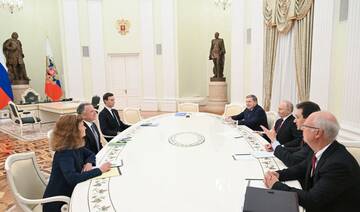
Russian President Vladimir Putin met US President Donald Trump’s son-in-law Jared Kushner and special envoy Steve Witkoff in the Kremlin, after earlier signalling that his forces were ready to fight on to achieve Russia’s initial war goals.
The meeting is a crucial moment for Ukraine in what could be a fraught week following days of frantic diplomacy. At the heart of it is a US plan to bring peace, which has since been revised under pressure from Kyiv and its European backers.
On occupied Ukrainian territories, “so far we haven’t found a compromise, but some American solutions can be discussed,” top Russian presidential aide Yuri Ushakov said after the meeting in the Kremlin.
“Some proposed formulations do not fit us, and work will continue,” he added.
Trump said progress on ending the nearly four-year-long war would not be easy.
“Our people are over in Russia right now to see if we can get it settled,” he said during a cabinet meeting at the White House.
“Not an easy situation, let me tell you. What a mess.”
Ukrainian President Volodymyr Zelensky said on Monday that any plan must end the war for good, and not just lead to a pause in the fighting that began with Moscow’s offensive in February 2022.
He also said in a social media post that “there will be no simple solutions.”
“What matters is that everything is fair and transparent. That there are no games played behind Ukraine’s back. That nothing is decided without Ukraine — about us, about our future,” he said.
- Moscow rejects amended plan -
Kushner and Witkoff were to present Putin with the new version of the US plan, which has been hammered out after the initial version raised fears in Kyiv and elsewhere in Europe that it made too many concessions to Moscow.
Ushakov said the initial US plan was broken down into four parts, which were discussed during the five-hour meeting in the Kremlin.
“There were some points we could agree on,” the top Putin diplomatic aide said, but “the president did not hide our critical, even negative, stance on a number of proposals.”
Putin has demanded that Kyiv surrender territory Moscow claims as its own. The Kremlin also rejects any European force in Ukraine to monitor a truce.
In his social media post, Zelensky said “the most difficult questions are about territories, about frozen (Russian) assets... And about security guarantees.”
Still, the talks in Moscow were “useful,” Ushakov said, and Russia and US positions did not become farther apart after it.
Russian pressure
Putin appeared to send a hawkish message shortly before the US talks began.
He said that Pokrovsk, an east Ukrainian stronghold that Russian forces claim they recently captured, was a “good foothold for solving all the tasks set at the beginning of the special military operation,” using the Kremlin’s term for the war.
Apart from Pokrovsk, Kyiv is under pressure on several fronts.
Russian forces advanced swiftly in November in eastern Ukraine, and Kyiv has been rocked by graft scandals that ended with the resignation of its top negotiator on the conflict — Zelensky’s right-hand man.
Moscow has also stepped up drone and missile attacks on Ukraine in recent weeks, leaving hundreds of thousands without electricity and heating, with Zelensky accusing the Kremlin of trying to “break” his country.
The Russian leader also accused Europe of sabotaging a deal on the conflict and sent a grim message, saying: “We are not planning to go to war with Europe, but if Europe wants to and starts, we are ready right now.”
Zelensky has said he expects to discuss key issues with the US president and suggested Moscow’s real motivation for the US talks was to ease Western sanctions.
Kushner included
Europe is worried Washington and Moscow could strike a deal over its head or force Ukraine into making unfair concessions.
The original 28-point US plan revealed last month hewed so closely to Moscow’s demands it prompted accusations that Russia was involved in drafting it, which Washington denied.
Bloomberg last month reported on an audio recording showing that Witkoff helped coach Russian officials on how Putin should speak to Trump.
Witkoff has met with Putin multiple times, but US media reported that it was the first time that Kushner — who also helped broker a ceasefire between Israel and Hamas in Gaza earlier this year — has joined talks with Putin.