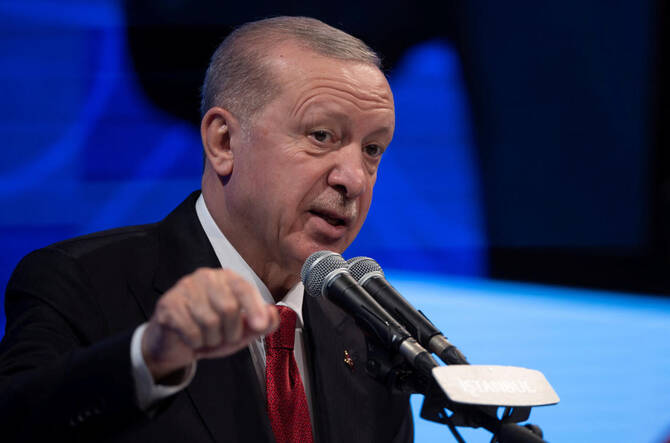
ISTANBUL: Turkiye’s President Recep Tayyip Erdogan on Sunday announced he was postponing a visit to Abu Dhabi because Emirati leader Mohamed bin Zayed Al Nahyan had a “health problem” — then deleted the message.
The message, posted by Erdogan’s team on X, said he had talked with Al Nahyan by phone.
“During the course of the call, President Erdogan expressed his sadness over the health problem experienced by (President) Al Nahyan and wished him a prompt recovery,” said the three-paragraph message.
Erdogan would travel to the United Arab Emirates at a later date, still to be determined, the message added.
Although the message — of which AFP has a screen grab — was quickly deleted from the account, it had already been picked up by official Turkish media.
Turkiye’s state broadcaster likewise took down its article on Erdogan that mentioned the Emirati leader’s health problem.
The official Emirati news agency, WAM, reported on the telephone conversation between the two leaders, but did not mention that Erdogan’s visit had been postponed.
Contacted by AFP, neither the Turkish presidency nor the Emirati authorities — who have themselves made no statement on their president’s health — have yet answered.
The Emirati leader’s team on Saturday evening released photos taken the same day showing Al Nahyan, known as MBZ, smiling and apparently in good health, with Sheikh Tamim bin Hamad Al Thani, the emir of Qatar.

Erdogan postpones UAE visit, saying leader has ‘health problem’
Short Url
https://arab.news/jr9jv
Erdogan postpones UAE visit, saying leader has ‘health problem’
- Turkiye’s President Recep Tayyip Erdogan on Sunday announced he was postponing a visit to Abu Dhabi because Emirati leader Mohamed bin Zayed Al Nahyan had a “health problem” — then deleted the message
WHO says Dubai global emergency logistics hub ‘resuming operations’
- Hanan Balkhy, WHO’s Eastern Mediterranean regional chief, says more than 50 emergency supply requests across 25 countries are affected by the pause
- The hub stopped work this week after Iran launched waves of missile and drone attacks across the Gulf
GENEVA: The World Health Organization said its global health emergencies logistics hub in Dubai was resuming operations on Friday after a pause caused by the war in the Middle East.
“One of our most immediate concerns is the disruption of humanitarian health supply chains,” Hanan Balkhy, the UN health agency’s Eastern Mediterranean regional chief, told a press conference in Geneva.
“After a temporary pause, WHO’s Hub for Global Health Emergencies Logistics is today resuming operations,” she said, speaking from Cairo.
She said the UAE, in coordination with the UN’s World Food Programme, had confirmed that it stood ready to facilitate urgent humanitarian shipments.
“More than 50 emergency supply requests across 25 countries are currently affected,” said Balkhy.
“These pending requests — which will benefit more than 1.5 million people — include WHO supplies for Lebanon, Gaza, Yemen, and Somalia, as well as polio laboratory supplies for global detection and eradication activities across a number of countries.”
She said the WHO would be working in the coming days to process urgent new shipments and clear priority backlogs.
Balkhy noted that even before the escalation of hostilities in the Middle East, health systems in many countries were already operating at full capacity.
“WHO has pre-positioned trauma supplies and essential medicines at our warehouse in Tehran and is closely monitoring the situation — including potential mass casualty needs, disruptions to essential health services, and possible displacement,” she said.
“One of our most immediate concerns is the disruption of humanitarian health supply chains,” Hanan Balkhy, the UN health agency’s Eastern Mediterranean regional chief, told a press conference in Geneva.
“After a temporary pause, WHO’s Hub for Global Health Emergencies Logistics is today resuming operations,” she said, speaking from Cairo.
She said the UAE, in coordination with the UN’s World Food Programme, had confirmed that it stood ready to facilitate urgent humanitarian shipments.
“More than 50 emergency supply requests across 25 countries are currently affected,” said Balkhy.
“These pending requests — which will benefit more than 1.5 million people — include WHO supplies for Lebanon, Gaza, Yemen, and Somalia, as well as polio laboratory supplies for global detection and eradication activities across a number of countries.”
She said the WHO would be working in the coming days to process urgent new shipments and clear priority backlogs.
Balkhy noted that even before the escalation of hostilities in the Middle East, health systems in many countries were already operating at full capacity.
“WHO has pre-positioned trauma supplies and essential medicines at our warehouse in Tehran and is closely monitoring the situation — including potential mass casualty needs, disruptions to essential health services, and possible displacement,” she said.
© 2026 SAUDI RESEARCH & PUBLISHING COMPANY, All Rights Reserved And subject to Terms of Use Agreement.


