

Afghanistan’s Taliban rulers carry out public execution in sports stadium in eastern city

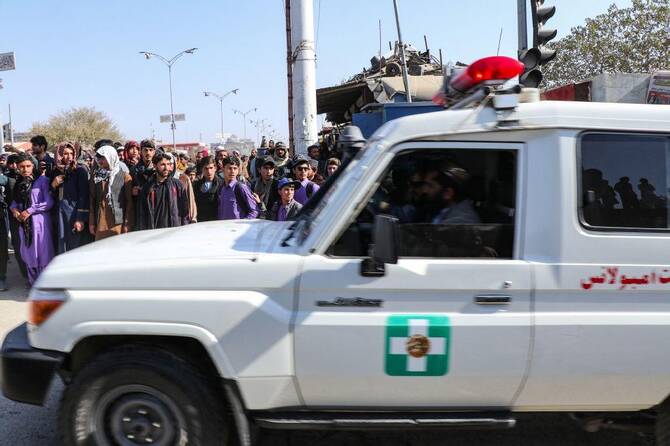
An ambulance transports the body of a man publicly executed by the Taliban at a football stadium in Khost on Dec. 2, 2025. (AFP)
Short Url
Updated 02 December 2025
Follow

Afghanistan’s Taliban rulers carry out public execution in sports stadium in eastern city

  • Tens of thousands of people, including relatives of the victims, attended the execution in the sports stadium
  • Bennet posted: “Public executions are inhumane, a cruel and unusual punishment, and contrary to international law”

KABUL: Afghanistan’s Taliban authorities carried out a public execution at a stadium in the eastern city of Khost on Tuesday, putting to death a man who the country’s Supreme Court said had killed 13 members of a family, including several children, earlier this year.
Tens of thousands of people, including relatives of the victims, attended the execution in the sports stadium, which the Supreme Court said was the 11th carried out since the Taliban seized power in 2021 in the wake of the chaotic withdrawal of US and NATO forces.

United Nations’ Special Rapporteur for Afghanistan Richard Bennet posted on X earlier Tuesday that reports had suggested the public execution was imminent and called for it to be halted.
“Public executions are inhumane, a cruel and unusual punishment, and contrary to international law,” he posted.
Afghanistan’s Taliban rulers have imposed a strict interpretation of Sharia law, which has included a return of public executions, as well as bans on Afghan women and girls from secondary school and university education and from most forms of employment.
According to a statement by the Supreme Court, the execution was ordered after a death sentence was passed down by a court, an appeals court and the top ccourt itself, and approved by Afghanistan’s supreme leader, Hibatullah Akhundzada.
The man was shot to death by a relative of those he was convicted of having killed, said Khost police spokesman Mustaghfir Gorbaz. The man had been convicted along with anothers of entering a family home in Khost province and shooting to death an extended family, including nine children and their mother, Gorbaz said.
The victims’ relatives had been offered the option of forgiveness and reconciliation that would have spared the man’s life, but instead requested the death penalty, the court said.
During their previous rule of Afghanistan in the late 1990s, the Taliban regularly carried out public executions, floggings and stonings.


Bangladesh begins exhuming mass grave from 2024 uprising

Updated 07 December 2025
Follow

Bangladesh begins exhuming mass grave from 2024 uprising

  • The United Nations says up to 1,400 people were killed in crackdowns as Hasina attempted to cling to power — deaths that formed part of her conviction last month for crimes against humanity

DHAKA: Bangladeshi police began exhuming on Sunday a mass grave believed to contain around 114 unidentified victims of a mass uprising that toppled autocratic former prime minister Sheikh Hasina last year.
The UN-supported effort is being advised by Argentine forensic anthropologist Luis Fondebrider, who has led recovery and identification missions at mass graves worldwide for decades.
The bodies were buried at the Rayerbazar Graveyard in Dhaka by the volunteer group Anjuman Mufidul Islam, which said it handled 80 unclaimed bodies in July and another 34 in August 2024 — all people reported to have been killed during weeks of deadly protests.
The United Nations says up to 1,400 people were killed in crackdowns as Hasina attempted to cling to power — deaths that formed part of her conviction last month for crimes against humanity.
Criminal Investigation Department (CID) chief Md Sibgat Ullah said investigators believed the mass grave held roughly 114 bodies, but the exact number would only be known once exhumations were complete.
“We can only confirm once we dig the graves and exhume the bodies,” Ullah told reporters.

- ‘Searched for him’ -

Among those hoping for answers is Mohammed Nabil, who is searching for the remains of his brother Sohel Rana, 28, who vanished in July 2024.
“We searched for him everywhere,” Nabil told AFP.
He said his family first suspected Rana’s death after seeing a Facebook video, then recognized his clothing — a blue T-shirt and black trousers — in a photograph taken by burial volunteers.
Exhumed bodies will be given post-mortem examinations and DNA testing. The process is expected to take several weeks to complete.
“It’s been more than a year, so it won’t be possible to extract DNA from the soft tissues,” senior police officer Abu Taleb told AFP. “Working with bones would be more time-consuming.”
Forensic experts from four Dhaka medical colleges are part of the team, with Fondebrider brought in to offer support as part of an agreement with the UN rights body the OHCHR.
“The process is complex and unique,” Fondebrider told reporters. “We will guarantee that international standards will be followed.”
Fondebrider previously headed the Argentine Forensic Anthropology Team, founded in 1984 to investigate the tens of thousands who disappeared during Argentina’s former military dictatorship.
Authorities say the exhumed bodies will be reburied in accordance with religious rites and their families’ wishes.
Hasina, convicted in absentia last month and sentenced to death, remains in self-imposed exile in India.