

Four including district administrator killed in militant attack on convoy in northwest Pakistan

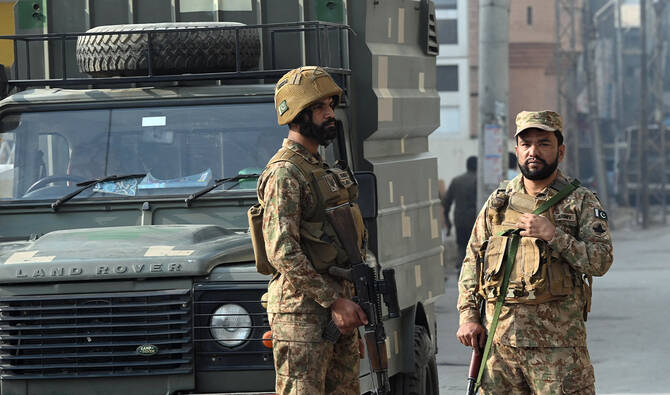
Security personnel stand guard at the site of a suicide attack outside the border force headquarters in Peshawar, Pakistan, on November 24, 2025. (AFP/File)
Short Url
Updated 02 December 2025
Follow

Four including district administrator killed in militant attack on convoy in northwest Pakistan

  • Assistant commissioner, two police officers and a civilian killed in convoy ambush in Bannu
  • Attack comes amid sharp rise in cross-border militancy and worsening Pakistan–Afghanistan tensions

PESHAWAR: A militant attack on a government convoy in northwest Pakistan on Tuesday killed a senior district administrator, two police officers and a civilian, officials said, marking the latest escalation in a wave of violence gripping the country’s border regions with Afghanistan.

The assault took place in Bannu, a district of Khyber Pakhtunkhwa (KP) province that has seen repeated attacks since the Pakistani Taliban, or TTP, ended a fragile ceasefire with the state in late 2022. Pakistan has blamed the Afghan Taliban government for allowing anti-Pakistan groups like the TTP to operate from Afghan soil, a charge Kabul denies, as Islamabad struggles to contain a surge in shootings, bombings and targeted killings across KP and other parts of the country. 

In Tuesday’s assault, the convoy of Assistant Commissioner North Waziristan Shah Wali was ambushed near Sher Brick Kiln on Miranshah Road. Wali, two policemen and a civilian were killed, police said. 

KP Information Minister Shafi Jan condemned the assault, calling it “a heinous and cowardly act, and we will not let the terrorists succeed in their nefarious designs.”

“The martyrdom of Assistant Commissioner Shah Wali is a significant loss for the province, and his services to the region will always be remembered. We will continue to stand strong against terrorism,” Jan said in a statement. 

In a separate statement, KP Chief Minister Sohail Afridi also denounced the attack. 

“The attack is highly regrettable and condemnable. The enemies of the country cannot deter us with such cowardly acts,” he said.

Afridi directed the provincial police chief to submit a detailed report and ordered “immediate and best medical treatment to the injured.”

No group has claimed Tuesday’s assault. 

Pakistan has experienced an intense escalation in violence over the past two years, with security officials attributing much of the renewed militancy to TTP fighters allegedly operating from sanctuaries inside Afghanistan. Kabul denies the accusation and says Islamabad must address its own internal security challenges.

Tensions between the two neighbors peaked in October 2025, when a series of deadly clashes along the border killed dozens of soldiers on both sides. Pakistan said Afghan forces had carried out unprovoked attacks. The Taliban government accused Pakistan of violating its territorial sovereignty through airstrikes. 

Following the clashes, the two sides held talks in Istanbul, but the discussions failed to produce a breakthrough. Issues related to cross-border militant attacks, border management and refugee repatriations remain unresolved, contributing to one of the most strained periods in Pakistan-Afghanistan relations in years.


Pakistan mulls 'Super App' for public services, document verification in major technology push

Updated 15 February 2026
Follow

Pakistan mulls 'Super App' for public services, document verification in major technology push

  • Pakistan has been urging technology adoption in public, private sectors as it seeks to become a key tech player globally
  • The country this month launched the Indus AI Week to harness technology for productivity, skills development and innovation

KARACHI: Pakistan is planning to launch a “Super App” to deliver public services and enable digital document verification, the country's information technology (IT) minister said on Sunday, amid a major push for technology adoption in public and private sectors.

Pakistan, a country of 240 million people, seeks to become a key participant in the global tech economy, amid growing interest from governments in the Global South to harness advanced technologies for productivity, skills development and innovation.

The country's information and communications technology (ICT) exports hit a record $437 million in Dec. last year, according to IT Minister Shaza Fatima Khawaja. This constituted a 23% increase month on month and a 26% increase year on year.

Pakistan's technology sector is also advancing in artificial intelligence (AI) and cloud computing, marked by the launch of Pakistan’s first sovereign AI cloud in November, designed to keep sensitive data domestic and support growth in the broader digital ecosystem.

“In developed countries, citizens can access all government services from a mobile phone,” Fatima said, announcing plans for the Super App at an event in Karachi where more than 7,000 students had gathered for an AI training entrance test as part of the ‘Indus AI Week.’

“We will strive to provide similar facilities in the coming years.”

Khawaja said the app will reduce the need for in-person visits to government offices such as the National Database and Registration Authority (NADRA) and the Higher Education Commission (HEC).

The Indus AI Week initiative, which ran from Feb. 9 till Feb. 15. was aimed at positioning Pakistan as a key future participant in the global AI revolution, according to the IT minister.

At the opening of the weeklong initiative, Prime Minister Shehbaz Sharif announced that Pakistan would invest $1 billion in AI by 2030 to modernize the South Asian nation’s digital economy.

“These initiatives aim to strengthen national AI infrastructure and make the best use of our human resource,” Khawaja said, urging young Pakistanis to become creators, inventors and innovators rather than just being the consumers of technology.