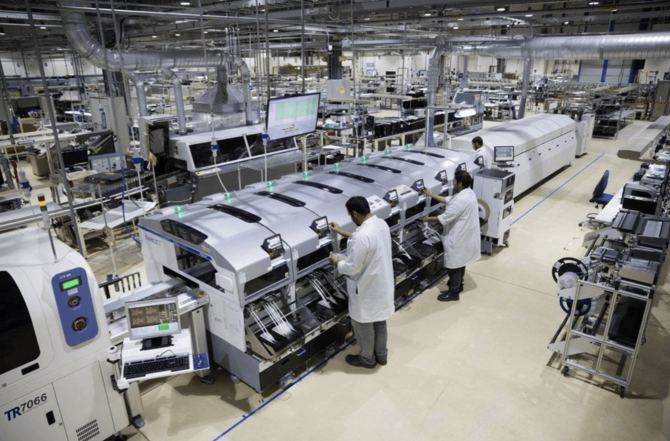
We are expanding incentives for factories: Saudi deputy minister 

Incentives to support factories will be expanded in the coming years. Al-Eqtisadiah
Short Url
Updated 02 December 2025
Follow

We are expanding incentives for factories: Saudi deputy minister 

RIYADH: The number of factories assessed by the Ministry of Industry and Mineral Resources has reached 8,000, with over 300 classified as advanced factories, Ahmed Al-Zawawi, assistant deputy minister for industrial competitiveness and advanced manufacturing, told Al-Eqtisadiah. 

He explained that since the announcement of the launch of the Advanced Manufacturing and Production Center, efforts have been underway to accelerate support for factories in their industrial transformation journey. 

Al-Zawawi said: “We have managed to evaluate more than 8,000 factories, and the results of these assessments showed that there are over 300 advanced factories. About 1,500 factories have undergone detailed evaluations, and transformation plans have been developed for them to enable their journey toward advanced manufacturing.” 

He pointed out that the ministry currently offers a wide range of incentives and enablers to support factories, revealing that these incentives will see significant expansion in the coming years. 

The assistant deputy minister said: “Today, we have 180 accredited service providers, 80 of whom were accredited this year alone,” adding, “We aim to reach more than 1,000 service providers by 2030, with the goal of reducing transformation costs for factories and enhancing their global competitiveness.” 

He stated that the ministry is working through several specialized programs, including the Basic Digitization Program, which offers support of up to SR2 million ($532,831), in addition to undertakings under the Competitiveness Program umbrella, which provides loans and grants of up to SR40 million through the Industrial Development Fund. 

Al-Zawawi affirmed that they aim for these programs to be a real driver for the industrial sector, enabling it to compete globally and enter the era of advanced manufacturing with confidence and capability. 


Saudi POS spending jumps 28% in final week of Jan: SAMA

Updated 06 February 2026
Follow

Saudi POS spending jumps 28% in final week of Jan: SAMA

RIYADH: Saudi Arabia’s point-of-sale spending climbed sharply in the final week of January, rising nearly 28 percent from the previous week as consumer outlays increased across almost all sectors. 

POS transactions reached SR16 billion ($4.27 billion) in the week ending Jan. 31, up 27.8 percent week on week, according to the Saudi Central Bank. Transaction volumes rose 16.5 percent to 248.8 million, reflecting stronger retail and service activity. 

Spending on jewelry saw the biggest uptick at 55.5 percent to SR613.69 million, followed by laundry services which saw a 44.4 percent increase to SR62.83 million. 

Expenditure on personal care rose 29.1 percent, while outlays on books and stationery increased 5.1 percent. Hotel spending climbed 7.4 percent to SR377.1 million. 

Further gains were recorded across other categories. Spending in pharmacies and medical supplies rose 33.4 percent to SR259.19 million, while medical services increased 13.7 percent to SR515.44 million. 

Food and beverage spending surged 38.6 percent to SR2.6 billion, accounting for the largest share of total POS value. Restaurants and cafes followed with a 20.4 percent increase to SR1.81 billion. Apparel and clothing spending rose 35.4 percent to SR1.33 billion, representing the third-largest share during the week. 

The Kingdom’s key urban centers mirrored the national surge. Riyadh, which accounted for the largest share of total POS spending, saw a 22 percent rise to SR5.44 billion from SR4.46 billion the previous week. The number of transactions in the capital reached 78.6 million, up 13.8 percent week on week. 

In Jeddah, transaction values increased 23.7 percent to SR2.16 billion, while Dammam reported a 22.2 percent rise to SR783.06 million. 

POS data, tracked weekly by SAMA, provides an indicator of consumer spending trends and the ongoing growth of digital payments in Saudi Arabia.  

The data also highlights the expanding reach of POS infrastructure, extending beyond major retail hubs to smaller cities and service sectors, supporting broader digital inclusion initiatives.  

The growth of digital payment technologies aligns with Saudi Arabia’s Vision 2030 objectives, promoting electronic transactions and contributing to the Kingdom’s broader digital economy.