

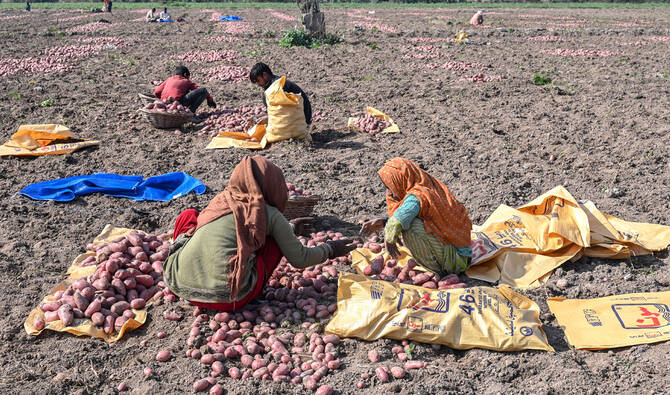

KARACHI: Pakistan is facing more than 70% decline in potato prices in domestic markets after the closure of its border with Afghanistan halted exports to the landlocked country, which is also a key route for Islamabad’s shipments to Central Asia, traders and farmers said on Monday.
Pakistan closed its border crossings at Torkham in the northwest and at Chaman in the southwest in October, following fierce clashes with Afghanistan over a surge in militant attacks inside Pakistan.
The persisting trade blockade is weighing more heavily on Pakistan which, according to official data, enjoyed over $750 million trade surplus with its war-torn neighbor in the last fiscal year that ended in June.
The suspension of trade has brought down the prices of potatoes, Pakistan’s largest vegetable by area and production, by as much as 77 percent in domestic markets in recent weeks.
“The market conditions are very bad as it is over supplied, which is risking the new crop,” said Khalid Mehmood Khokhar, president of the Pakistan Kissan Ittihad (PKI) that represents farmers across the country.
“The 60-kilogram bag of potatoes, which earlier used to be sold at Rs2,600 ($9.3), is now not even fetching its godown rental cost of Rs600 ($2.1).”
Khokhar appealed to the government to resolve the issue of border closures with Afghan government as soon as possible as farmers were facing huge losses, with their produce not even fetching its cost.
“Afghanistan is a big market for Pakistani potatoes,” the PKI president said. “It is also a transit country for our exports to Central Asian countries as well as Russia.”
Pakistan’s commerce ministry spokesperson, Naveed-ul-Haq Kallu, did not respond to a request for comment.
“Pakistani lives are more important than trade,” another commerce ministry official, who is privy to the matter, told Arab News, requesting anonymity. “Until a solid commitment is given by the Afghan side, this will remain closed.”
Pakistan’s agriculture sector accounted for 24 percent of the gross domestic product (GDP) and employed more than 37 percent of the nation’s labor force last year, according to the Economic Survey 2024-25.
The country of more than 240 million exports vegetables, particularly potatoes, a big chunk of which goes to Tajikistan, Kazakhstan, Kyrgyzstan, Turkmenistan, Uzbekistan and beyond via Afghanistan.
While the sector resisted climate-related odds and grew 0.6 percent last year, the country’s vegetable exports fell 15 percent to $368 million, according to the Pakistan Bureau of Statistics (PBS).
Pakistan’s overall exports fell 4 percent to $10.4 billion from July till October.
This is reflecting on the country’s current account deficit which widened to $733 million during Jul-Oct period, compared to $206 million recorded during the same period a year earlier, according to the Pakistani finance ministry data.
Pakistan produces more potatoes than it consumes and exports the surplus, according to Khokhar.
The country harvested 9.4 million tons of potatoes from 386,000 hectares in the last fiscal year, which was 12 percent higher than 8.4 million tons of the crop in the preceding year.
The Federal Committee on Agriculture (FCA) targets the production of 8.9 million tons of potatoes during the 2025-26 Rabi crop season that begins in October and lasts till April.
Malik Nusrat Mahmood, a potato trader in Islamabad, said he was concerned about a lack of buyers for his huge potato stocks, while the new crop was around the corner.
The wholesale price of a 5-kilogram bag of potatoes has declined by as much as 60 percent to Rs80 (less than a dollar) since the exports halted, he said.
“Potato prices have witnessed a significant decline while the new crop has started hitting the market,” he told Arab News, voicing his worries.
Pakistan-Afghanistan clashes erupted on Oct. 11 after Islamabad hit what it said where Tehreek-e-Taliban Pakistan (TTP) targets inside Afghanistan. The two sides reached a ceasefire in Doha on Oct. 19.
Landlocked Afghanistan has since leaned more heavily on trade routes via Iran and Central Asia to reduce its dependence on Pakistan as tensions remain high between the neighbors.
Thousands of Afghanistan-bound shipments have been stranded at Pakistani ports or border crossings, making traders from across the Durand Line liable to pay heavy penalties on account of port demurrage and shipping detention daily.
Bilateral trade between the neighbors surged 40 percent to $804 million in 2024-25, according to the State Bank of Pakistan data. Pakistan’s exports to Afghanistan stood at $778 million, while its imports were recorded at a meager $26 million.
“There is a glut in the markets because the exports have halted while the new crop from Punjab province, which is a major producer, is about to arrive,” Rizwan, another vegetable trader from Islamabad who only gave his first name, told Arab News.
“Poor farmers will lose everything if this [Pakistan-Afghanistan] route does not open anytime soon.”


