

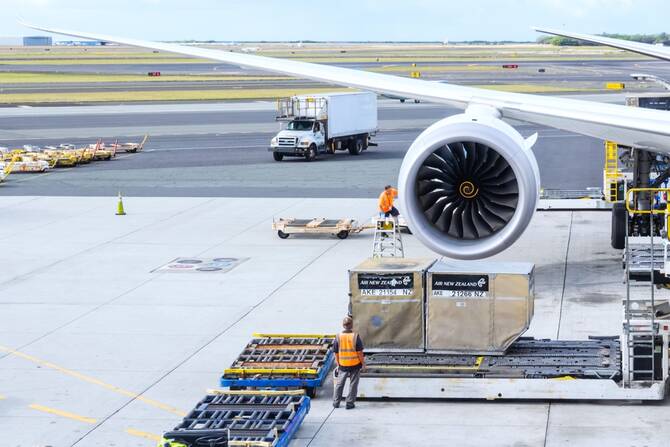

RIYADH: Global air cargo markets strengthened in October, with Middle Eastern carriers posting a 5.7 percent year-on-year increase in demand as worldwide volumes rose to their highest level on record.
According to the latest data issued by the International Air Transport Association, capacity in the region jumped 10 percent from a year earlier — the strongest expansion globally — even as geopolitical risks and airspace disruptions continued to influence routing patterns.
The gains came as global cargo demand advanced 4.1 percent year on year, marking the eighth straight month of growth and pushing industry volumes to a historic high.
“The shifting growth pattern shows that air cargo is enabling global supply chains to adapt to the impact of US tariffs,” IATA Director General Willie Walsh said in a statement, adding that October delivered near double-digit expansion on key lanes within Asia, between the Middle East and Europe, and between Europe and Asia.
The strong performance coincided with signs of improving industrial activity. Global goods trade rose 5.3 percent in September, while world industrial production increased 3.7 percent, the fastest pace since March 2025.
Manufacturing sentiment also strengthened, with the global purchasing managers’ index climbing for a third month to 51.45, although new export orders remained in contraction territory at 48.31.
Despite lower crude prices, jet fuel costs rose 2.5 percent in October as tight diesel supplies pushed the crack spread to nearly double last year’s level, adding pressure to operating costs.
Regional performance
Asia-Pacific airlines posted an 8.3 percent year-on-year increase in air cargo demand in October, alongside a 7.3 percent rise in capacity.
North American carriers saw a 2.7 percent annual drop in cargo demand, the weakest performance globally alongside Latin America, despite a marginal 0.1 percent uptick in capacity.
European carriers reported a 4.3 percent increase in cargo demand from a year earlier, matched by an identical 4.3 percent rise in capacity.
Latin American carriers also posted a 2.7 percent year-on-year decline in cargo demand — tying North America for the weakest regional performance — while capacity grew 2.8 percent.
African airlines delivered the strongest growth worldwide, with cargo demand surging 16.6 percent year-on-year in October and capacity expanding 20 percent.
Trade Lane
Europe–Asia remained the standout corridor, expanding by 11.7 percent, while traffic between the Middle East and Asia rose 11.5 percent and Asia–Africa gained 10.9 percent. Intra-Asia routes added 9 percent.
Asia–North America extended its decline to a sixth straight month, down 1.4 percent in October, while Europe–Middle East traffic was broadly flat at 0.1 percent. Europe–North America saw modest growth of 2.6 percent.
Walsh said the latest data signals resilience ahead of the industry’s peak year-end shipping period: “This positive news is especially significant as the air cargo sector enters the peak fourth quarter shipping season.”


