

Pope arrives in Lebanon with message of peace for crisis-hit country

1 / 2
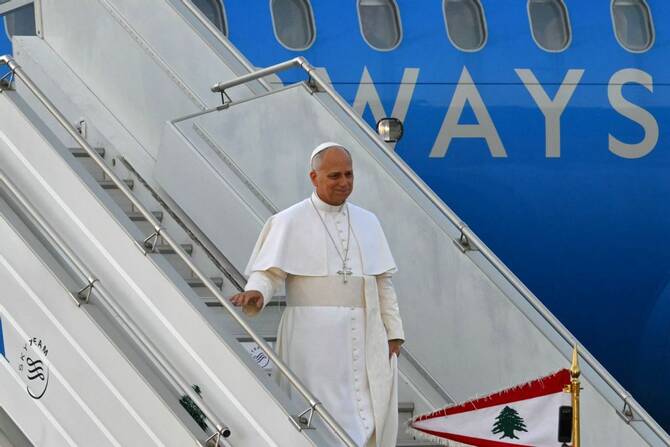
Pope Leo XIV arrives at Beirut International Airport, in the Lebanese capital, on November 30, 2025. (AFP)
2 / 2
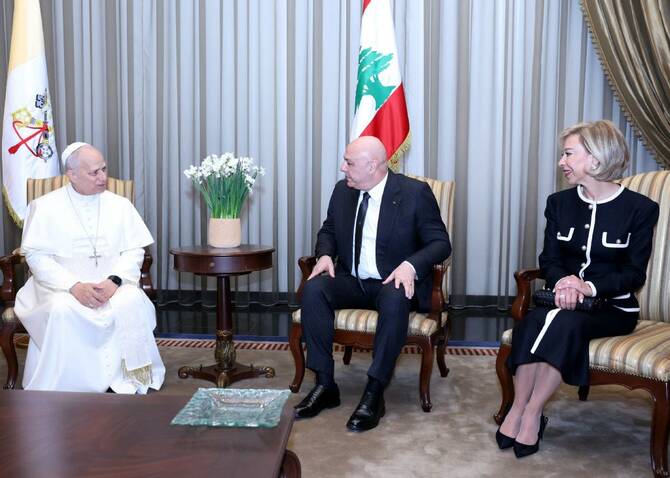
A handout photograph released by the Lebanese Presidency's press office shows Pope Leo XIV meeting with by Lebanon's President Joseph Aoun (C) and first lady Nehmat Nehme (R). (AFP/Lebanese Presidency)
Short Url
Updated 30 November 2025
Follow

Pope arrives in Lebanon with message of peace for crisis-hit country

  • Leo will not travel to the south, the target of Israeli strikes
  • Schedule includes prayer at site of Beirut port blast, leading an outdoor Mass on city waterfront, visiting psychiatric hospital

BEIRUT: Pope Leo XIV arrived in Lebanon on Sunday with a message of peace for the crisis-hit nation, still reeling from a war between Israel and Hezbollah and the conflict’s lingering aftereffects.

The pope had previously visited Turkiye, where he kicked off his first overseas tour since being elected leader of the world’s 1.4 billion Catholics in May.

He told journalists on the plane that the visit to the two countries had “a special theme of... being a messenger of peace, of wanting to promote peace throughout the region.”

Leo was met in Beirut by officials including President Joseph Aoun, the Arab world’s only Christian head of state.

Lebanon rolled out the red carpet and a 21-gun salute for Leo, who was also greeted at the airport by children and a brass band as ships at the port sounded their horns.

Two Lebanese military aircraft escorted his plane on descent.

“I came to say that the Lebanese are one people and we are united,” said Zahra Nahleh, 19, from Lebanon’s war-ravaged south, who was waiting along the road from the airport to welcome the pontiff.

“The pope is not just for Christians but for Muslims too, and we love him a lot,” she told AFP. “We want him to bless our land, we wish he could visit the south.”

The two-nation tour is something of a test for the first American pope, whose understated style contrasts with that of his charismatic and impulsive predecessor, Francis.

Although Leo’s four-day visit drew little attention in Turkiye, a Muslim-majority nation whose Christian community numbers only around 100,000, his 48-hour stopover has been eagerly awaited in Lebanon, a religiously diverse country of around six million people.

Hezbollah scouts

Long hailed as a model of coexistence, Lebanon since 2019 has been ravaged by successive crises, from economic collapse, to a devastating Beirut port blast in 2020, to the recent war between militant group Hezbollah and Israel, which largely ended with a ceasefire last November.

The last papal visitor was Benedict XVI in 2012.

Christians play a key political role in Lebanon, where the post of president is reserved for a Maronite Christian — but they have seen their numbers dwindle, particularly due to emigration.

Leo held talks with Aoun, Prime Minister Nawaf Salam and parliament speaker Nabih Berri at the presidential palace, and made a speech to authorities and diplomats.

A group of traditional dancers welcomed him at the entry to the presidential palace despite the rain.

Youth scouting groups affiliated with Hezbollah had waited to welcome the pope along the road in Beirut’s southern suburbs, where the Iran-backed militants hold sway and where posters of slain chief Hassan Nasrallah appeared near billboards welcoming the pontiff.

On Saturday, Hezbollah had urged the pope to reject Israeli “injustice and aggression” against Lebanon.

Israel has kept up regular raids on Lebanon, usually saying it is striking Hezbollah targets, despite the truce that was supposed to end more than a year of hostilities, including two months of open war with the group.

The pope said  that a two-state solution was the only one likely to resolve the conflict between Israel and the Palestinians.

“The Holy See has publicly backed the proposal for a two-state solution for several years. We all know that Israel still does not accept it, but we consider it the only solution likely to resolve the current conflict,” he said during a brief exchange.

He said he discussed the issue on Thursday in Ankara with Turkish President Recep Tayyip Erdogan “who fully supports this proposal,” adding that “Turkiye has an important role to play in this process.”

The Holy See has recognized the State of Palestine since 2015.

Since his election in May, the pope has expressed his solidarity with the “martyred land” of Gaza and denounced the forced displacement of Palestinians.

On Sunday, he said the Vatican maintained “friendly” relations with Israel and had offered its services as a mediator.

“My gratest dream”

In Turkiye, Leo’s visit was firmly focused on calls for greater unity among different branches of Christianity.

He began his trip on Thursday by holding talks with President Recep Tayyip Erdogan.

Then he traveled to Iznik to mark 1,700 years since the First Council of Nicaea, one of the early Church’s most important gatherings, which he celebrated at an ecumenical service alongside Patriarch Bartholomew I, leader of the world’s 260 million Orthodox Christians.

Saturday saw Leo hold mass in Istanbul with thousands of worshippers braving heavy rain, many of whom had traveled across Turkiye for the moving multilingual service.

On his last day, Leo met privately with a bereaved father whose 14-year-old Italian-Turkish son died in February after being stabbed at a market in Istanbul.

He then went to the Armenian Cathedral where he had words of encouragement for the largest of Turkiye’s Christian communities — with some 50,000 members — thanking God “for the courageous Christian witness of the Armenian people throughout history, often amid tragic circumstances.”

It was an apparent nod to the massacres the Armenians suffered at the hands of the Ottoman troops in 1915-1916, which has been qualified as genocide by around 30 countries, although Turkiye firmly rejects the term.


Israel’s Barak ‘regrets’ knowing Epstein after documents detail friendship

Updated 8 sec ago
Follow

Israel’s Barak ‘regrets’ knowing Epstein after documents detail friendship

  • Former Israeli prime minister apologizes for his years-long friendship with convicted sex offender Jeffrey Epstein
  • Barak is among several political elites found to have maintained long relationships with Epstein, even after his 2008 conviction
TEL AVIV, Israel: Former Israeli Prime Minister Ehud Barak has apologized for his years-long friendship with convicted sex offender Jeffrey Epstein that included regular correspondence, multiple visits to the disgraced financier’s Manhattan apartment and one to his private island.
The former Israeli leader has not been implicated in Epstein’s sexual abuse of underage girls and faces no accusations of wrongdoing. In an exclusive interview with Israel’s Channel 12 on Thursday, he said he regretted having ever known Epstein and apologized to all those “who feel deeply uncomfortable.”
“I am responsible for all my actions and decisions, and there is definitely room to ask if there wasn’t room for more in-depth judgment on my part and a more thorough examination of what the details really are, what exactly happened there,” he said.
Barak is among several political, business and cultural elites found to have maintained long relationships with Epstein, even after his 2008 guilty plea for soliciting prostitution from an underage girl in Florida. Epstein died by suicide in detention in 2019 while awaiting trial on federal allegations of sexually abusing and trafficking dozens of girls.
Barak, who has previously distanced himself from Epstein, gave the latest interview after millions of pages of documents were released by the US Justice Department in connection with its investigations of Epstein.
Barak and his wife, Nili, have turned up frequently in the documents, showing they stayed in regular contact with Epstein for years, including after he cut a deal with prosecutors in 2008 that resulted in an 18-month prison sentence.
Barak has acknowledged visiting Epstein numerous times, flying on his private plane and staying at his New York apartment when he was out of public office. Barak said he and his wife and some security guards paid a three-hour visit to Epstein’s home in the US Virgin Islands, but saw only Epstein and some maintenance workers there.
Barak said he never observed or took part in any inappropriate behavior. He said he was aware of the earlier Epstein case but assumed he had paid his debt to society.
“Only in 2019, when a reinvestigation of the whole story begins, does the breadth and depth of the man’s heinous crimes become apparent and I cut off relations with him, and everyone cuts off relations with him,” Barak said.

A Netanyahu rival

Barak served as prime minister from 1999 to 2001, when Israel and the Palestinians held high-level peace talks before the process collapsed and a Palestinian uprising broke out. He later served as defense minister.
His ties to Epstein came to light seven years ago after Barak announced a political comeback in an unsuccessful bid to topple Israeli Prime Minister Benjamin Netanyahu.
At the time, US tax records showed Barak received some $2 million in grants for unspecified “research” the previous decade from the Wexner Foundation — a philanthropic organization that supports Jewish causes. At the time, Epstein was a trustee of the foundation.
Barak downplayed those ties when they surfaced, saying Epstein “didn’t support me or pay me.”
The new batch of released documents show regular correspondence among Barak, his wife and Epstein.
Some detail plans for a 2017 stay at Epstein’s New York residence, while others discuss mundane logistics for other visits, meetings and phone calls. In June 2019, Barak’s wife, Nili, emailed Epstein saying they delayed their flight to New York by roughly a week. In 2013, Epstein’s assistant, Lesley Groff, emailed Epstein about dinner with Barak, his wife and several business people and celebrities, including Woody Allen.
In 2019 — about a week before Epstein was arrested — an exchange about Barak between Epstein and an unknown person shows Epstein saying he was ”dealing with Ehud in Israel. Making me crazy.”
The documents show that Epstein connected Barak with US President Donald Trump’s former adviser, Steve Bannon, who was seeking to become more involved in Israeli politics. Emails from Epstein to his staff and others in 2018 discussed setting up dinners or meetings between Barak and Bannon.
Bannon has not been implicated in any wrongdoing related to Epstein.
In Thursday’s interview, Barak said it’s likely more information will emerge from the documents in the weeks ahead, but he maintained that he had done nothing illegal or improper.
“I promise you that nothing will be discovered, because there is nothing,” he said.