

Travel chaos fears ease after Airbus intervenes on software fix

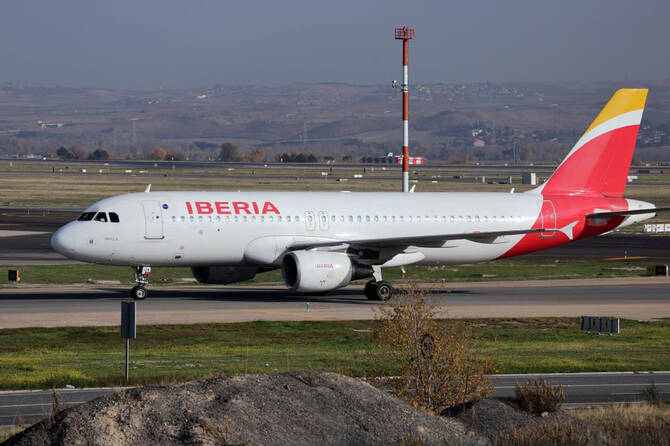
An Airbus A320 plane of Spain's flagship carrier Iberia arrives at the Madrid-Barajas Adolfo Suarez Airport in Madrid on December 3, 2024. The Spanish airline Iberia reported on November 29, 2025 a "security incident" that "compromised the confidentiality of certain customer data," while specifying that, at this stage, it has "no evidence indicating fraudulent use" of this information. (AFP)
Short Url
Updated 30 November 2025
Follow

Travel chaos fears ease after Airbus intervenes on software fix

PARIS: Fears of days of travel chaos across Europe and the world eased on Saturday after plane manufacturer Airbus intervened rapidly to implement a software upgrade it had said was immediately needed on some 6,000 of its A320 planes.
The announcement by Europe’s top plane manufacturer late Friday that the planes could not fly again until the switch was made followed an incident in the United States and raised concerns that hundreds of planes would need to be grounded for long periods.
But several leading European airlines said there had been minimal or no cancelations as a result, although there were indications the situation was more problematic in Latin America and Asia.
Airbus CEO Guillaume Faury acknowledged that the fix “has been causing significant logistical challenges and delays” but added its operators were working around the clock to ensure the required updates “are deployed as swiftly as possible to get planes back in the sky.”
“I want to sincerely apologize to our airline customers and passengers who are impacted now. But we consider that nothing is more important than safety,” he wrote on Linkedin.
Airbus had instructed its clients Friday to take “immediate precautionary action” after a technical malfunction on board a JetBlue flight in October exposed that intense solar radiation could corrupt data critical to the flight controls.

‘Far fewer’ than feared’

French Transport Minister Philippe Tabarot told BFMTV television that the aircraft manufacturer had been able to correct the defect “on more than 5,000 aircraft” on Friday and during the night from Friday to Saturday.
He indicated that the number of aircraft requiring more prolonged servicing could be much lower than the 1,000 originally feared.
“According to the latest information I have... it would seem that there would be far fewer A320s that would be impacted in a more prolonged way by the software change.”
“We had evoked the possibility of a thousand aircraft. It seems that we are now only talking about a hundred,” he added.

Produced since 1988, the A320 is the world’s best-selling airplane. Airbus sold 12,257 of the aircraft by the end of September compared with the sale of 12,254 Boeing 737s.
Air France told AFP it would be able to “transport all of its customers” on Saturday with the exception of flights on its Caribbean regional network. Air France had canceled 35 flights on Friday.
German airline Lufthansa added for its stable of carriers that “most of the software updates were completed overnight and on Saturday morning,” with no flight cancelations expected but isolated delays not excluded.
Budget airline giant EasyJet indicated that it had not canceled any flights, as the work on all its A320s was complete.

‘Quite fast’

French Economy Minister Roland Lescure also told BFMTV that “for the vast majority of these aircraft,” the software update “can be done remotely, it is quite fast.”
On October 30, a JetBlue-operated A320 aircraft encountered an in-flight control issue due to a computer malfunction.
The plane suddenly nosedived as it traveled between Cancun in Mexico and Newark in the United States, and pilots had to land in Tampa, Florida.
US media quoted local firefighters saying that some passengers were injured.
JetBlue, a budget carrier, said Saturday it was doing everything to minimize disruption to passengers.
Despite the Thanksgiving holidays, the impact in the US was limited with American airlines still favoring homegrown Boeings over Airbus. United Airlines said Saturday’s flights was proceeding as normal, while American Airlines said only four aircraft had been grounded.
In India, the aviation ministry said on Saturday that 68 aircraft still required updating, representing 20 percent of the country’s fleet affected by the problem.
Colombian airline Avianca said 70 percent of its fleet had been impacted and warned of “significant disruptions in the next 10 days,” suspending ticket sales until December 8.
In the Philippines, local carriers Philippine Airlines and Cebu Pacific were offering refunds or rebooked tickets after grounding at least 40 domestic flights on Saturday.


Russia jails 15 for life over IS-claimed 2024 concert hall attack

Updated 3 sec ago
Follow

Russia jails 15 for life over IS-claimed 2024 concert hall attack

  • Eleven other men were also jailed for life for acting as accomplices and of having terrorist links
  • Four more men were handed sentences of between 19 and 22 years over their links with the attackers

MOSCOW: A Russian court on Thursday handed life sentences to four gunmen from Tajikistan, and 11 others it said were their accomplices, for the 2024 Crocus concert hall attack that left 150 people dead.
The March 2024 shooting spree was claimed by Daesh and was the deadliest militant attack in Russia in more than two decades.
Relatives of some of the victims stood in the grand Moscow military court as the verdict was read out.
Shamsidin Fariduni, Dalerdzhon Mirzoyev, Makhammadsobir Fayzov and Saidakrami Rachabolizoda — all Tajik citizens who went on a shooting spree in the building before setting it on fire — looked down as the judge sentenced them to life.
Eleven other men — some Russian citizens — were also jailed for life for acting as accomplices and of having terrorist links.
Four more men — including a father and his sons — were handed sentences of between 19 and 22 years over their links with the attackers.
The gunmen entered the concert hall shortly before a show by Soviet-era rock band Picnic. They went on a shooting spree before setting fire to the building, trapping many victims. The attack wounded more than 600 people. Six children were among those killed.
Uliana Filippochkina, whose twin brother Grigory was killed in the attack, flew from Siberia’s Novosibirsk for the verdict.
She said she was “satisfied” with the ruling and that she had looked the men who killed her twin in the eyes during their final statements in the trial.
“They didn’t explain anything, they tried to escape responsibility, appealing to the fact that they had wives and children... That they were under the influence of drugs,” she said.

- ‘No remorse’ -

“There was no sympathy or remorse whatsoever,” she added.
Her brother went to the concert shortly before his 35th birthday. The family were only able to identify what was left of his body weeks later, burying his remains in Novosibirsk.
The verdict came ahead of the second anniversary of the killings.
“For us all it’s like yesterday,” Ivan Pomorin, who was filming the Crocus Hall concert at the time, told AFP.
Lawyers said some of the victims are still being treated for their wounds, while others have severe PTSD, unable to sleep, use public transport or be in crowded places.
The four gunmen — aged 20 to 31 at the time — worked in various professions, among them was a taxi driver, factory employee and construction worker.
They stood in the glass defendant’s cage, surrounded by security guards.
According to media reports, Mirzoyev’s brother was killed fighting in Syria, possibly leading to his radicalization.
Hours after the attack, Russian police brought them to court with signs of torture — including one barely conscious in a wheelchair.

- ‘Redeem guilt with blood’ -

The attack came two years into Moscow’s war in Ukraine, with Russia — bogged down by the offensive — dismissing prior US warnings of an imminent attack.
The Kremlin had suggested a Ukrainian connection at the time of the attack, but never provided evidence.
Russia’s Investigative Committee said after the verdict it was “reliably established” that the attack was “planned and committed in the interests of” Kyiv.
It accused the men of also plotting attacks in Dagestan.
TASS state news agency reported this month, citing a lawyer, that two of them — Dzhabrail Aushyev and Khusein Medov — had asked to be sent to fight in Ukraine instead of a life sentence.
Throughout its offensive, Russia has recruited prisoners for its military campaign, offering a buy-out from their sentences should they survive.
According to the lawyer quoted by TASS, Medov said he wanted to “redeem his guilt with blood.”

- Anti-migrant turn -

Russia — already undergoing a conservative social turn during the war — upped anti-migrant laws and rhetoric after the attack.
This has led to tensions with Moscow’s allies in Central Asia, some of whom have confronted Russia and called on it to respect the rights of their citizens.
Russia’s economy has for years been heavily reliant on millions of Central Asian migrants.
But their flow to Russia dipped after Moscow launched its Ukraine campaign and some Central Asians also held back from going to Russia after the post-Crocus migrant crackdowns.