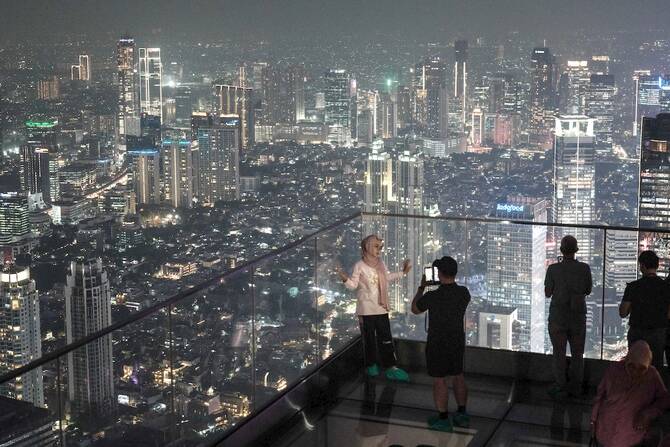

JAKARTA: Born and raised in Jakarta, Handini Mawar Putri has grown up witnessing the Indonesian capital’s transformation over the last two decades, from the rise of new skyscrapers and the massive changes to public transport, to the comings and goings of its political leaders.
The 22-year-old is one of nearly 42 million people residing in the megacity, a number that makes it the most populated city in the world according to the UN’s World Urbanization Prospects 2025 report, published earlier this month.
But as Jakarta toppled Tokyo as the world’s most populous city, many residents harbor growing concerns over the future of the megapolitan area.
“Congested. Complicated. Chaotic. I don’t know what other words can be used to describe this city. Behind its luxuries, Jakarta also holds many miseries that are rarely highlighted and barely taken seriously,” Putri told Arab News.
For years, Jakarta has made international headlines for its poor air quality, notorious traffic jams and regular flooding that have repeatedly brought life to a standstill across the capital.
In the city center, luxury residential areas and glass office towers are located only a few meters away from dense villages and slums, a stark display of Jakarta’s gaping economic divides.
Many neighborhoods in the city are also sinking and already below sea level, one factor that in 2022 prompted authorities to start building a new city; Nusantara is eventually intended to ease the burden on Jakarta and replace it as the capital.
“To live here, it is neither cheap nor easy, and our money as well as physical and mental health are at stake. Now that the city is gaining some spotlight, the government should make some improvements across all aspects: economy, health, public infrastructure, education, and more,” Putri said.
Elisa Sutanudjaja, executive director of the Rujak Center for Urban Studies, said the UN report was not surprising for many urban experts, as Greater Jakarta’s population had exceeded that of Tokyo for years.
In the 2025 report, the UN used a new methodology that included “densely populated communities” connected to the Jakarta city center. This meant around 30 million more people were included than would be under the old criteria.
Growth in the Greater Jakarta area, locally known as Jabodetabekpunjur and comprising the national capital, five satellite cities and three regencies, faces many challenges such as urban sprawl, Sutanudjaja said.
She highlighted how some housing areas in the region have been built on previously undeveloped land, such as farmland and environmentally sensitive sites, which can lead to problems like flooding.
“Secondly, if the rate of urban sprawling is faster than the growth of public infrastructure, such as public transport, and they continue to focus only on the center of Jakarta, then there will be a problem of mobility,” Sutanudjaja said.
“It will become another problem if the city center itself is unable to provide affordable housing, which means sprawling will only worsen.”
Though the government has developed subsidized housing over the years, there is a low demand for these properties due to their locations far on the outskirts of the city, she added.
These growing suburbs are also contributing to an increased reliance on cars, which makes navigating Jakarta’s congested roads a daily frustration for many residents, including 31-year-old entrepreneur David Teru.
“I’m an entrepreneur who goes around the city for meetings, to meet clients … and there’s always traffic jams,” he told Arab News.
“Personally, as someone who’s been working here and making a living in Jakarta, it’s pretty much an ordeal to hit the roads of Jakarta … We’re so packed here like sardines, but there’s no order.”
Though the Greater Jakarta area is “one ecosystem,” it has been functioning separately as decision-making processes are under multiple authorities governing different cities and regencies under the megapolitan, said Rizki Dwika Aprilian, an Indonesian urban historian and researcher at Tenggara Foundation.
“A possible solution is to formalize the Greater Jakarta region into one province,” he told Arab News. “Planning and budgeting will be easier, there will be less need for coordination between different governors, and program execution will be smoother compared to the current system.”
Jakarta’s new title as the world’s most populous city should serve as a warning, Aprilian said, pointing to its vulnerability to earthquakes and floods, such as the deluge that inundated the capital area in March.
“We’re being warned to do something to save this 42 million population from dangerous threats,” he said. “If the March 2025 floods were enough to paralyze the whole Greater Jakarta, what would happen if a bigger disaster were to occur in the future?”